
Kategória: Research Blog
Forrás: https://digitalistudastar.ajtk.hu/en/research-blog/will-law-and-justice-be-able-to-maintain-the-status-quo
Will law and justice be able to maintain the status quo?
Szerző: Ziarek Dominika,
Megjelenés: 05/2019
Reading time: 10 minutes
The European Parliamentary elections are taking place on 23–26 May and will give a chance to all adult EU citizens to decide what kind of Europe they want to have in the coming years. Poland has 52 seats in the EP, and 20 electoral committees have already started their campaigns to fill those seats. The governing party, Law and Justice, will be exposed to several challenges, as it will potentially have to face a new wave of protests and strikes shortly before elections. Although turnover is usually lower in the EP elections than in the national ones, it is the first test before the Polish parliamentary elections in autumn.

Source: Shutterstock
The European Parliamentary (EP) elections are taking place on May 23–26 and will give a chance to all adult EU citizens to decide what kind of Europe they want to have in the coming years. Poland has 52 seats in the EP, and 20 electoral committees have already started their campaigns to fill those seats. The governing party, Law and Justice (Prawo i Sprawiedliwość, PiS), will be exposed to several challenges, as it will potentially have to face a new wave of protests and strikes shortly before elections. Teachers, trade unionist from the Independent Self-governing Labour Union “Solidarity” (Niezależny Samorządny Związek Zawodowy “Solidarność), farmers, disabled people and their caretakers are just a few of those groups that took to the streets to give voice to their dissatisfaction. With the EP elections approaching, these protest are expected to continue—in fact, several of them have already been scheduled.
As an initiative by former ministers and prime ministers, the so-called European Coalition was formed in February. Five Polish opposition parties, the Civic Platform (Platforma Obywatelska, PO), .Modern (.Nowoczesna), the Polish People’s Party (Polskie Stronnictwo Ludowe, PSL), the Democratic Left Alliance (Sojusz Lewicy Demokratycznej, SLD), and the Greens (Zieloni), united their forces in order to get more seats in the European Parliament than the ruling Law and Justice. They are campaigning with the slogan “The Future of Poland: the Great Choice” and have summarised their programme in a 10-point declaration. The creation of electoral lists was a tricky task for the European Coalition. The most important positions that are on top of the electoral list belong to the most well-known politicians in the alliance. According to the coalition arrangements, the Civic Platform has seven of those top places, the Polish People’s Party and the Democratic Left Alliance have three each, while .Modern and the Greens have none. In fact, .Modern is the party with the least names on the European Coalition’s electoral lists—it has only 8. 13 candidates were endorsed by the Greens, 15 by SLD, and 16 by the PSL. The Civic Platform will be represented altogether by 78 politicians. After obtaining the mandate to the European Parliament, the European Coalition’s members will join four different fractions in the European Parliament: Christian Democrats, Social Democrats, Liberals, and Greens.

The logo of the European Coalition
Source: WikimediaCommons, author: KoalicyjnyKomitetWyborczyKoalicjaEuropejska PO PSL SLD .NZieloni, licence: CC BY-SA 4.0
The governing Law and Justice, identified as a national conservative, right-wing party (often compared to Hungary’s governing Fidesz) appears to remain widely popular among Polish voters. There are many speculations, however, that the coming months will pose a serious challenge to the party. Law and Justice has plenty of unresolved matters and unsuccessful efforts which, in the election year, may gain more publicity and influence the election results too. Also, the Polish government will potentially need a reconstruction after the May elections, as several of its top politicians are on the list of candidates to the European Parliament. Among others, the deputy prime minister and other ministers and deputy ministers will be on the party’s electoral lists for the European Parliament.
Parallel to the European Parliamentary election campaign, Law and Justice also started its campaign for the Polish national elections. Its new programme is a series of socials promises. In pursuit of attracting voters, the party offers an extra pension payment amounting to the country’s minimum pension of PLN 1,100 (EUR 254) for every Polish pensioner. Also, they would exempt people under 26 from the Personal Income Tax (PIT). Another promise is to extend the already running Family 500+, a programme designed to help families raising their children through monthly childcare benefits for the second and each subsequent child in the family, to also include the first child. The chairman of the ruling party Jarosław Kaczyński opposed the adoption of the euro by Poland and described the opposition as supporters of the rapid introduction of the European currency. The European Coalition did not publicly declare its policy on Poland’s accession to the Eurozone, although it is perceived to be adopting a more supportive stance than Law and Justice.
Despite the criticism from the EU about the abuse of law by public officials and voices about “Polexit,” Law and Justice wishes to strengthen Poland’s position in the EU and achieve European-level living standards in the entire country. Surely, politicians from Law and Justice are aware of the high approval of Poland’s EU membership among Poles.
Another topic that arouses many emotions in Polish domestic politics is Spring (Wiosna), a recently formed progressive party. Its leader, Robert Biedroń, has the ambition to write a new chapter in Polish politics even though his proposals do not appear to offer anything radically new. Many of them have already been part of the public debate when the Palikot Movement (Ruch Palikota, RP) entered the Polish parliament (2011–2015), and we could also find them in the electoral programme of the Together Party (Razem).The charismatic party leader aims to attract voters with a programme that calls for a stronger separation of the state from the church, women’s rights (e.g., access to abortion on demand until the 12ᵗʰ week of pregnancy and full financing of in vitro fertilization), and legalisation of partner relationships. The party also stands up for ecological issues, such as the closure of coal mines and the fostering of the renewable energy sector. Robert Biedroń admitted that, although he was running in the European Parliament elections, he did not intend to become a MEP—he only participates to promote candidates of his group. It is noteworthy that his party ruled out any coalition with both Law and Justice and the European Coalition. Convention in American style, a “fresh and quite progressive” program, refusing to cooperate with parties that were or are currently in power—the million-dollar question is whether it is enough to attract Polish voters that are tired of the constant war between the government and the opposition?
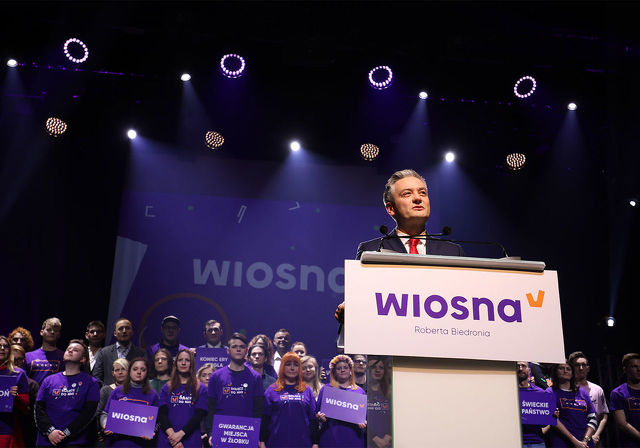
Robert Biedroń during the convention of Spring
Source: Shutterstock
Politicians of the Civic Platform can no longer accuse Biedroń of cooperating with Law and Justice because he promised to prosecute all those guilty of abusing the law. One of Biedroń’s proposals is the establishment of the Justice and Reconciliation Commission, which would examine the abuse of law by public officials between 2015–2019. Law and Justice supporters fear that, in case Spring would win the national elections, the party would end Family 500+. However, Biedroń promised that the benefit would not be withdrawn—what is more, it would be extended. Other left-wing parties question the political ideology of Biedroń and that of his team even though Spring supports leftist ideas in its campaign, took a clear position on moral matters from sex education through the real possibility of abortion to the legalisation of same-sex relationships as marriages. However, the foregoing does not mean that Spring has tackled all criticism from its political opponents. Experts and observers accuse Biedroń of pushing populist agenda that is far from economic realities. The lack of clear declarations on raising taxes on the most affluent, state security, the issue of European integration, relations with allies and opponents, the EU and NATO are also a few issues mentioned by critics.
In recent weeks, various results of different surveys on the EP elections have been made public. Some polls have shown that the new European Coalition and the Polish right-wing government are running neck and neck. Other surveys imply that Law and Justice will significantly outstrip opposition parties. According to the average of surveys on support for electoral committees to the European Parliament, Law and Justice would win the most seats, around 39% of them, in the elections. The European Coalition would be the second with around 34%. Other parties that would cross the electoral threshold are Spring (7.8%) and Kukiz’15 (5.3%).
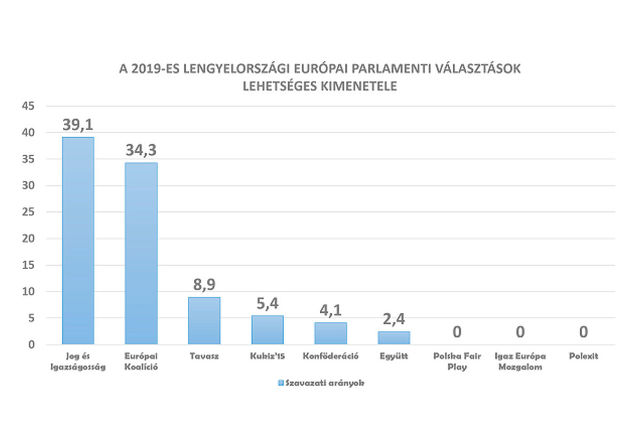

Source of data: http://ewybory.eu/eurowybory-2019/sondaze/
Although in the EP elections turnover is usually lower than in the national elections, it is the first test before the Polish parliamentary elections in autumn. The future of the European Coalition and its possible transformation into an alliance of the opposition parties for the parliamentary elections depends mainly on the outcome of the May elections. A good performance would make the opposition feel more confident in the domestic political arena and would increase its chances of winning against Law and Justice in autumn. Whatever the outcome will be, the coming months will potentially define Poland’s political landscape for the next 4-5 years.