Kategória: Research Blog
Forrás: https://digitalistudastar.ajtk.hu/en/research-blog/water-scarcity-the-texas-files

Water Scarcity

The Texas-Files


Szerző: Mihály Kálóczy,
Megjelenés: 12/2017
 Reading time: 10 minutes

From a few points of view on Earth, climate change seems to be just a kind of distant phenomenon which affects people far-far away. If it had been the case up to a point, it was no longer so.

The Fridge Has Been Left Open–Food Insecurity

The level of greenhouse gases’ emission definitely reached a point where the correlation between human activity with its related pollution and the increasingly frequent weather extremes could firmly have been claimed, and now the consequences have to be borne by poor and rich countries together.

The fridge has been left open and now it’s warming inside.

Earth’s climate has been relatively stable for the past 12,000 years and this stability provided the opportunity for our civilization to develop and create our current way of life. Primarily, stability means only a few °C change in the global mean temperature. Although a rate of 2 or 3 °C change does not threaten humanity with extinction, it is definitely able to crunch economies, causing crisis by hindering water or food supply. Water naturally needs to be readily available to constantly supply societies with enough food, so the amount of drinking water on Earth is crucial not just for direct consumption.

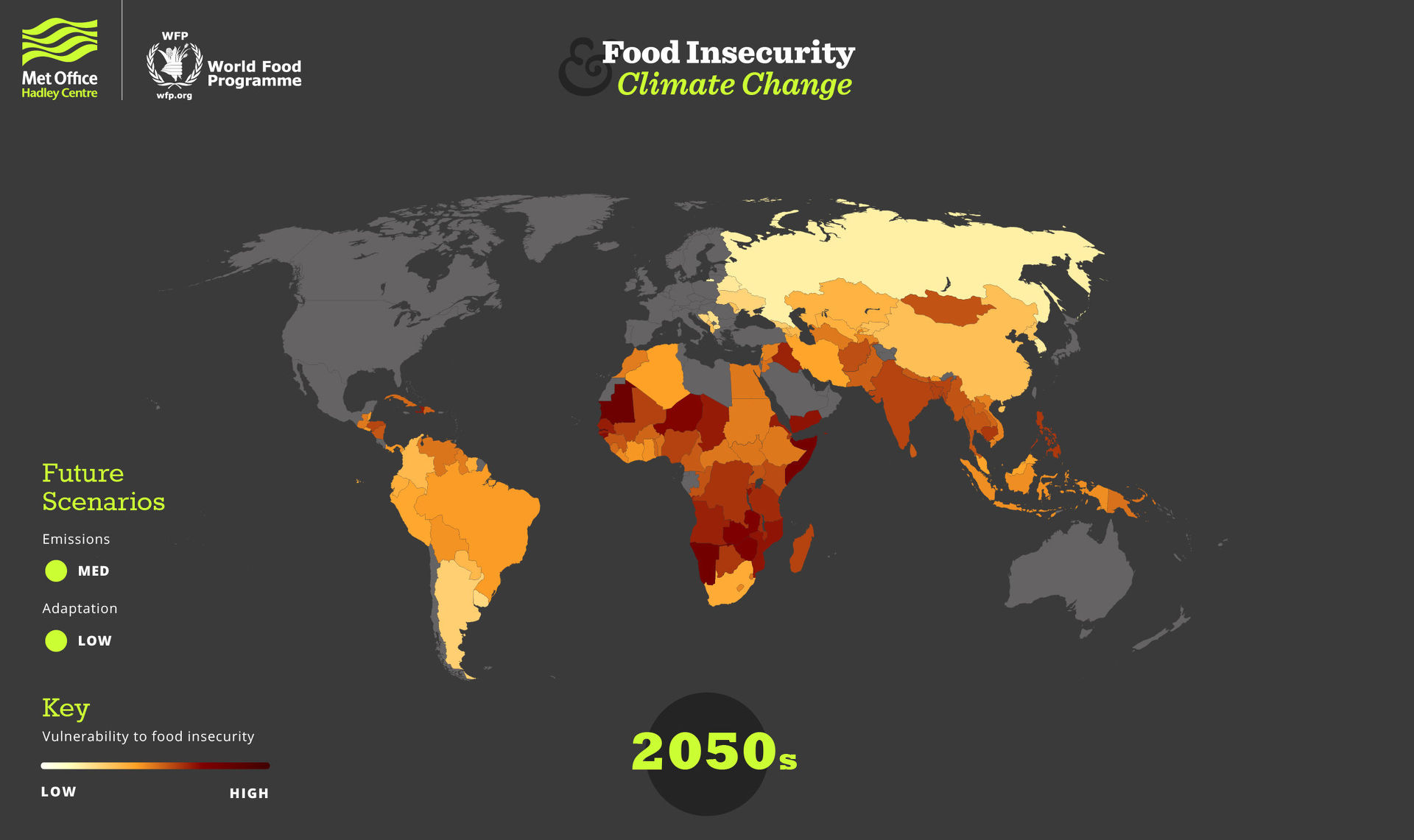
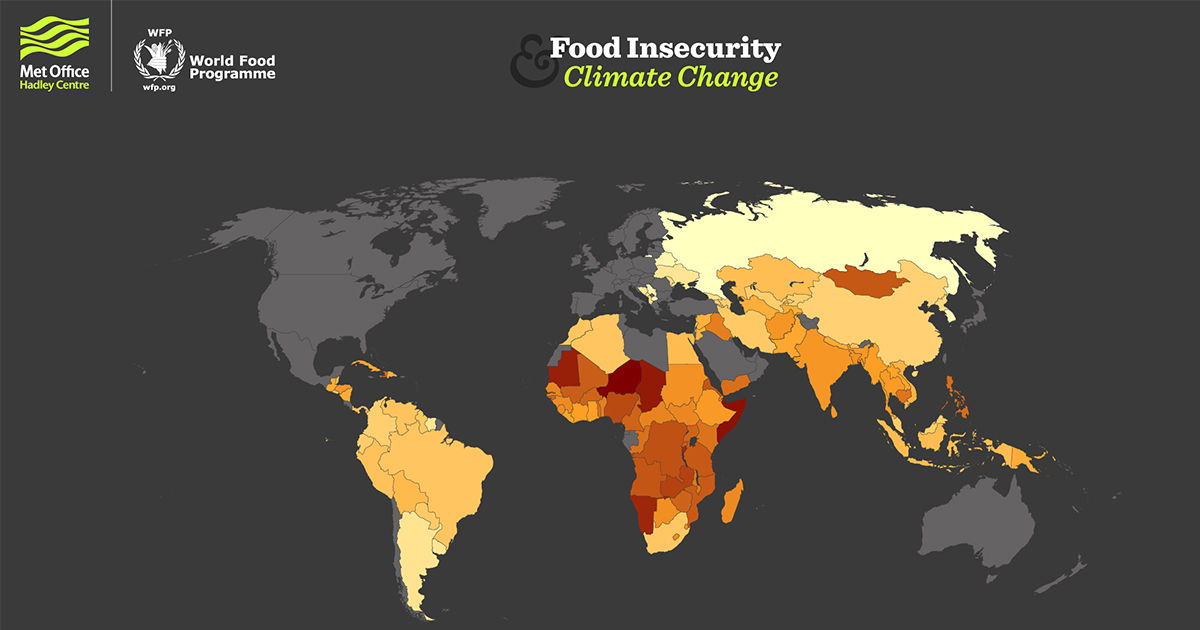
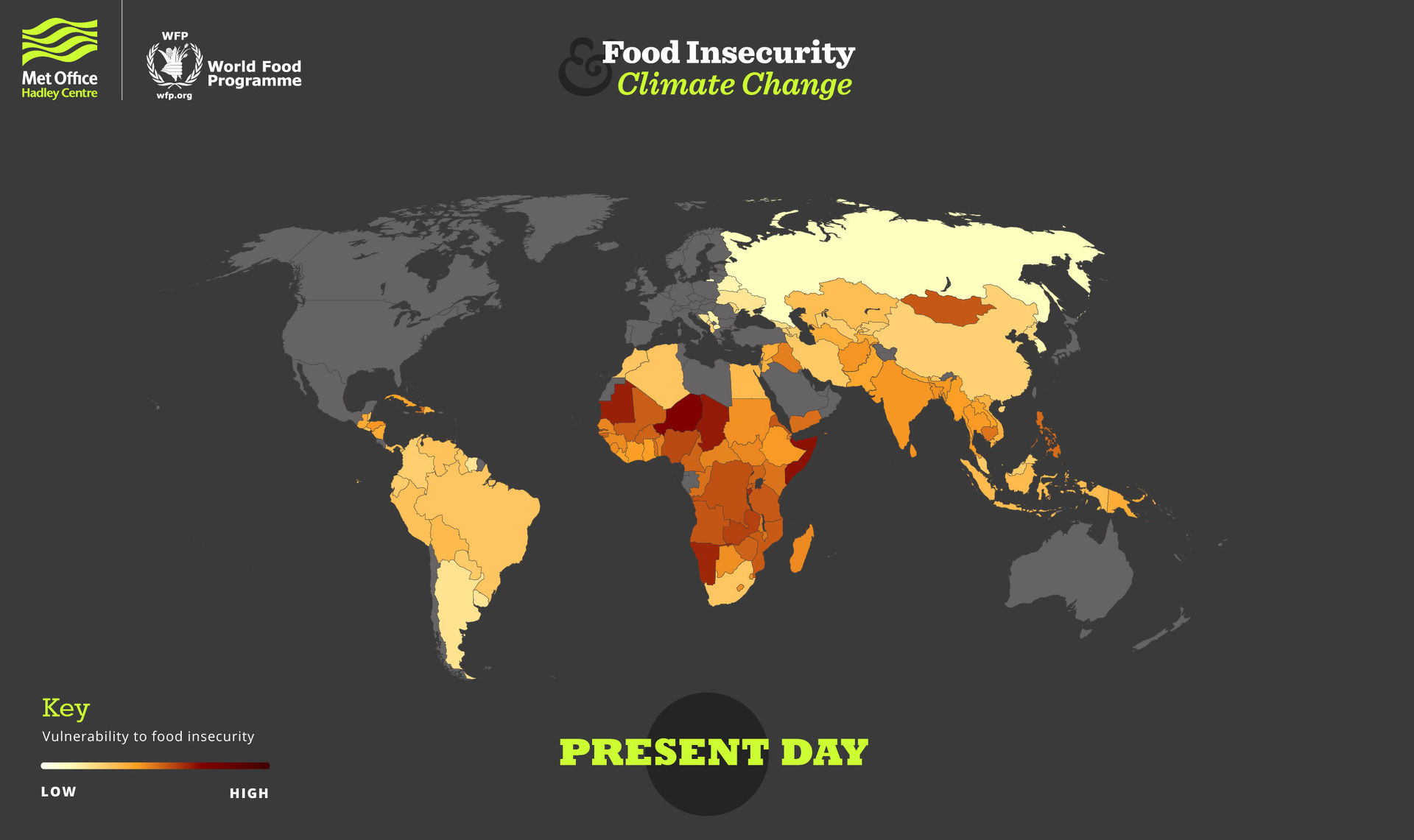
As for food insecurity, comparing the current and estimated data of the 2050s (presuming middle-level greenhouse gas emission and low-level adaptation), Africa and the Middle-East seems to be the most vulnerable areas on our planet.
Source: MET Office & WFP: Food Insecurity Index

Water–Ice Cubes Are Melting

Only 3% of the world’s water is fresh water, and two-thirds of it is tucked away in frozen glaciers or otherwise being unavailable for human consumption. Not to mention that the amount of ice worldwide, as a possible source, speaking of polar caps or glaciers in high mountains, is also on the wane due to the global warming trend. The thermohaline circulation, also known as global conveyor belt, connects the three water states on a global scale, which means it balances the temperature differences, reducing the risk of extreme events. So the melted ice has not disappeared, but become less spectacular. Not every country is suffering from sea level rise or the hurricanes bringing heavy precipitation. (The warmer the air, the more water vapour it can hold.) Naturally, the amount of groundwater is a possible stock, but it is more a local challenge to have it in the appropriate quality and quantity.

The last ice age ended 15,000 years ago, and the next one was due in 50,000 years’ time. (Ice age means “a period of long-term reduction in the temperature of Earth's surface and atmosphere, resulting in the presence or expansion of continental and polar ice sheets and alpine glaciers.”) Currently, we are in the middle of the Holocene, an interglacial epoch, which seems to last for a long time.

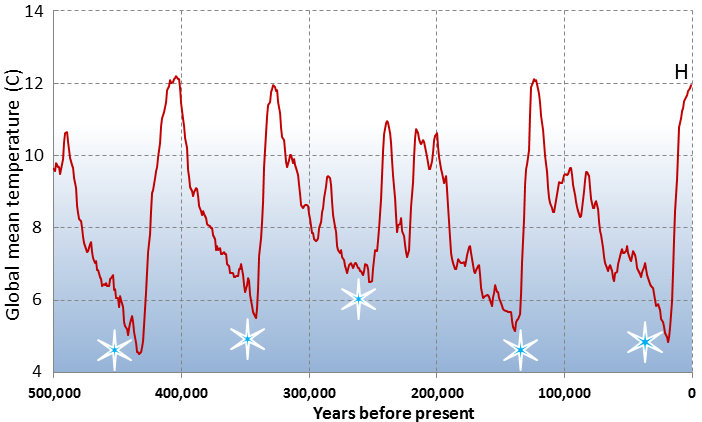
Global mean temperature shows the glacial periods in the past 500,000 years. The last five periods are marked with snowflakes.
Source: Steven Earle: Physical Geology. BC Open Textbook Project, license: CC BY 4.0

According to the scientists of the Potsdam Institute for Climate Impact Research, the Earth will skip a whole glacial cycle. The next ice age may have been delayed by over 50,000 years.

Texas serves as an excellent example of the complexity of climate change effects.

Texas–From Deluge to Drought

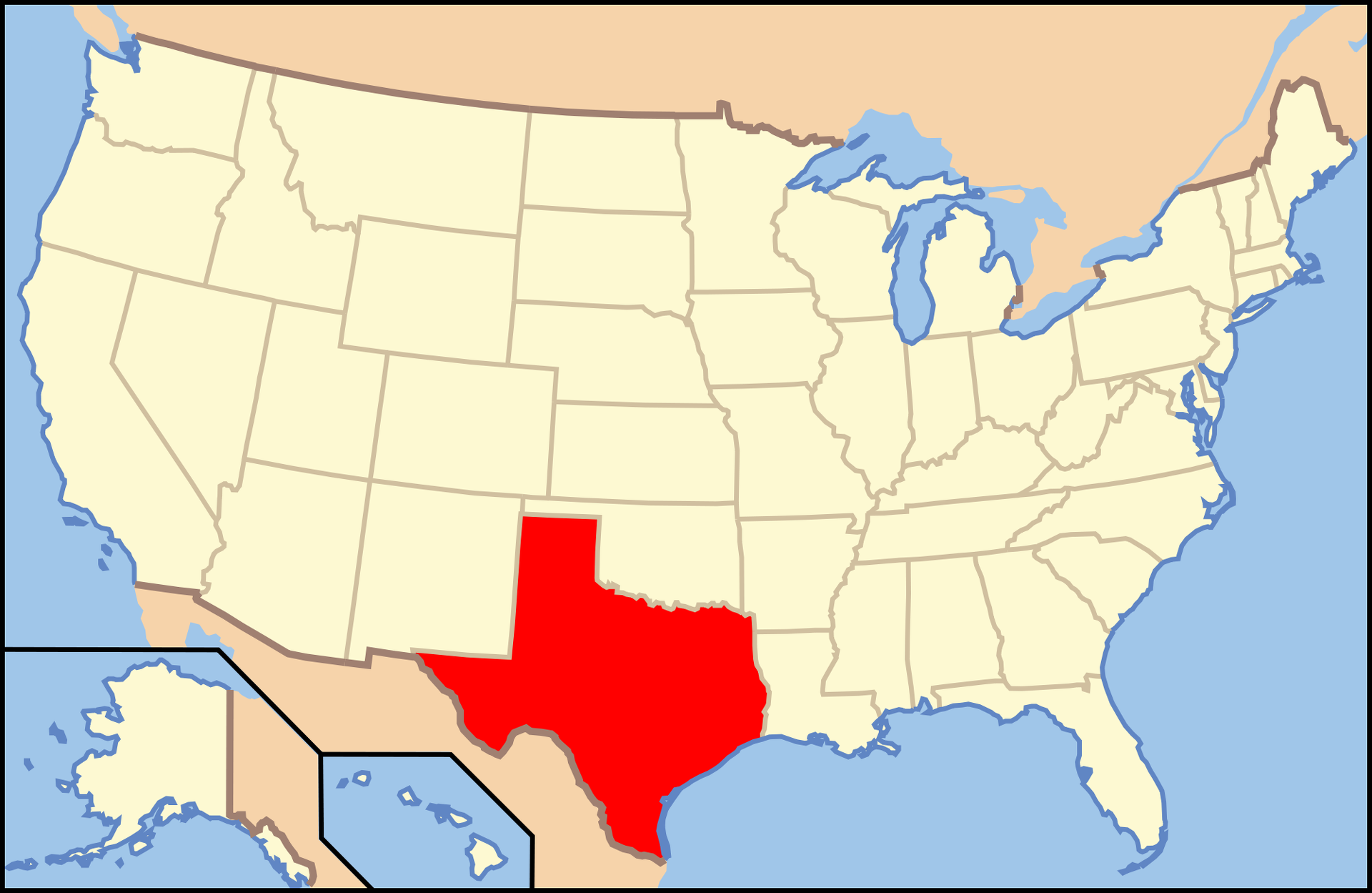
The State of Texas
Source: Wikipedia

Traditionally, cattle and bison industry had been a major economic driver for the state. In the later 19th Century, timber and cotton, and, in the 20th Century, the oil industry flourished, allowing Texas to lead the nation in state export revenue since 2002, and had the second-highest gross state product in 2016. As Wikipedia says, “If it were a country, Texas would be the 10th largest economy in the world.” It seems that the state will need everything in its possession to adapt to new climatic conditions.

Hurricane Harvey, a Category 4 storm, hit Texas on August 25, 2017. As of September 14, 2017, at least 82 people died. It caused $180 billion (almost €153 billion) in damage. It was probably the most devastating natural phenomenon in the U.S history. Beyond the casualties and money loss, several public services have been partially or totally destroyed countrywide.

  • as of September 14, at least 3,900 homes were without power,
  • there were 77 warnings in effect to boil water before use,
  • Houston’s school district said 75 of its 275 schools were closed due to flood damage,
  • in the Gulf area, 1 million vehicles were ruined beyond repair,
  • Harvey forced 25 percent of oil and gas production to shut down in the region so gas prices rose across the country. That affects 5 percent of nationwide output.
  • Harvey flooded 800 wastewater treatment facilities and 13 Superfund sites. (A Superfund site is any land in the United States that has been contaminated by hazardous waste and identified by the EPA as a candidate for cleanup because it poses a risk to human health and/or the environment.) That spread sewage and toxic chemicals into the flooded areas. 19 water systems were down and 31 wastewater systems remained offline.

Most of Harvey's damage was caused by the massive rainfall. Total rainfall reached almost 132 centimeters (Cedar Bayou, Houston), which means it is a 1-in-1,000-year flood event. The sheer weight of the water depressed the Earth's crust that resulted in Houston sinking 2 centimeters.

As for the economy, the water demolished fences and ruined the crops planted for feeding cattle. In the flood, some of the owners were able to get their herd to higher grounds, but some of the cattle were trapped and died. The standing water provided a perfect breeding ground for insects that could transmit diseases (e.g. pinkeye, which causes the animals’ blindness).

(A part of the ranchers hoped that the wet weather ultimately works in their favor having the greatest grass and forage and hay yield of all time.)

When they think it is over…

No Water at Home

Three months had been passed since Harvey, and Texas had to face a new natural enemy: the drought. As abruptly it came, the ranchers were forced to sell off roughly a million animals they couldn't afford to feed. The drought condition always makes the beef prices sour, the state of the soil deteriorated, which both contribute to food supply problems.
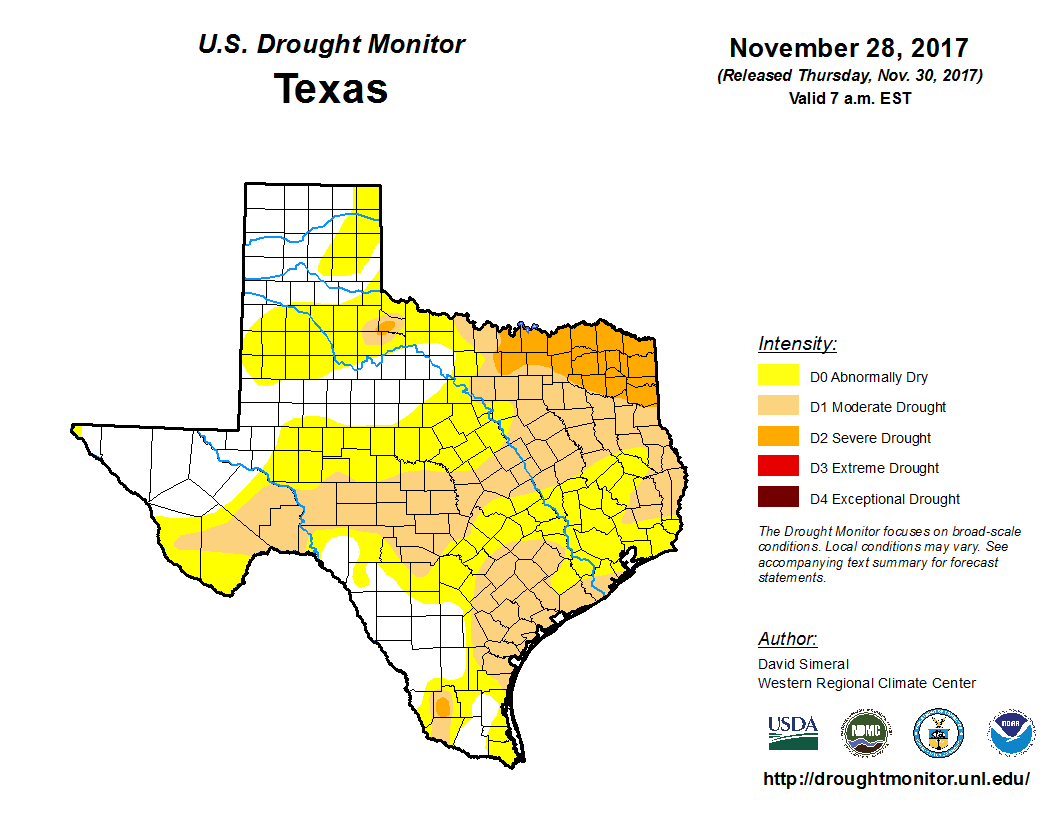
Drought in Texas at the end of November.
Source: United States Drought MonitorDavid Simeral, Western Regional Climate Center

The Snow Must Go on

If the weather of the year 2017 could have not surprised the Texas dwellers until the beginning of December, the snowfall surely did. It is the first one that has been recorded in the city of Corpus Christi since 2004. Though it has not made any damage to Texas (until now), it is part of a storm system that knocked out electricity for more than 40,000 customers in Alabama.

Global Warming Warning

The effect of climate change is complex, so sometimes it is hard to believe that it can result in totally different weather conditions. In our case, the air temperature of the Gulf region is 16-17°C hotter than it was in the past, which extremely enhanced the power of Harvey by the increased amount of moisture. Meanwhile, the changed weather patterns in the region allowed Harvey to hover over Texas instead of returning towards the ocean. And from where did it bring that high amount of water?

The melting ice caps–those are shrinking at 1.6 meters per year, compared to 3.8 centimeters before 1992–serve as a source not only causing the sea level to rise in itself.

The questions will be pending for a long time:

When will we be able to close the fridge door?

What will the ones do suffering from thirst and starvation? 


Opening Pic: MET Office