Kategória: Research Blog
Forrás: https://digitalistudastar.ajtk.hu/en/research-blog/variations-on-geopolitics-the-social-contents-of-french-beer
Variations on geopolitics
The Social Contents of French Beer
Szerző: Wilhelm Benedek Tibor,
Megjelenés: 08/2017
Reading time: 12 minutes
The French school of geopolitics came into being as a reaction to German geopolitics in the late 19th and early 20th century. From the outset, French geopolitics has emphasized the role of the human factor in geopolitics and refused deterministic German perspectives on geography. According to most French geopoliticians, social conditions represent a significant factor of geopolitics and prevent to be exposed exclusively to geography. French geopolitics continued to exist after the Second World War and contributed significantly to critical geopolitics.
Since the 17th century, countless chefs, bakers, butchers, and wine connoisseurs have contributed to the development of French cuisine. These days, it sets standards for gourmet restaurants and luxury hotels worldwide. French gastronomy is world famous for its diversity and quality. Accordingly, in 2010, French gastronomy was added by the UNESCO to its list of pieces of intangible global cultural heritage. The standard that French cuisine sets for world gastronomy is definitely comparable with French contributions in science. However, every role model has its weak points. Similar to Russian geopolitics, French geopolitics can be seen as a reaction to the dominant German and Anglo-Saxon school. However, the French school of geopolitics adds new elements to this scientific area. In other words, French breweries get inspiration from the multitude of German beer types.
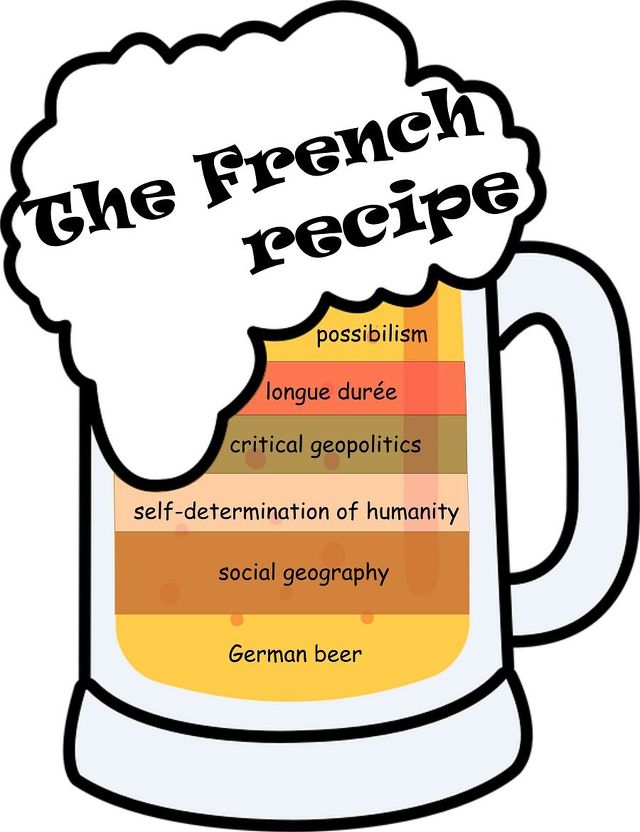
French geographer Paul Vidal de la Blache (1845-1918) developed the concept of possibilism as an alternative to German environmental determinism. According to de la Blache, geography poses a limit for humanity but offers possibilities for human choices at the same time. Moreover, on the one hand, these choices are connected to the natural environment, but on the other hand, they rely on the relationship between the cultural milieu and humans, or rather civilization as a whole. De la Blache calls this relationship “lifestyle”, or “genre de vie”. With regard to France, he applies his anthropogeographic concept on regions, which are in his view not determined by landscapes, but by man-made contours. In an international context, de la Blache argues similarly for the consideration of social conditions in order to maintain a powerful French geostrategy. Using the beer example, one could say that master brewer de la Blache enriches the German beer with a strong social component or rather with his inventions of possibilism and anthropogeography.
The great rival: The German beer
Source: Shutterstock
The second notable public intellectual in French geopolitics was Élisée Reclus (1830-1905), who established the idea of social geography. Similar to de la Blache, the social element stands in this context for the centrality of humans as a reference point. Geography serves as a tool to understand humanity in its totality through its relationship with the environment. According to Reclus, humans are embedded in nature. However, humanity is lacking in the consciousness of this embeddedness and needs to improve its understanding of natural and social factors in order to liberate itself from perceptual constraints. Based on the aforementioned ideas, the aim of human self-realization and a flourishing world as a whole can be summarized as the core of Reclus’ vision of social progress. In order to prove his theory, Reclus published several books, mapping the world and analyzing social and geographic features in different areas. Going back to the beer example, Reclus added not only a new ingredient to geopolitics but also a different perspective. His holistic view and concept of progress share a strong political message: the self-determination of humanity. To visualize this notion, Reclus attempts to work on the whole beer recipe in order to share it with the whole world. In this way, the master brewer Reclus developed both a new beer with peach taste and a business plan for selling his invention.
Paul de la Blache and Élisée Reclus paved the way for other French contributors in human geography and social geography, such as Albert Demangeon and Jean Brunhes. They contributed mainly with social ingredients and techniques to the established classics of geopolitics of the time. However, the work of the geopolitician Jacques Ancel (1882-1943) can be rated as the strongest antithesis to the established classical school of German geopolitics. In this spirit, Ancel questions the relevance of religious, ethnic, linguistic, and economic determinators for the constitution of borders and highlights common history as the key factor for man-made borders. Accordingly, Ancel declares German ambitions for expansion to be unhistorical and geographic claims to be irrelevant, because borders emerge to his mind from a national consensus to live peacefully with each other. If Jacques Ancel were master brewer, he would insist on French purity requirements to underline that the German purity law does not lead to a better beer taste.
The French recipe
Design by AJKC Research
In order to complete the picture on French geopolitics, Fernand Braudel (1902-1985) and Yves Lacoste (1929 – ) need to be mentioned, as they are the most influential personalities of contemporary French geopolitics. Fernand Braudel describes different environments (especially the sea) and derives social, cultural, and economic conditions from them. In addition, Braudel developed the concept of longue durée (long term) further, which builds on levels of time for societal developments. One of the most important pioneers of critical geopolitics is Yves Lacoste. Lacoste was one of the first geopoliticians who questioned classical concepts of geopolitics, including those of Anglo-Saxon and German scholars. Due to his perspective, the concept of geography came into being due to the concept of statehood and is therefore strongly connected to control and war. Furthermore, Lacoste’s reinterpretation of borders highlights arbitrary delineation processes. Regarding these, diplomats and military men would use topographical information to apply control and force in bilateral relations. To reiterate, Yves Lacoste’s key message is that geography is politicized, or in other words, that geography serves politics as an instrument of domination.
In a metaphorical sense, the social and progress-oriented contributions of French geopolitics can be likened to refinements to or even the reinvention of the German beer recipe. However, Yves Lacoste’s pioneering works on critical geopolitics are different from other French geopoliticians because the rejection of the use of geography in politics can be seen as the rejection of classical geopolitics in general or, in a broader sense, as the rejection of the alcohol content of beer. This makes Yves Lacoste both the founder of critical geopolitics and the inventor of alcohol-free beer. In conclusion, the differentiation between Lacoste’s critical geopolitics and classical French geopolitics is warranted. Nevertheless, the role of humanity and man-made decisions in present and past French geopolitics is remarkable, just like the persisting beer taste of alcohol-free beers.
The next blog post will introduce a strong reaction to European power claims, the Russian school of geopolitics. Check our AJKC research blog next week and you find out, what Russian geopolitics and human dating preferences have in common.
Get inspired:
de la Blache, Paul Vidal (1917) La France de l'Est (Lorraine-Alsace), Paris: Armand Colin.
de la Blache, Paul Vidal (1911) „Les genres de vie dans la géographie humaine“. Annales de Géographie, Vol. 20. No. 112. 289-304.
de la Blache, Paul Vidal (1921) Principes de géographie humaine. Paris: Armand Colin.
Réclus, Élisée (1830-1905) L’homme et la Terre, Encylopédie en 6 volumes. Paris: Librairie Universell.
Ancel, Jacques (1938) Géographie des frontiers. Paris: Gallimard.
Braudel, Fernand (1949) La Méditerranée et le monde méditerranéen à l'époque de Philippe II. Paris: Armand Colin.
Lacoste, Yves (1976) La géographie, ça sert, d'abord, à faire la guerre. Paris: Edition Maspero.
Opening picture by Shutterstock