Kategória: Research Blog
Forrás: https://digitalistudastar.ajtk.hu/en/research-blog/variations-on-geopolitics-the-anglo-saxon-winning-strategy
Variations on geopolitics
The Anglo-Saxon Winning Strategy
Szerző: Wilhelm Benedek Tibor,
Megjelenés: 07/2017
Reading time: 12 minutes
The Anglo-Saxon school of geopolitics includes both British and American thinkers. The denomination Anglo-Saxon school refers primarily to Anglo-Saxon contributions to the field in the late 19th and 20th century. While in the beginning mainly geostrategic aims (such as the control over the seas and continents) were articulated, later ideas mostly served the preservation of world power and democracy. The Anglo-Saxon school represents one of the most continuous directions of thought in geopolitics.
The ruleset of contemporary soccer as a team sport was invented in the 19th century England. It is played between two teams of eleven players. The aim of the two teams is to get a ball into the opposing goal or rather to score more goals than the opponent. The outcome of this effort is influenced by, among others, the defense skills of each team, which help to hinder the opponent’s progress towards the goal. Moreover, the success of a team depends on several other variables, such as the individual talent of the soccer players, the team spirit, their physical and mental state on match day, and even luck. However, there is another variable in soccer, which serves as an ideal example for the geopolitical thinking of the Anglo-Saxon School.
In soccer, the starting formation of a team and a clear strategy greatly influence the outcome of the match. They help determine whether the team will attempt to overcome its opponent by holding onto the ball and controlling the field, or by relying on surprising and dynamic counterattacks and defense. Whichever strategy a team chooses to go with, the ultimate aim is to utilize the field to the best of its abilities. This success-oriented usage of the playing field can easily be compared to the geostrategic ideas of Anglo-Saxon thinkers in the late 19th and 20th century.
One of the pioneers of Anglo-Saxon geopolitics was Alfred Thayer Mahan (1840–1914), who argued that controlling strategically important locations and having a strong fleet are essential for the United States to maintain the Monroe Doctrine. Apart from the Monroe Doctrine and the potential conflicts with other sea powers like the United Kingdom, Mahan believed that sea powers are more successful than land powers and emphasized the seas’ commercial usage in peace and the benefits of its control in war. The first three of Mahan’s six conditions for the establishment of a sea power (1. advantageous geographical position, 2. serviceable coastlines, abundant natural resources and favorable climate, 3. extent of territory, 4. number of population, 5. character of the people, 6. character of the government) are directly connected to the strategic use of territory for sea powers. This is very similar to the success-oriented usage of the playing field in soccer. Alfred Thayer Mahan’s “advantageous geographical position” stands therefore for the planned formation of the soccer team and determines, if a team aims to play more offensive or defensive soccer. Following the same analogy, it can be argued that the necessity of “serviceable coastlines, abundant natural resources and favorable climate” stands for taking the talent and characteristics of the players into consideration. Meanwhile “the extent of territory” could be compared to ball possession and degree of control over the opponent.
Another key thinker in Anglo-Saxon geopolitics was Halford Mackinder (1861–1947), from England. Mackinder is famous for his Heartland Theory, in which he divided the world into the Heartland, or the Pivot Area, which represents parts of Eastern Europe and Asia, the Inner Crescent (present-day Germany, Austria, Turkey, India and China), and the Outer Crescent (Great Britain, South Africa, Australia, the United States, Canada and Japan). According to his theory, the control of the Heartland has enormous strategical significance. Mahan concludes that the Heartland’s size, central location, distance from the sea and abundance of resources create both an ideal defensive barrier and an opportunity for self-sufficiency. From this, he infers that to control the Heartland means to rule the whole world. Unlike Mahan, Mackinder underlines the significance of land in the distribution of power in international relations.
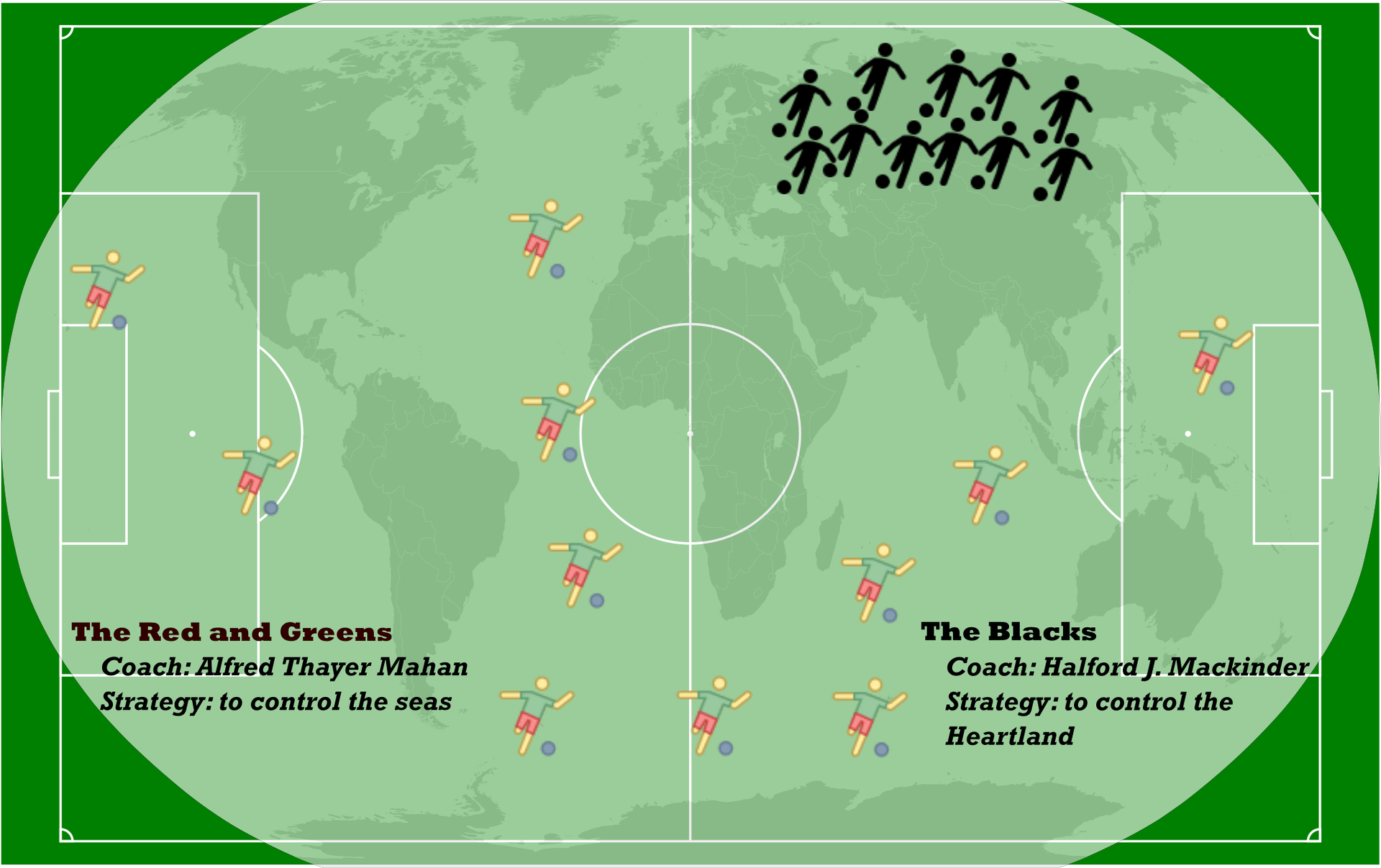
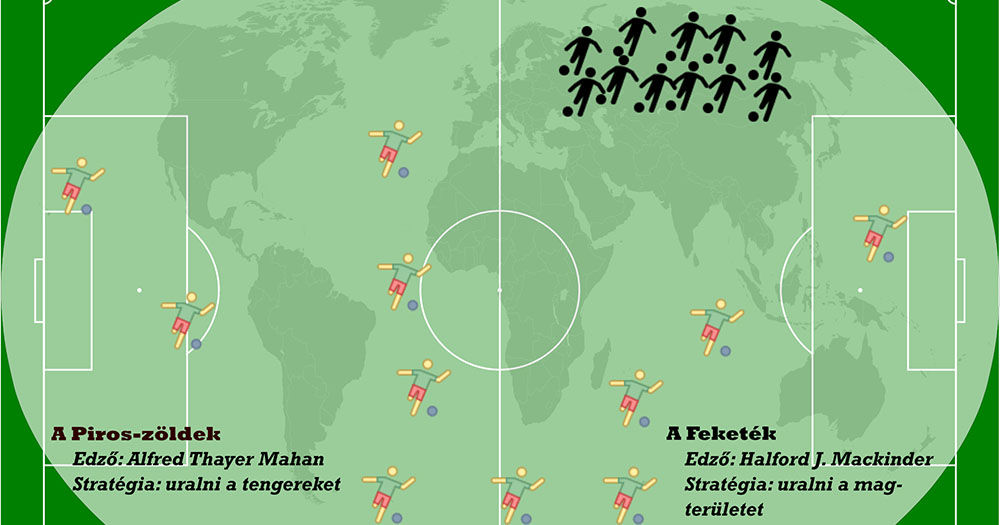
Mahan vs. Mackinder
Design by AJKC Research using Soccer icons (red and green here, black here) by icons8.com and Soccer field by Nuno Tavares.
Licensing: CC BY-SA 2.5.
In keeping with the soccer analogy, coach Mackinder would not demand position-specific tactical moves, but total control of crucial territories like the penalty area. A soccer coach with a similar profile—since he adapted Mackinder’s approach—would be Nicholas John Spykman (1893–1943). Nevertheless, Spykman disagrees with the key role of the Heartland. He concludes that the dominance of the Rimland (countries with coastlines in Europe, the Middle East and Asia) is essential for the control of the world and a balance of power in Europe is necessary for America’s security. Like Mahan and Mackinder, Spykman focuses on one specific territory and emphasizes characteristics such as demographic weight, natural resources, and industrial development. Accordingly, in the context of soccer, he belongs to the same generation of coaches as Mahan and Mackinder. However, instead of the penalty area and the midfield, he would focus on another territory, such as the outer lane, to cross and shoot as many goals as possible.
After the Second World War, the role of British geopolitics diminished and American geopolitical thinkers came to shape the strategic focus of their country. Along these lines, in 1947, George Kennan (1904-2005) articulated the American containment strategy, which is compatible with the approaches of Anglo-Saxon classics to gaining control in world politics. According to Kennan, the Soviet Union had to be contained, and if necessary, confronted by providing economic and other types of support to developing countries. This geostrategy was realized in the Truman Doctrine and the economic reconstruction plan (Marshall Plan) in Europe. Going back to the soccer field, the containment strategy does not only focus on territory, but also introduces new strategic factors like economy and military. Accordingly, as a football coach, George Kennan would campaign at his club for the players’ high salaries and social security benefits. Hence, his players would not switch to teams with better conditions.
At the same time, geopolitician James Burnham (1905–1987) criticized America’s defensive approach, represented by the containment theory. Consequently, he proposed to follow a more offensive alternative and achieve the liberation of states in the Soviet sphere of influence, as well as the fall of the Soviet Union. To go back to our soccer analogy, as a coach, Burnham—in contrast with Kennan—identified his primary task as weakening the opponent by acquiring the best players for his own team. Parallel to Kennan and Burnham, American diplomat William Christian Bullitt (1891-1967) introduced the domino theory, which described the necessity of intervention in regions (mainly Asia) with a high potential for Soviet expansion and a domino effect, meaning the spread of communism. In soccer terms, effective interplay between opposing players has to be stopped with tactical moves.
Over time, all of the above theories influenced US Presidents’ Cold War doctrines, which in turn became intertwined with the development of geopolitical thought. Henry Kissinger (1923–) enriched the theoretical approach in 1979 with the principle of “linkage”. In this context, linkage means to connect political and military issues and to cooperate with communist countries to receive economic and nuclear concessions. Geostrategist Zbigniew Brzezinski (1928–2017) formulated the theory that the United States can maintain its containment efforts only if they control linchpin states, which, due to of their geographical position, play a significant role in matters of economy and military. Clearly, these ideas are somewhat different from the ones previously discussed and are much more closely connected to the practical shaping of US foreign policy. Thus, one common question regarding post-WW2 Anglo-Saxon geopolitical ideas is to what degree are they related to the influential theories of former geopolitical thinkers. In any case, when “translated” to the soccer example, Kissinger and Brzezinski improved training conditions but did not have a decisive impact on the style of play.
This post offered an overview of the uninterrupted development of Anglo-Saxon geopolitics from its beginnings until the Cold War era. The work of every geopolitical thinker above put great emphasis on the idea that, in order to maintain their global predominance, the United Kingdom (an island physically removed from the Eurasian continent) and the United States needed to expand and reinforce their influence over territories they deemed strategically important—or, in other words, the areas within the soccer field that were essential to victory. While the strategy necessary for winning a match changed along with the circumstances of each era, the rules of the game were respected by all parties.
Anglo-Saxon geopolitics is still relevant today—for example, in the works of Saul Bernhard Cohen (1925–). In addition to further Anglo-Saxon contributions to the field, it needs to be mentioned that a number of Anglo-Saxon thinkers, such as Gerard Toal, Simon Dalby and Thomas Dodds, contributed to the establishment of the critical school of geopolitics. Their ideas can be viewed as an effort to completely change the game of soccer and therefore to change the trajectory of Anglo-Saxon geopolitics, which had been relatively consistent since its beginnings in the 19th century.
The next blog post will introduce the second remarkable direction of geopolitical thought, the German school of geopolitics. Check the AJKC research blog next week to find out what German plans for expansion have in common with the growing of trees.
Get inspired:
Mahan, Alfred Thayer (1890) The Influence of Sea Power Upon History, 1660–1783. Boston: Little, Brown and Company.
Mackinder, Halford John (1904) “The Geographical Pivot of History”. The Geographical Journal, 23, pp. 421–444.
Spykman, Nicholas John (1942) America's Strategy in World Politics: The United States and the Balance of Power. New York: Harcourt, Brace and Company.
Spykman, Nicholas John (1944) The Geography of the Peace. New York: Harcourt, Brace and Company.
Kennan, George (1947) “The Sources of Soviet Conduct”. Foreign Affairs, July 1947. URL.
Burnham, James (1953) “Containment or Liberation? An Inquiry into the Aims of United States Foreign Policy”. New York: John Day Cooperation.
Cohen, Saul Bernhard (1963) Geography and Politics in a World Divided. New York: Random House.