
Kategória: Research Blog
Forrás: https://digitalistudastar.ajtk.hu/en/research-blog/variations-on-geopolitics-schools-and-analogies
Variations on geopolitics
Schools and Analogies
Szerző: Wilhelm Benedek Tibor,
Megjelenés: 07/2017
Reading time: 12 minutes
The heyday of geopolitics was the first half of the 20th century. However, it seems that geopolitics has been experiencing a revival in the 21st century. It has come into vogue to reference geopolitics, even though many people might not even know what this term means and how multifaceted this scientific branch is. Our summer series will provide an insight into the main approaches of the most important geopolitical schools, drawing on examples from everyday life.
It is the year 2017. The world is divided in centers of conflict and power shifts dominate the scene. Donald Trump is the most polarizing president in America’s current history, Ukraine became a warzone in the heart of Europe and the Middle East is a venue for international conflicts of interest and confessional wars. How should one perceive this reality? As the political interpretation of geographical conditions, geopolitics enables researchers to process the aforementioned events in a scientific way. Geopolitics is a branch in social sciences which facilitates the comprehension of foreign policy; that is, the comprehension of existing political paradigms in different regions of the world. However, several scholars have criticized geopolitics for fostering a hierarchic world order and a conflict-oriented foreign policy. This article is the first in a series which aims to reveal that the realm of geopolitics is versatile, offering, as any other discipline in social sciences, scientific methods and paradigms which can easily be applied to understand international politics.
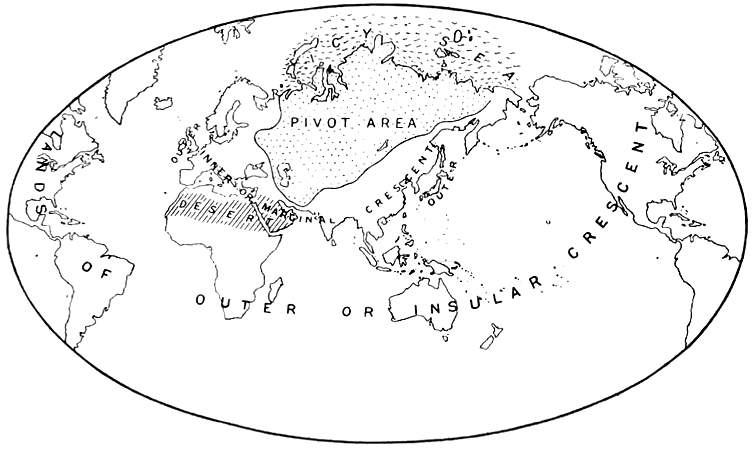
Map of the “Heartland Theory”, as published by Mackinder in 1904.
Source: Wikipedia
“America first!”, “we will build a wall!” and “China is killing us” were some of the most persistent slogans of Donald Trump’s election campaign. At first glance, the three statements seem unrelated to geopolitics. However, if in an intellectual game, the slogan “America first” were understood as a territorial concept, it would, by and large, show some similarity with the general concept behind the great geopolitical schools of the 19th and 20th centuries, which also propagated that geographical areas and the rule over them were the most important factors influencing one’s place and importance in world politics. In the framework of this interpretation, building up a wall might also have a geopolitical aspect, as it implies the defense of a strategic geographical area from unwelcome migration. Finally, the statement “China is killing us,” might have a protectionist overtone, which, in turn, has geopolitical consequences, too: by maintaining an autarchic, self-sustaining economy, a country is less vulnerable and can maintain more easily its territorial integrity and its elbow room. Thus, in this hypothetical interpretative framework, all these slogans would suggest an idea, also central to geopolitics: the best possible control over and the strengthening of strategic areas that one assumes as having key importance are instrumental in achieving certain political goals.
As pointed out earlier, focusing on strategically strengthening territories has a long tradition in geopolitics. The American geopolitician Alfred Thayer Mahan (1840–1914), for instance, argued that controlling strategically important locations in the world and having a strong fleet are essential for the United States to maintain the Monroe Doctrine. In this sense, Donald Trump’s wall can be compared with Alfred Thayer Mahan’s fleet, because both the wall and the fleet function, in spite of their profound strategic differences, could be understood as auxiliary means to advance America’s interests. Another key thinker in Anglo-Saxon geopolitics was Halford Mackinder (1861–1947) from England. According to Mackinder’s theory, the so-called Heartland, which covers parts of Eastern Europe and Asia, has enormous strategical significance. The Heartland’s size, central location, and its abundance in resources would enable powers with influence over these territories to control the world. This example also shows that even if Donald Trump’s protectionism would be interpreted in a geopolitical way, its underlying isolationist attitude by principle contradicts the expansive strategy so common in Anglo-Saxon geopolitics. In reference to Trump’s ideas, it can be said that he and his administration might have considered the world map from a strategic point of view. Nevertheless, the simple interpretations of this paragraph neither reflect Donald Trump’s real foreign policy intentions nor form a coherent geopolitical concept; instead, they indicate how useful geopolitical approaches can be when it comes to interpreting contemporary politics.
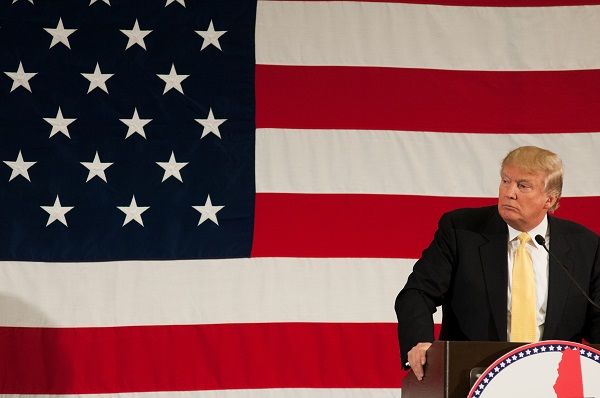
America First!
Source: Shutterstock
For the sake of completeness, it has to be also mentioned that geopolitics lost its popularity after the Second World War. It is due largely to the fact that geopolitics seemed to have had a part in the countries’ aggressive expansion plans and the misery in both world wars. While geopolitics became a taboo word in post-war Germany and in the Soviet Bloc, implicitly it shaped paradigms such as the American containment theory during the Cold War. Nonetheless, the geopolitical contributions after the Second World War cannot be compared to the lively prewar debates between the most important schools of classical geopolitics: the Anglo-Saxon school, the German school, the French school, the Russian school and the Japanese school.
As a consequence of the strong antipathy in humanities towards classical geopolitics, a debate about the end of geopolitics emerged in academic communities, especially after the end of the Cold War. The collapse of the bipolar system led to the triumph of liberal democracy and the world expected an era of international cooperation and globalization. In this sense, there was no space for geopolitical paradigms to foster nation-state-specific strategies, ambitions of ruling the world, or plans of expansion. In other academic communities, such as in France, the discipline of geopolitics began to be reconceptualised already in the 1970s, adapting to the changed circumstances as a legitimate field of study.
Concurrent to this debate, the 1980s and 1990s saw another turning point in geopolitics with the establishment of a new point of view: critical geopolitics. Critical geopolitics rejects traditional approaches and the positivist methods of geopolitics, applying a constructivist and poststructural lense to understand the intertwinedness of geography and politics, and criticizing classical geopoliticians for using geography as a tool to exert political power. Critical geopolitics expands the scope of analysis, allows interdisciplinary contributions and accepts new methods such as discourse analysis. As a last reference to Donald Trump’s statements, “China is killing us” would serve as an ideal narrative for critical geopolitics, representing the U.S.’s fear of China’s political and economic expansion. To illustrate the scope of explanatory patterns in critical geopolitics, it is worth referring to the related ideas of one of the best-known scholars in the field, the Irish-born Simon Dalby (1958–), who put a special emphasis on the role of fear in geopolitics. Dalby uses the tool of discourse analysis to prove how the language of confrontation led to the intensification of the Cold War in the 1970s. In this way, critical geopolitics does not only criticizes classical geopolitics, but also to use new methods and perspectives to contribute to the understanding of the world.
As mentioned in the introduction, the political situation of 2017 seems to considerably differ from the perspectives of the 1990s – and from anything that we could call ‘the end of geopolitics.’ The perspective of comprehensive international cooperation and peace was undermined at first in 2014, which was also lucidly indicated by the American academic, Walter Russel Mead, in his article written for Foreign Affairs titled “The Return of Geopolitics.” Mead argued that old-fashioned power claims regained their significance in international politics illustrating it by referring to countries such as Ukraine, Iran or China. Nevertheless, it has to be emphasized that power claims, power shifts and international conflicts are not equal to the rise of an academic branch. However, geopolitics as a discipline has always been related to the events of its time and might in certain cases even be interpreted as academic reactions to political actions. In this case, political actions apparently triggered a remarkable academic outcome and led to the strengthening of the geopolitical point of view.
Therefore, the aim of this AJKC research blog article series is to introduce the most important geopolitical schools in a non-traditional, playful way in order to prepare our readership for the resurgence of future academic contributions in this field. In the next weeks, our readers will have the chance to approach the realm of geopolitics on the basis of the introduction to the five main schools of classical geopolitics (Anglo-Saxon, German, Russian, French, Japanese) and its challengers (critical geopolitics). Our series aims to make forgotten and practiced geopolitical knowledge tangible through illustrations and comparisons from everyday life.
The next blog post will introduce the well-established school of Anglo-Saxon geopolitics. Visit our AJKC research blog to find out what the success-models of Anglo-Saxon geopolitics and soccer have in common.
Get inspired:
Mahan, Alfred Thayer (1890) The Influence of Sea Power Upon History, 1660-1783. Boston: Little, Brown and Company.
Mackinder, Halford John (1904) “The Geographical Pivot of History”. The Geographical Journal, 23, pp. 421-437.
Dalby, Simon (1990) Creating the Second Cold War: The Discourse of Politics. London: Pinter.
Opening pic by Shutterstock