Kategória: Research Blog
Forrás: https://digitalistudastar.ajtk.hu/en/research-blog/variations-on-geopolitics-ladies-choice-in-russian-style
Variations on geopolitics
Ladies' Choice in Russian Style
Szerző: Wilhelm Benedek Tibor,
Megjelenés: 08/2017
Reading time: 12 minutes
The Russian school of geopolitics was established in the era of Panslavism in the 19th century. One of its most significant features is its inner conflict between the desire for self-realization not only in a territorial manner, but also in terms of identity formation and Western-inspired ideas. Therefore, the Russian school of geopolitics was mainly built on the debate of whether to belong to the East or the West. During the socialist days, Russian geopolitics as a formal school of thought lost significance, whereas in practice it kept is influence on political thinking and was reactivated after the regime change.
More than 2300 years ago, Aristotle said “Man is a social animal. He who lives without society is either a beast or a god.” Following these thoughts, human relations is one of the defining features of our nature as social beings. Among human relations, the relations between men and women bear a special meaning, because they can imply the creation of new life. Along these lines, famous personalities like Nikolai Berdyaev compared Russia symbolically to a woman waiting for her suitor. Similarly to such a woman, Russia occupies a middle position between East and West politically, culturally and geographically. This way of looking at the problem is similar to Russian geopolitics, which is torn between the choice of whether to intensify relations with Europe or Asia, while also being faced with the problem of having to find its own identity and standing between two attractive suitors.
One of the fathers of Russian geopolitics is Nikolay Danilevsky (1822-1885). His work “Russia and Europe: a look at the cultural and political relations of the Slavic world to the Romano-German world” from 1869 is recognized as the bible of Panslavism. In his book, Danilevsky argues that commonality of humanity is an abstraction, while nations are the reality. Nations or rather civilizations and their own cultures and languages are considered unique. He derives from this perspective that the young Slavic historical-cultural type needs to follow the Romano-German model and refuse westernization. Danilevsky’s geopolitical view is shaped by a strong cultural and spiritual perception, which leads him to the aim of the declaration of Constantinople (Tsargrad) as the political and religious capital of the pan-Slavic union. Even though Danilevsky emphasizes the cultural dimension in his approach, the unification of Slavic nations includes a territorial dimension as well. Recognizing the fact that Russia would nominate the emperor, it would expand its sphere of influence tremendously. In the analogy between Russian geopolitics and gender relations, Russia would stand for a self-confident woman, which aims to have stronger ties with her Slavic friends and to refuse her European suitor.
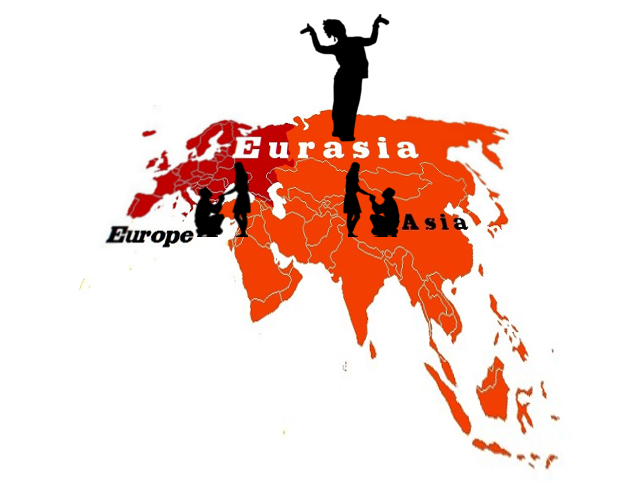
Torn between two suitors
Design by AJKC Research using the following elements: map of Eurasia (by Caspiax), boy proposing to a girl (by waldryano), women (by OpenClipart-Vectors).
Licencing: CC BY-SA 3.0
The approach of the second founding father of Russian geopolitics, Léon Metchnikoff (1838-1888), is less Russian-centric than that of Danilevsky. Metchnikoff describes progress as the transformation of social bonds and rates cooperation as the main principle of social life. Nonetheless, Metchnikoff’s concept of progress differs from Western ideas on this topic. While in the West Darwinist and organic models of development dominated the discourse of the time, Metchnikoff introduced cooperation as the key to progress. Furthermore, Metchnikoff defines historic stages of society, which he links in his book Civilization and the Great Historical Rivers to geography. Metchnikoff differentiates between three different environments: the fluvial environment, the littoral or Mediterranean environment, and the oceanic environment. According to Metchnikoff, river civilizations have the chance to develop into littoral or oceanic civilizations. On the one hand, he supports his theory with historical examples from Europe to China and Africa. On the other hand, Metchnikoff emphasizes that water provides opportunities for development. However, water itself is no guarantee for the success or failure of civilizations. To reiterate, Metchnikoff’s geopolitics seek alternatives especially in the context of progress. This could be interpreted as the Russian woman disagreeing with the worldview of her European suitor. Nevertheless, she cares about him and is inspired by his ideas and ready for a debate.
Danilevsky’s and Metchnikoff’s contributions make them the pioneers of Russian geopolitics. However, there have been new tendencies in Russian society, questioning not only theoretical concepts of the West and focusing on Slavdom, but discovering new territories for the strategic use of Russia. A key figure in this context is Pyotr Savitsky (1895-1968). Savitsky established with many other influential thinkers of his time (such as Nikolay and Evgeny Trubetskoy) the Eurasian school of geopolitics. Like Danilevsky, Savitsky highlights Russian characteristics. In connection with geography, Savitsky states that Eurasia is equal to the Russian territory. Accordingly, Eurasia is neither a part of Europe nor Asia, because it displays its own geographic features from the Carpathians to the Hinggan mountains. In addition, Savitsky links these geographical connotations to the history and culture of this territory. He concludes that, in spite of the diversity of ethnicities, cultures, and religions, Eurasians share a common spirit, which can be traced back to the success of nomadic people like the Mongols, Khazars, and others. Based on the aforementioned ideas, Pyotr Savitsky concluded—with reference to Mackinder’s work—that Eurasia is a continental-ocean, providing cultivation areas for grain, cotton wool, rice, and the potential for industrial development. Savitsky’s goal is a self-sustaining Russia. Regarding the Russian woman and her Western and Eastern suitor, this means that she would prefer to live on her own. Nevertheless, it can be said that Savitsky would prefer stronger relations to her Asian suitor in his theory.
Symbols for the Eurasian spirit?
Source: Shutterstock
The geographer Veniamin Semyonov-Tyan-Shansky (1827-1914) developed a geostrategic concept of world domination. In it, he defines three different ways of maritime control. He first describes the ring system, which was used by the Greek states, Carthago, the Roman Empire, Venice, and Genoa, to control the internal maritime space. The second system is based on the control of strategic points and was applied by Portugal, Spain, Netherlands, France, and, most successfully, Great Britain. The third system is linked to continental control and follows the paradigm “from sea to sea”. Semyonov-Tyan-Shansky analyzes this system in detail as Russia should, in his opinion, continue following this system and optimize its control of the Arctic Ocean, the Pacific Ocean and the Black Sea. Moreover, he gives concrete advice on moving the Russian cultural and economic center between the Volga and Yenisei rivers and between the Arctic Ocean and the southern borders. Semyonov-Tyan-Shansky uses the term of Eurasia strategically to define his vision of a strong continental Russia. Remembering the metaphor of the Russian woman, in this case she would act similar to Savitsky’s example. However, his concrete advice of moving the Russian center could be seen as an attempt to move to a place where Ms. Russia would be more independent about her decisions.
After the Second World War, geopolitics was not widely practiced as national interests and strategies conflicted with the all-encompassing Soviet ideology. Nonetheless, geopolitics in Russia survived as an interdisciplinary practice and regained its significance in the 1990s. The famous Russian historian and ethnologist Lev Nikolayevich Gumilyov, for instance, applied geopolitical thoughts even in the Soviet days to explain nomadic migration by geographical factors and the evolution of ethnic groups with the concept of “passionarity”, which describes stages of activity for ethnicities to expand. Similarly to other Eurasian thinkers, he saw strong links between Russians and the people from the steppes, while he idealized the Eurasian idea.
Regarding the revival of geopolitics in the 1990s, Russian geopolitics saw a new star born in Aleksandr Dugin. Dugin became a public intellectual in Russia, influencing both Russian academics and politicians with his neo-Eurasianian ideas. Even though the discourse between “Westerners” and “Easterners” continues, Dugin’s voice is the most recently cited in contemporary Russian geopolitics. His vision can be summarized as the reestablishment of multipolar world politics and a strong Eurasianian entity. In retrospect, it is interesting to see how Eurasian ideas had such a lasting effect on Russian geopolitics that they were even applied in the Soviet Union and adapted to the new world order in the 1990s. In reference to this thought and the aforementioned geopoliticians, Russian independence from Europe and self-sufficiency are revealed as dominant ideas in Russian geopolitics. The Eurasian concept and its inseparable links to territories in Asia and the Caucasus reveal its significance not only in the past, but also in todays’ contributions. However, this article also shows that the theoretical demarcation from Europe needed and needs geopolitical reflections. In this sense, Russian geopolitics are inevitably connected to Western geopolitics. In conclusion, the Russian woman knows her European suitor well and dislikes some of his characteristics. At the same time, she seems to be interested in getting to know her Asian suitor better and looks forward to intensive dating. Still, she would like to be independent in her decisions, remain strong, and earn her living. It has not been decided yet who the Russian woman will marry or to which extent she will prefer to live on her own.
The next blog post will introduce the Japanese school of geopolitics, which was created as a response to German geopolitics during the 1920s and 1930s. Check our AJKC research blog next week to understand why Japan may resemble an awakening dragon.
Get inspired:
Danilevsky, Nikolay Yakovlevich (1895) Rossiya i Evropa, Sankt-Peterburg: Brothers Panteleev.
Metchnikoff, Léon (1889) La civilisation et les grands fleuves historiques, Libraire Hachette: Saint-German.
Savitsky, Pyotr Nikolayevich (1931) V Borbe za Evroziistvo, Paris: Izdanie Evrositsev.
Semyonov-Tyan-Shansky, Veniamin (1915) “О mogushchestvennom territorialnom vladenii primenitelno k Rossii: Ocherk po politicheskoi geografii,” in Izvestiia Imperatorskago Russkago Geograficheskago Obshchestva, Vol. LI, Petrograd, 425-457.
Dugin, Aleksandr (1997) Osnovy geopolitiki: geopoliticheskoe budushchee Rossii, Moscow: Arktogeia.
Opening pic by Shutterstock