Kategória: Research Blog
Forrás: https://digitalistudastar.ajtk.hu/en/research-blog/towards-a-smart-european-integration
Towards a smart European integration?
An Overview of the European Digital Revolution
Szerző: András Braun,
Megjelenés: 03/2019
Reading time: 12 minutes
The free movement of goods, persons, services, and capital has already become part of the everyday life within the EU. However, when it comes to the digital sphere, barriers are still present among its citizens. Small wonder, the EU aims to make ties even closer and integrate its huge digital market through its Digital Single Market strategy. What are the main potentials of this strategy, and how far have member states got with their e-transformation process? Which countries are the smart frontrunners in the EU? This article analyses these questions and reviews the development of the European digital revolution.
Source: Shutterstock
The free movement of goods, persons, services, and capital is undoubtedly the biggest advantage for the citizens of the European Union. However, when it comes to the digital sphere, barriers are still present among the 28 member states and other nations on our continent. As there is a potential market of 500 million people, the European Commission aims to remove the barriers to integrate the states in the cyberspace as well. But the Commission is treading on thin ice with this ambitious project, as a compromise has to be reached between the different stakeholders, member states, and the European Parliament. The digitalisation of the European public services has been an ongoing process, and such innovative solutions are being supported through the Digital Single Market strategy. This post will offer a brief overview on the present state of the European digital revolution.
The Digital Single Market strategy: a short background
The Digital Single Market strategy (DSM) was launched in 2015 through which the European Union (EU) aimed to follow the objectives of the Lisbon Strategy. A major aim of DSM is to create unrestricted access to digital goods and services, and contribute to a competitive and knowledge-based economy in Europe. The strategy is based on three pillars: (1) ensuring better access to digital goods and services; (2) creating an environment for digital networks and innovations; (3) reaching the potential of the digital economy. A completed Digital Single Market would be one of the most tangible results of the European integration project. Europeans across the whole EU would be connected, and Europe might finally become an important digital power on the globe.

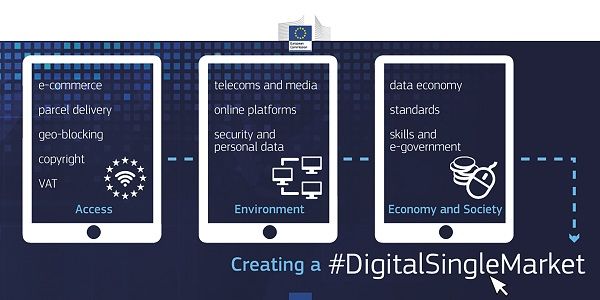
The three pillars of the 2015 EU DSM initiatives
Source: A Digital Single Market for Europe: Commission sets out 16 initiatives to make it happen, licence
For this reason, the DSM strategy is a top priority for the Juncker Commission. According to the EU statistics, DSM could contribute with EUR 415 billion to the EU economy. Since the project was launched, 35 legislative proposals have been delivered by the European Commission. In order to implement these ideas successfully, an agreement between the European Parliament and the European Council is needed on the proposals. In May 2017, the Commission highlighted three main areas where action is required. The first of them is the development of the European Data Economy, the second is tackling cybersecurity threats that the EU is facing, and the last one is the promotion of a fair internet ecosystem.
As mentioned earlier, DSM would contribute to the European economy with more than EUR 415 billion per year, and according to estimates, it would create around 1.3 million new jobs. In addition, the strategy opened space for large investments. As an example, in the first three quarters of 2016, EUR 10.1 billion was invested into European tech companies. If such trends continue, the European data economy will have a 4% share in the EU’s GDP by 2020. When it comes to the digitalisation of the society and economy, EU member states are amongst the best global performers in terms of connectivity, digital skills, use of internet, and e-public services. In order to make DSM complete, the EU institutions, and the member states as well, have to take actions. Besides boosting the e-commerce in the EU and improving the European cybersecurity, there is also a need for investing in the relevant fields of digital infrastructures.
What has been achieved so far?
Since May 2015, EU citizens have been able to experience significant and substantial changes. Small businesses can now make easier sales in their cross-border commerce, local authorities are able to offer “free WiFi4EU connections” to their communities, and there are clear limits on the use of personal data published online. The transition to e-procurement and e-signatures will allow governments to save around EUR 5 billion per year in the framework of the e-government action plan. Beyond any doubt, the abolition of roaming charges (on 15 June 2017) was the most visible achievement for the Europeans. Moreover, as of 2018, cross-border portability is provided for online films and sport broadcasts, music and e-book subscriptions. Europeans can now enjoy services such as Spotify and Netflix in all EU member states.
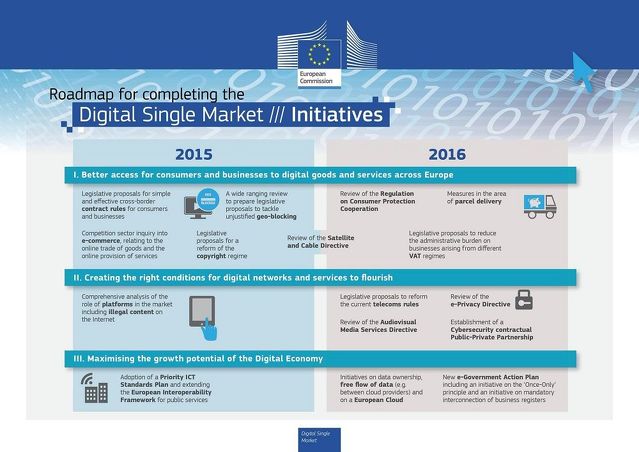
The Roadmap for the EU’s 2015 initiatives
Source: A Digital Single Market for Europe: Commission sets out 16 initiatives to make it happen, licence
The Network Information Security Directive (NIS Directive) is the first EU-wide legislation on cybersecurity. Its expected benefits are linked to economic growth and the creation of new jobs — the changing economic environment will certainly require the creation of new kinds of jobs. Increasing investment within Europe is also a huge potential of DSM. Besides the obvious economic and job market advantages of the strategy, DSM could potentially be a breakthrough for Europe. Firstly, because the EU is lagging behind Asia and the United States when it comes to technological development. Secondly, because Europe is currently divided in many political issues — so it is time to get the skates on, and develop a more coherent and unified European economy. If the EU wants to deal with external threats in the cyberspace, the single market has to be extended in the digital sphere as well.
Tackling implementation related challenges: the role of the EU institutions and the member states
According to a Commission-released brief, the European Commission made 35 legislative and policy proposals related to the Digital Single Market. Commission Vice-President Andrus Ansip, the Commissioner for Digital Single Market, put pressure not only on the European Parliament but also on the member states by saying that they have to take actions in order to adopt the proposals made by the Commission as soon as possible. Commissioner Ansip’s view was also echoed by the Estonian, Bulgarian, and Austrian presidencies. The eighteen-month programme of the Council prepared initiatives and actions for the Digital Single Market. The presidencies aimed to remove the remaining barriers, facilitate connectivity and cross-border e-commerce, and move towards smart economy by enhancing the free flow of data and advancing digital public services by implementing the principles of the EU e-Government Action Plan 2016–2020. As a part of this plan, electronic identification will be facilitated on the internal market.
Connecting EU candidate countries with member states
The principles behind the DSM strategy might also be a good accelerator for the EU when it comes to value transfer to non-EU countries. Removing digital barriers could also contribute to a stronger regional and cross-regional connectivity in Europe. Not only member states but also other European countries perform well concerning the digital reforms. For instance, besides the EU28, Norway, Switzerland, or Iceland are also frontrunners in the European digital revolution. Transition to digital economy is not only important for the member states, but it is also a priority for the European Union when it comes to supporting the EU accession process of the Western Balkan countries (Albania, Bosnia & Herzegovina, Kosovo, Montenegro, Macedonia, and Serbia). In order to assist the modernisation of public administrations, the strengthening of cybersecurity, and the increase of the connectivity between the EU and the enlargement countries, Mariya Gabriel, Commissioner for Digital Economy and Society, announced on 25 June 2018 that a Digital Agenda for The Western Balkans is to be launched. Investing in digital economy allows a higher degree of connectivity between the EU member states and the region. Moreover, improving online security is a common objective for both sides. For that reason, the Digital Agenda will allow the participants to increase cybersecurity in Europe.

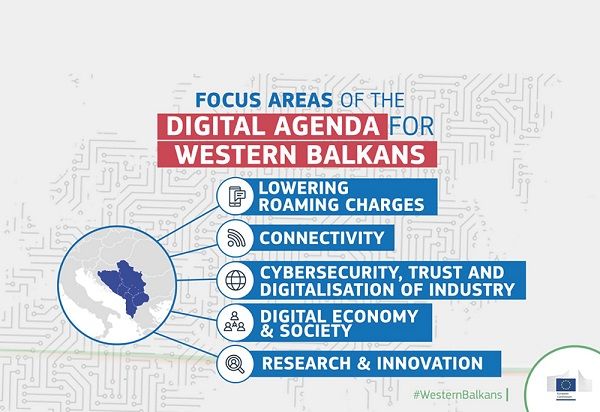
The Digital Agenda for the Western Balkans
Source: European Commission launches Digital Agenda for the Western Balkans, licence.
Modernisation of the European public administration: cross-border accessibility
The digitalisation of public services and the eGovernment make governments more efficient and transparent. For instance, eGovernance means not only digitalisation and modernisation but also a change of attitudes. DSM launched a new eGovernment Action Plan for 2016–2020 to modernise the public administration systems of the member states. The vision behind the Action Plan is to channel technological and digital opportunities in the public administration environment to facilitate the relations of the citizens and the public institutions. The European Commission’s strategy would like to catalyse the transformation of the administrative systems. The concept framework of the Action Plan is to realise these goals by following different principles to increase digital services, transparency, and facilitate mobility. It can be seen then that these principles are in compliance with the four EU freedoms; moreover they also aim to strengthen security and trust. In the future, banking, finance, commerce, and other economic activities in Europe will be shaped and formed by these innovations. Cross-border and cross-sector interactions will be facilitated by electronic identification.
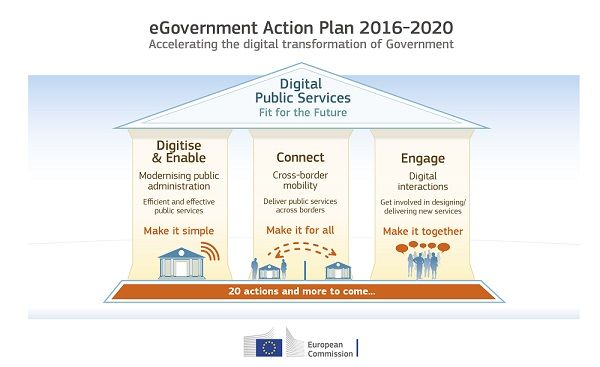
The EU’s eGovernment Action Plan 2016–2020
Source: European eGovernment Action Plan 2016–2020, licence
The frontrunners
But how different countries are progressing in their digital economic development? Thanks to different types of measures, the European Commission is able to assess the progress made by member states in their modernisation of public services. No doubt, the best performers are the Scandinavian countries (Denmark, Sweden, and Finland are in the top 3), the Benelux states, and the United Kingdom. In the Eastern part of the EU, Estonia is the leader, by far. These countries are able to provide high level of eGovernment services not only for their but for European citizens as well. In practice, this means that governments are bringing more and more public information and services online. Cross-border mobility generated more interconnections between different start-ups. The advantages of the digitalisation could be observed not only on the state but also on the local levels.
The Digital Economy and Society Index (DESI) ranks countries by five criteria: connectivity, human capital, use of internet services, integration of digital technology, and digital public services. Concerning digital public services, Estonia is one of the countries that are possessing the highest score of this category. For instance, the proportion of eGovernment users reaches 96%, more than twice as much as the EU average. But what does it mean in practice? The online service completion and digital services are available for the business sector. The launch of X-road project (digital information infrastructure) highly contributes to the Estonian success story.
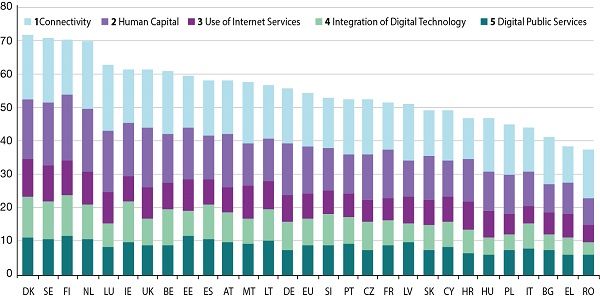

Digital Economy and Society Index (DESI) 2018 ranking
Source: The Digital Economy and Society Index (DESI), licence
In the Central European region, Austria seems to be the best performer. Just like Estonia, Austria puts great emphasis on the digitalisation of public services. Thus 98% of the public services are available online. In addition, when it comes to mobile devices, Austria is among the best performers. As for Hungary, our country is lagging behind the European average in this field. In 2014, Hungary started the adoption of the National Infocommunication Strategy, but Digital Public Services are still part of the most challenging issues. The share of the eGovernment users is 45%, which is under the EU average.
The challenges ahead
The DSM strategy initiated by the European Commission aims to transform the European Union to a digital superpower. The European digital revolution has started, and this will certainly have a strong impact on the life of European citizens. The EU has successfully started to remove the unnecessary barriers, and the digitalisation of public administration services will turn the European member states into “smart countries.” The digital transformation of Europe will also contribute to the development of many other related fields, such as cybersecurity, healthcare, job creation, and connecting small- and medium-sized enterprises.
The main challenges for the DSM strategy are currently related to legal and technical issues, but there are some political challenges, too. The lawfulness of data transfer, as well as personal data connections, professional and business secrecy are the main concerns regarding the legal approach. A higher degree of influence is needed from the EU in order to regulate data sharing between member states. Regarding technical challenges, cross-border data sharing represents another barrier besides legal issues. As a matter of fact, different information and communication technologies (ICT) are not harmonised between the member states. For this reason, differences in data quality, models, and systems are culminating on the top European level, preventing the compatibility of the national levels. For this reason, the European Union will have to support and initiate a major technological, organisational, and legal harmonisation on the European level.