“The star of the East is high,” Prime Minister Viktor Orbán said on 27 November in Budapest, at the opening of the three-day economic and trade forum between China and the 16 Central and Eastern European (CEE) countries. Strengthening the cooperation with China is also of key importance for the Western Balkan countries and their economic growth, especially for Serbia.
At the three-day summit, it was highlighted several times that the 16+1 represents a major partnership among member states—the 11 EU, the 5 Western Balkan countries, and China. In 2016 bilateral trade between China and the CEECs totalled almost $59 billion. Li Keqiang, the Premier of the State Council of the People’s Republic of China, announced that in the forthcoming period China would provide another $3 billion for development in Central and Eastern Europe.
Current bilateral projects between Serbia and China amount to $6 million, with further contracts signed at the Budapest 16+1 Summit. One of them is about the construction of an over 30-kilometre-long part of Corridor XI, with a budget of around 450 million euros. The motorway has multilateral significance, as Corridor XI links Serbia and Montenegro and will be part of the Belgrade–Sarajevo highway in the future. With this Corridor, Serbia will hopefully become a Balkan hub, taking full advantage of its favourable geographic position, said Serbian Minister of Transport Zorana Mihajlović. Furthermore, in January, Serbia and China agreed to a 30-day visa waiver for one another’s citizens. Also in 2017 the Bank of China opened a branch in Belgrade, which will serve as a centre office in the region, as it will cover the former Yugoslavian countries, as well as Greece, Romania, Bulgaria and Albania. It is also the first Chinese-owned bank opened in Serbia.
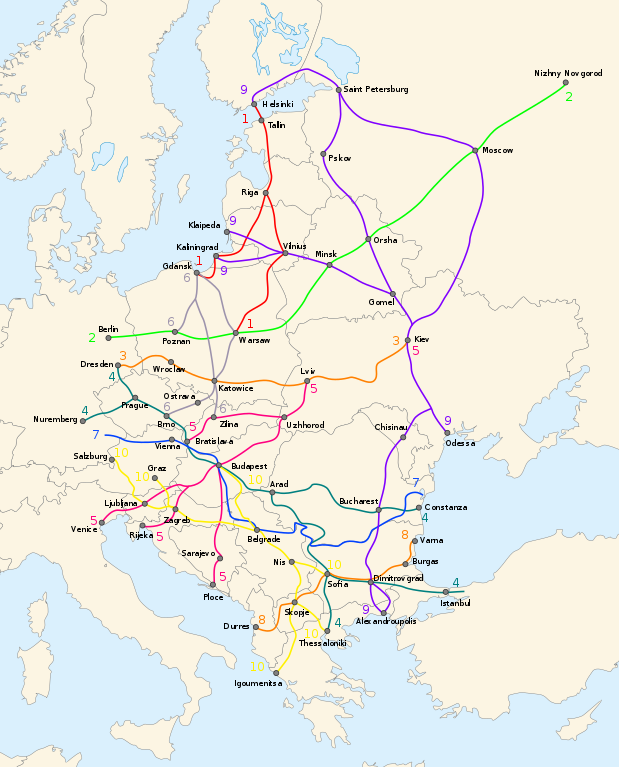
During the 16+1 Summit, Prime Minister Viktor Orbán met Serbian Prime Minister Ana Brnabić, with whom he discussed, among others, the modernization of the Belgrade–Budapest railway line, serving both passenger and freight transport purposes. The railway line is part of the Pan-European corridors and the so-called Corridor X. For Serbia, the most important initiative of the 16+1—as part of the One Belt, One Road Initiative—is the modernization of the above-mentioned railway line. This is also the first joint cross-border project between Hungary as an EU member of the, Serbia as an EU candidate country, and China, stated the Serbian prime minister.
The Balkans section of the Pan-European corridor
Source: Wikipedia, author: historicair, license: CC BY-SA 3.0
The reconstruction of the railway network began in late November with the first 34.5-kilometre section between Belgrade and Stara Pazova. This first phase of the construction will cost $300 million, for which Serbia received a loan from the Chinese Export–Import Bank, with an annual two-percent interest rate, 180-month repayment plan, and 60-month grace period. Some reports indicate that the building materials and labour force will mostly be brought in from China. The modernization of the entire 184-kilometre-long Serbian line of the railway—between Belgrade and Kelebija—will cost approximately $2 billion and will mostly be financed from Chinese loans. According to the plans, the reconstruction will be divided into three stages, and within six years a new international express train will be launched, capable of reaching speeds up to 200 km/h. Three years passed between the initial proposal of the railway renovation and the start of the actual work, while the Serbian party worked to collect all the necessary documentation and licences. According to Serbian Minister of Transport Zorana Mihajlović, the beginning of these renewal works was considered an important and successful day in Serbia, as the average speed of Serbian trains is limited to 40 km/h, and in the past thirty years (during and after the Yugoslav Wars) there were no major investments in railway network renewal and maintenance. Based on the reports, after the renovation, four tracks will be active on the Belgrade–Budapest railway line—two will allow a speed of up to 200 km/h for passenger transport, while the other two, used for transporting cargo, will accommodate 120 km/h.
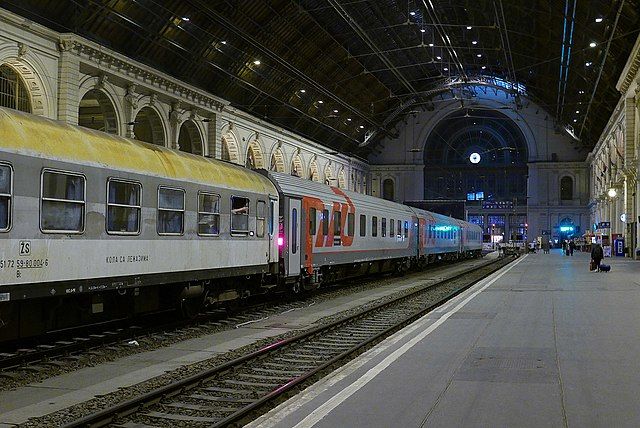
The Belgrade–Budapest international train in Keleti train station, Budapest
Source: Wikipedia, author: NAC, license: CC BY-SA 4.0
The 350-kilometre railway line connecting the Hungarian and Serbian capital was built between 1881 and 1884. It also stops at two major cities of the Serbian Autonomous Province of Vojvodina: Novi Sad and Subotica—a city near the Hungarian border, largely inhabited by a Hungarian ethnic minority. It still offers several departures a day, but the poor railroad network and the low speed of trains (their maximum speed is only 70 km/h) make the trip approximately eight and a half hours long. After the reconstruction, this time is expected to be reduced to three hours.
The modernization of the railway line would be of extreme importance for Serbia, regarding both passenger and freight traffic. After the break-up of Yugoslavia, the Yugoslav Wars, and the Bulldozer Revolution, this central hub country in the Balkans is in dire need of economic and trade stimulation. As Boris Nikolic stated in his working paper Serbian Interest within One Belt One Road, “It seems as if Serbia, and most other former Yugoslavian republics, have wasted almost three decades only to find themselves at their economic development levels of the eighties.”
Opening pic: Flickr