At the end of November, Budapest is going to host the sixth annual summit of the so-called “16+1 cooperation,” a platform established with the aim to manage more effectively the relations between Central and Eastern European Countries (CEEC) and China. The event is carefully monitored by political, business, and academic circles from both Hungary and the CEE region because, over the recent years, the cooperation has grown into the most important institution regarding CEEC–China relations. However, there is still limited interest toward the cooperation at European Union level, where an attitude of suspicion and scepticism prevails.
Central and Eastern European (CEE) – Chinese relations started to deepen more swiftly after the 2008–2009 global financial crisis, hence the post-crisis reviled the common interests of the parties. The closer cooperation was soon followed by the demand for giving it an institutional framework.
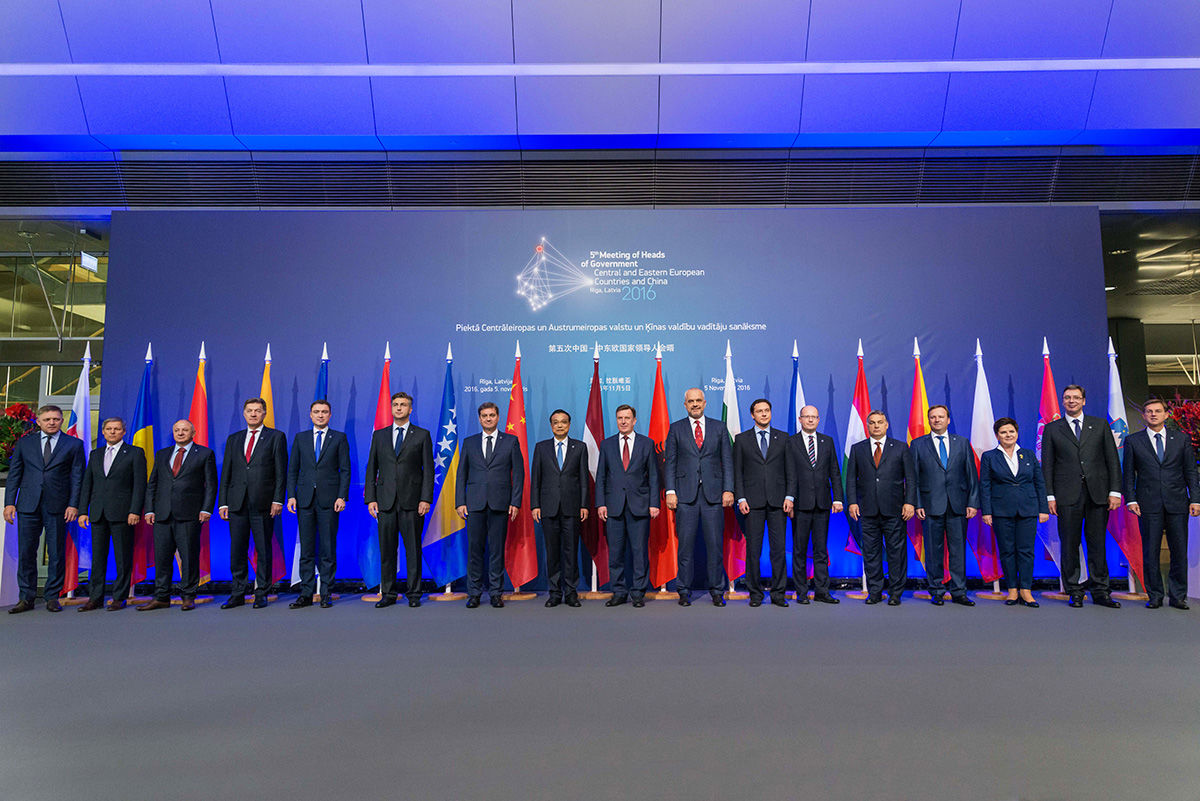
At the first CEE – China Economic and Trade Cooperation Forum which was held in Budapest in June 2011, the then Premier Wen Jiabao of the People’s Republic of China proposed the idea of establishing a regular cooperation platform in order to manage the relations more effectively. The second Economic and Trade Cooperation Forum held in Warsaw the following year can be regarded as the first summit of “16+1 cooperation” (which involves the 16 CEE countries and China). Since then, it has been annually followed by other summits, always assembled in the capital of one of the member states. This year, Hungary will be the host country.
Since its establishment, the cooperation has developed relatively quickly, and in the last three years, after forming the necessary structural institutions, the operative work and the realization of common projects has begun.
Accompanying the above mentioned, the creation of the project’s financial background has started as well. Despite the promising beginning and the enthusiasms of the involved parties – especially the V4 countries, Serbia, and China – it received only limited interest from the EU, and it has reflected – especially in the case of the leading EU countries – more of a sceptical and suspicious attitude.
One of the reasons for this suspicion lies in the fact that the cooperation’s specific role in the European–Chinese relations is unclear. The situation was complicated even further after the Bucharest summit in 2014, where Li Kejiang announced the cooperation’s integration into the Belt and Road Initiative (BRI). From the viewpoint of the “16+1,” this announcement was clearly a positive sign, as BRI is viewed as the most important Chinese foreign political initiation in the recent years, and this integration is seen as a proof that the cooperation with the CEE region is important for the Chinese side. However, since its announcement, no joint EU strategy on the BRI has been developed, although it is far more important than the “16+1.” From the EU’s perspective, “16+1” seems aimless, and means only an extra, uncontrolled channel in the EU–China relations.
It is also often criticized that the financial background and the management of the projects is not fully aligned with free-market rules, EU legislation, and transparency demands. A critical point concerning this issue is that 11 countries out of 16 are EU members, while 5 are not, so the legal regulations can be different, which could cause problems regarding joint projects, such as the often-cited Budapest–Belgrade railway project.
The growingly active Chinese presence in the CEE region is a matter of principle too, whereas during the competition between CEE countries for Chinese FDI and investments, some of the EU’s own interests – that are sometimes connected to political concessions (e.g. human rights, democracy and free market) – could be put in jeopardy. These worries are closely related to the criticism towards some of the CEE countries (like Poland and Hungary), regarding the European principles of rule of law and transparency.