The Three Seas Initiative is a cooperation between 12 states connecting the Baltic, Black, and Adriatic Seas. It has three main goals: economic development, improving European cohesion, and strengthening transatlantic ties. The main goal of the Three Seas Initiative lies in energy security by increasing self-sustainability and positive economic competition within the region. According to the European Commission report on the Three Seas Initiative Summit, the Three Seas countries account for 28% of the European Union’s territory, 22% of their population, but only 10% of their GDP. This proves a clear deviation between CEE countries and their Western European counterparts. The Three Seas Initiative is one project that aims to curb the structural weaknesses that perpetuate a lack of economic growth within CEE countries, which have enormous potential on the international stage.
The Three Seas initiative aims to improve infrastructure in three main areas: transport, energy, and digital. In order to improve regional economic development, there is a need to connect large cities with more rural regions, especially considering that as of right now, traveling in CEE takes 2 to 4 times as long to cross the same distance as in Western Europe. Increased mobility by railways will foster economic growth through tourism, trade, and business opportunities. In terms of the energy sector, the goal is to reduce reliance on external actors for energy through building gas pipelines. Thirdly, it aims to improve the digital sector by increasing access to internet and networks in rural regions.
As the share of gas in primary energy consumption grows, the more CEE countries become dependent on gas imports. As of right now, almost all gas for CEE is imported from outside sources. This dependence for energy has now become intertwined with foreign policy and security. Why? Because most CEE gas pipelines come from Russia. It is the origin of 75-100% of their gas imports. The Russian Federation is the largest shareholder for Gazprom, one of the biggest natural gas companies that supplies the European Union. This gives Russia a major geopolitical advantage in the energy sector. Due to lack of competition, they can control prices as well. The main concern is that Russia could use these price controls as leverage to exert influence over CEE countries.
Because of the geopolitical position of CEE countries, the Three Seas Initiative has attracted the attention of other foreign countries, such as the United States. Donald Trump has emphatically expressed his interest in and support for the project, saying in a meeting with Poland’s President Andrzej Duda that “The TSI will not only empower your people to prosper, but it will ensure that your nations remain sovereign, secure, and free from foreign coercion.” Building infrastructure also requires massive amount of investment, time, and commitment. There is much skepticism towards whether or not the TSI will deliver its promised achievements. In order for the TSI to succeed, it would require full participation and commitment on behalf of the participant countries, as well as investment from outside sources, such as the European Commission and European Regional Development Fund, and potentially even investment from the United States.
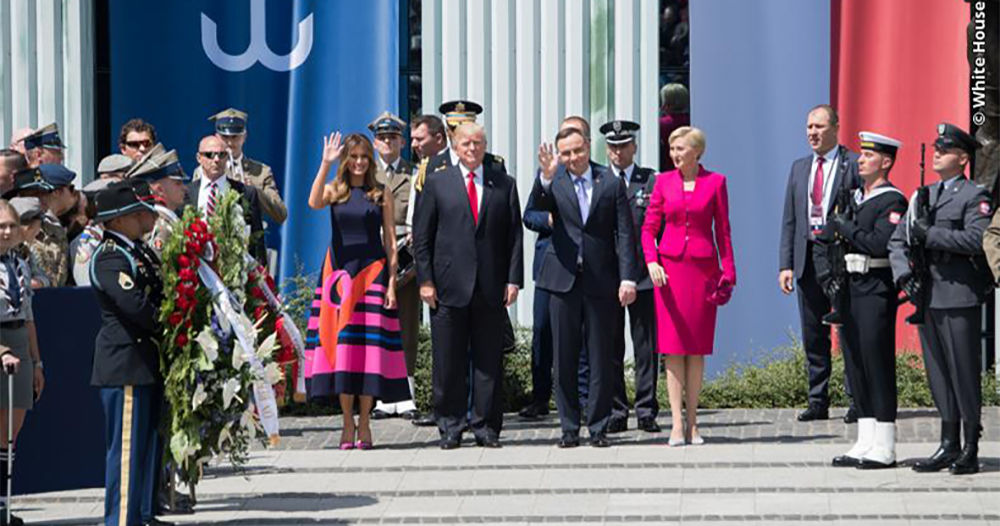
President Donald Trump’s presence at the 2017 Warsaw Summit also shows American interest in the Three Seas Initiative. The United States, despite some recent tensions over trade with some EU member states, has been an advocate for European Integration and projects that support movement in the direction of greater connectivity. At the Three Seas Initiative Summit in Warsaw, Trump said, “With the expanded trade and new infrastructure, we will unleash incredible energy innovation that is safe, responsible, and environmentally friendly. The United States supports a commonsense approach to protecting natural resources—one that responsibly balances economic growth, job creation, and energy security.” Although American interest in the Three Seas Initiative has been criticized by some as a political play against the Russian Federation, its motives are much more aligned with the political and economic benefits that a stronger CEE could have for the US. This includes maintaining democratic values, and ensuring peace and security in Central and Eastern Europe.