Kategória: Research Blog
Forrás: https://digitalistudastar.ajtk.hu/en/research-blog/the-belt-and-road-forum-what-was-it-all-about

The Belt And Road Forum

What Was It All About?


Szerző: Viktória Anna Papp,
Megjelenés: 05/2017
 Reading time: 6 minutes

Today, China doesn’t want to continue “concealing its capabilities and avoiding the limelight” as it had done for decades after the Reform and Opening-up. Rather, it wishes to take the role and responsibility as the world’s second-largest economy. Therefore, it has harked back to the ancient Silk Road to make its plan less threatening. Culminating much of China’s work invested into developing its modern Silk Road projects, this May, the first ever Belt and Road Forum for International Cooperation was held in Beijing. The event proved to be a major diplomatic show, yet said little about China’s flagship project.

At the Belt and Road Forum for International Cooperation held in Beijing from 14 to 15 May, Chinese President Xi Jinping announced that China would further channel RMB 100 billion (USD 14.5 billion) into the Silk Road Fund and that the China Development Bank and the Export-Import Bank will set up special lending schemes of RMB 250 billion (USD 36.2 billion) and RMB 130 billion (USD 18.8 billion), respectively, for Belt and Road projects.

The Belt and Road Forum was one of this year’s highest-profile diplomatic gathering, attended by 30 heads of state and governments as well as representatives from more than 130 countries and 70 international organizations. During the forum, the thirty world leaders signed a joint communique promoting free trade and globalization. China also signed bilateral agreements and deals with almost 70 countries and international organizations.

In his keynote speech, President Xi also underlined a few of the most important projects under the Belt and Road framework: “We have accelerated the building of Jakarta–Bandung high-speed railway, China–Laos railway, Addis Ababa–Djibouti railway, and Hungary–Serbia railway, and upgraded Gwadar and Piraeus ports in cooperation with relevant countries.”

In response to previous concerns about Belt and Road Initiative’s (BRI) ambitions, President Xi said: “In pursuing the Belt and Road Initiative, we will not resort to outdated geopolitical maneuvering. What we hope to achieve is a new model of win-win cooperation.”
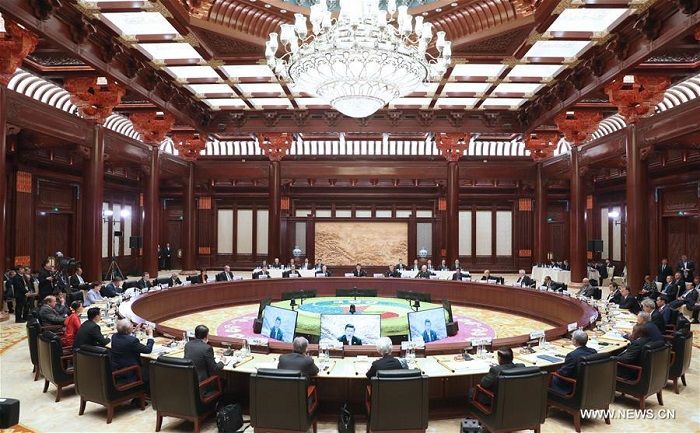
Leader’s Roundtable Summit, Belt and Road Forum for International Cooperation, 15 May, 2017
Forrás: Xinhua

Launched in 2013, the Belt and Road Initiative (or One Belt One Road) is President Xi Jinping’s signature initiative, which is one of the core elements of his political agenda and crucial to his ideological program the “China Dream” (Zhongguo meng, 中国梦) of reviving China’s national greatness. Therefore, successfully organizing the Belt and Road Forum not only increases China’s sway on the international stage but also underpins Xi’s dominance being core leader to the CCP as the 19th Communist Party Congress approaches.

As China articulated, the objective of the BRI is to strengthen cooperation among the countries on the Belt and Road and to achieve prosperity of people in the region. The ambitious initiative is regarded as the largest regional platform for cooperation including 65 countries and approximately 40 percent of global GDP. The Belt and Road Initiative aims to build interlinked infrastructure, trade and financial network stretching from China to South and Southeast Asia, the Middle East, Europe, and Africa. Although there are many projects in the making, such as railways connecting China to Laos, Mongolia and Kazakhstan; gas and oil pipelines through Turkmenistan and Myanmar; road and port development in Sri Lanka as well as the keystone 46 billion USD China–Pakistan Economic Corridor (which comprises highways, pipelines, several energy projects, and the Chinese-operated Gwadar port) it is still not quite clear what exactly qualifies as a Belt and Road project.

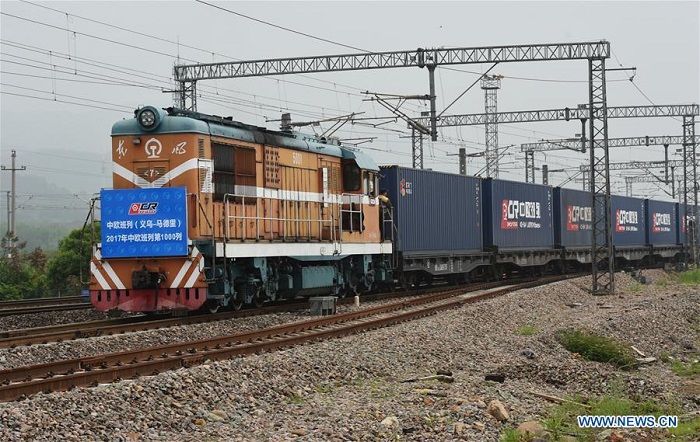
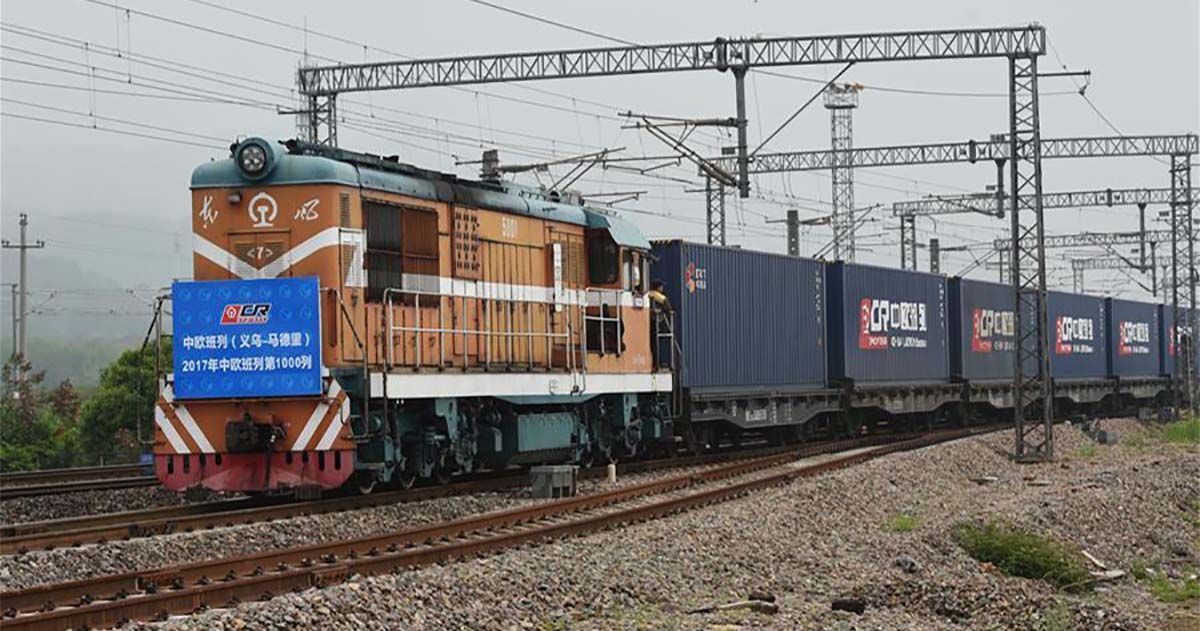
The 1000th freight train linking China and Europe this year
Forrás: Xinhua

China is definitely seeking growth abroad as the domestic economy slows – expecting only 6.5% growth for this year – and exports its overcapacity in heavy industry. However, with a largely abstract nature of its overall shape and form, the Belt and Road Initiative is still subject to much speculation both in geopolitical and economic terms. Some argue that BRI is China’s grand strategy for creating a sphere of influence and hegemony in the region and it is simply the extension of its “going out” policy. Again, some observers think that BRI is aimed at countering instability in bordering Islamic states spilling over to Xinjiang, and, at the same time, it is also part of Beijing’s soft power offensive.

On one hand, the Belt and Road Forum reinforced the fact that the BRI will continue to be backed by large investments and political capital on the Chinese side. On the other hand, it did not radically alter preexisting perceptions about the initiative’s nature, nor did it shed more light on what the Chinese approach is towards tackling security or financial challenges the initiative would have to face. Even though, President Xi tries to sell BRI as a peaceful narrative of connectivity and win-win cooperation, he soon will probably need to explain when exactly geopolitical maneuvering became outdated.


Opening pic by Xinhua