Kategória: Research Blog
Forrás: https://digitalistudastar.ajtk.hu/en/research-blog/smoke-tinted-green-energiewende-in-germany

Smoke-tinted green

Energiewende in Germany


Szerző: Roland Menyes,
Megjelenés: 06/2017
 Reading time: 15 minutes

Germany goes green at full steam. After the imminent decommission of nuclear and coal power plants, the sun and the wind are to become the main energy sources of the country. Efficient technologies make economic growth possible with a falling overall energy consumption, whereas electric cars fill the roads en masse seriously contributing to the reduction of CO2 emissions.

Meanwhile, the country is building the fundaments of its future by funding cutting-edge innovations. This would be the optimistic interpretation of the processes of the upcoming decades. In spite of the remarkable development in the energy sector, however, the plan of the German government to push the energy transition forward at an unaltered speed is nothing short of audacious. Experts warn that in the absence of technological miracles and a thorough overhaul on the systemic level, the lofty goals of the Energiewende will inevitably founder due to the tenacious laws of economics and science.

Goals and achievements

The basic document of the current energy regime, the Federal Government’s Energy Concept was adopted in 2010. The targets are ambitious indeed:  

  • 40-45 % of the electricity consumed in Germany to be covered by renewables by 2025
  • 20% less primary energy consumption by 2020 (from 2008)
  • 40% less greenhouse gas emissions by 2020 (from 1990)
  • 10% less final energy consumption in transport by 2020 (from 2005)

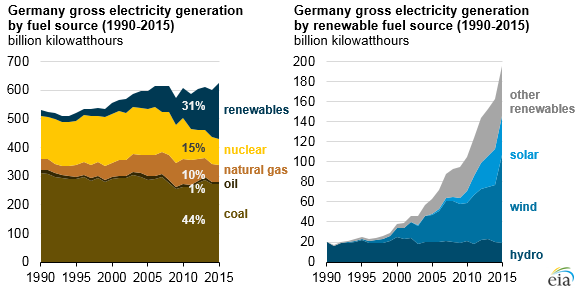
The interim achievements, however, show that the fulfilment of the envisioned progress within the remaining less than three years is very unlikely. While the use of renewables have been expanding more or less at the necessary rate, reaching a 31.1% share by 2016, efficiency gains have been by far not high enough to mitigate consumption according to plans – the relevant figure in 2014 was just 8.3%. The third and the fourth goals have also proved to be too idealistic. The transport sector is especially lagging behind, where CO2 emissions practically remained on the same level over the last decade and energy consumption actually rose in the period from 2005 to 2014.

Electricity generation
Forrás: euanmears.com

Progress in the field of investment

Regarding investments, there are mainly good news. Today, there are over 27.000 wind turbines and around 1.5 million photovoltaic systems commissioned all over the country. The sheer size of this installed capacity along with the favourable weather conditions recently made it possible for renewables to set a new milestone by covering nearly the entire domestic demand for at least a short period. The setup of new capacities is facilitated by the continuously falling establishment costs – in fact, this year saw the first wind farm that was commissioned without subsidies. This example shows that renewable generation has become competitive and can function under market circumstances. Furthermore, the financial support and the flexible conditions applied to civic societies resulted in the fact that 90% of the projects in the first federal tender in 2017 were won by them, elevating the democratization of energy on a new level.

The costs and their distribution

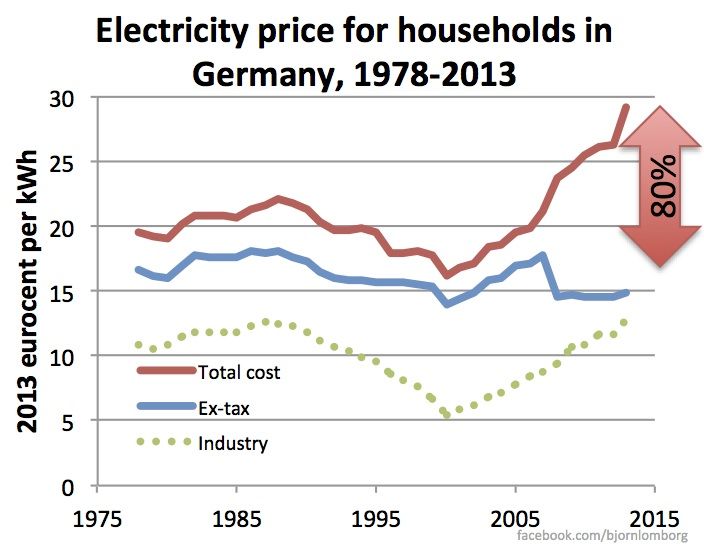
The costs of the Energiewende were estimated a decade ago to be more or less equal to the price of an ice cream per month for an average household, however costs spiralled upwards as the process unfolded. There are three basic reasons for this. Firstly, wind and solar generate electricity intermittently and unpredictably putting the electrical system under strain. In order to uphold stability network operators are forced to intervene when imbalance occurs. The applied measures, however, are - as a general rule - expensive.  Secondly, supply and demand are dynamically separated not only in time but also in space. Due to this, the transportation of an immense amount of electricity over large distances is inevitable. The required infrastructural development entails serious financial investment. Thirdly, high electricity prices exert negative influence on the competitiveness of the country. Taking this into consideration, the government exempts pivotal branches and companies from paying the EEG surcharge, leaving the households to compensate for the loss.

Price
Forrás: linkedin.com

Infrastructural development and unanswered questions

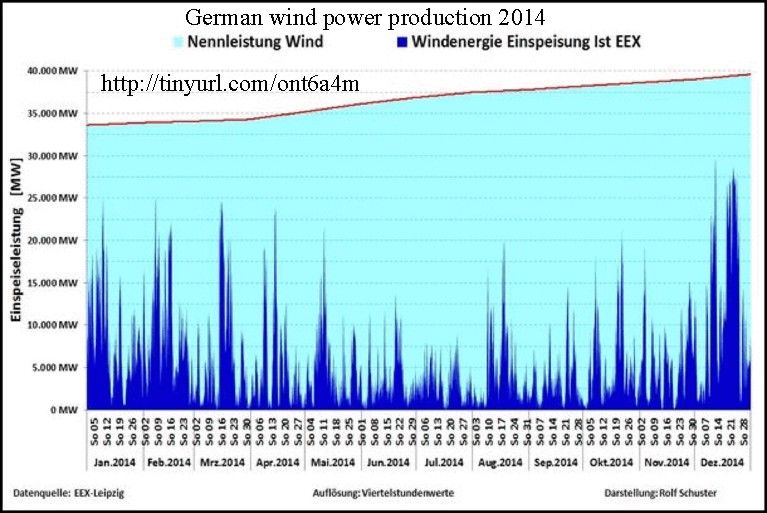
As mentioned previously, on account of their intermittency and unpredictability the expansion of wind and solar power in the electricity sector affects both the security of supply and network stability negatively – to take a look at the sheer figures, only the seventh of their average performance is secured and can be prudently calculated with. To offset the resulting imbalances, four basic solutions exist, namely the expedient activation/deactivation of conventional power plants, the import and export of lacking and redundant electricity respectively, the drawing on storage capacities, and the dynamic synchronization of supply and demand via smart grids.

As to the first possibility, it is seriously constrained by the imminent abandonment of nuclear energy, leaving only coal and gas plants to act as buffers. Yet falling back on these to a large extent jeopardizes the planned progress regarding CO2 emissions targets. To add to the problem, without the support of nuclear sources transportation is also unlikely to go electric at an appropriate rate.

Wind volatility
Forrás: wryheat.wordpress.com

Regarding the second option, although the infrastructure for international electricity trade is available, in its practical usage several difficulties arise. Since neither volatility in itself, nor redundant supply are desirable, neighbouring countries are prone to reject the tapping into their network when demand is not attendant. On the contrary, temporary domestic electric scarcity is complicated from a rather normative point of view. Nuclear power plants are scattered all around Germany providing enough capacity to quench domestic demand at any time, but drawing power from them seems to be a hypocrisy transferring the associated environmental risks beyond the borders.

Concerning the third method of dealing with intermittency and storage, progress is not visible and there is a good reason for this. It is estimated that only securing the average performance of the already deployed wind turbines would require around 10.000 (!) pumped storage power plants – from which only 35 is in operation today. The situation would not become significantly better even if solar panels, the daily performance curve of which is different from that of the wind turbines, are factored in. In this case, “merely” an approx. 5.000 of such facilities would be sufficient. The associated costs are accordingly mind-blowing and move in the realm of one trillion Euros.

Since the mentioned drawbacks of the conventional methods are not easy to circumvent, new solutions must be developed. Electric cars are regarded by many as the saviour of the future, because their batteries can be operated as buffers when attached to the electricity network. As promising and progressive as it may seem, this concept is also likely to founder on practical obstacles. According to recent calculations, at the current share of renewables, well over 100 million e-vehicles would be needed for a perfect smooth-out, while presently 42 million non-e-vehicles are running on the roads. The possibilities in smart grids, which promise dynamic energy distribution and intelligent load shifting, are questioned too, as they are currently suitable only to offset local and temporal imbalances, but cannot successfully handle the seasonal volatility so characteristic of renewables. Moreover, the effectivity of smart grids is highly contingent on customer behaviour, making the assessment of their real potential very difficult.

The chances of decarbonisation

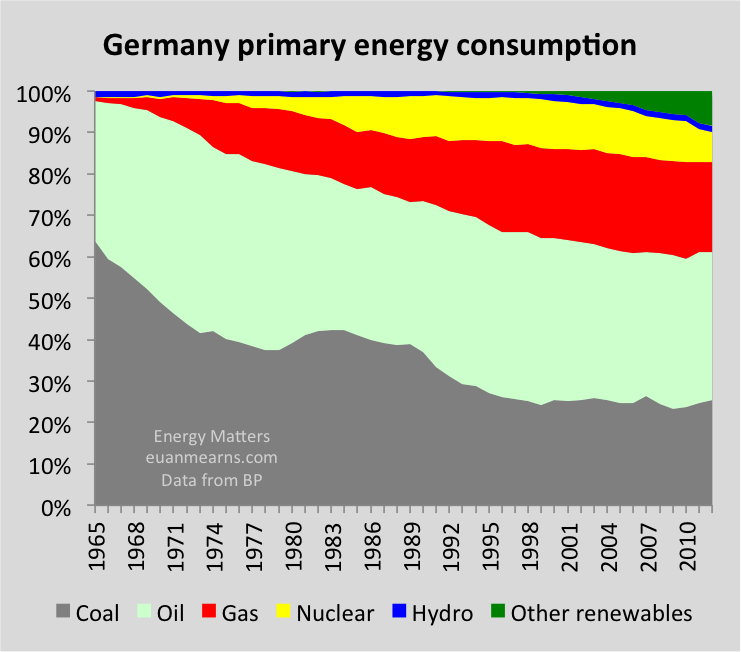
Apart from the above-mentioned major technical concerns, there are also others putting the viability of the Energiewende as well as the attainability of the interdependent German climate goals in doubt. The most important is that the share of renewables in total energy production is just negligible, making decarbonisation even in the middle run a titanic endeavour. And the picture does not become rosier if we take a look at the trends. Transport, which accounts for more than one quarter of the overall CO2 emission, has not shown any improvement within the last decade. The EEG-surcharge, introduced to support the energy transition, also failed to exert any tangible influence in this field. As a matter of fact, it had undesired side effects: the subvention of green energy in Germany led to the use of emission certificates in other EU countries. In view of this, the abolition of the EEG-surcharge and the establishment of appropriate incentives on European level seems to be inevitable for the Energiewende to be at least partially successful. 
Final energy consumption
Forrás: euanmearns.com

Conclusion

In view of the pros and cons, how can the Energiewende be eventually evaluated? On the account of its impressive results, it must be appreciated as a success. The many difficulties it created, however, certainly raise doubts regarding the smoothness of its further unfolding. From today’s perspective, it is far from clear whether the technical and economic innovations can keep pace with the arising problems in a way in which the project remains politically and socially supportable. The variety of opinions and different approaches, which are the indicators of the existence of a vivid and active public sphere, make it necessarily challenging to see the general picture realistically and to construct transitional problems only as such. What we can therefore surely say is that in spite of the criticism, the Energiewende has been and stays a remarkable and progressive endeavour which promises wide-range benefits both on national and global scale.