Kategória: Research Blog
Forrás: https://digitalistudastar.ajtk.hu/en/research-blog/significant-still-complementary-nato-s-contribution-to-energy-security
Significant still complementary
NATO's Contribution to Energy Security
Szerző: Péter Stepper,
Megjelenés: 06/2017
Reading time: 15 minutes
The main purpose of NATO as a military alliance is to defend its member states from any external attacks with all means available. After the collapse of the Soviet Union, more and more non-conventional threats appeared, thus NATO had to reinvent itself and adapt to the new security challenges. Access to vital energy sources has always been essential for its member states, but they rarely considered international institutions as useful tools which can contribute to their energy security. Even less efforts have been put in an energy cooperation within NATO, a transatlantic military alliance based on the idea of consensual decision-making. Despite this, after a decade-long series of negotiations, NATO member states decided to contribute to energy security initiatives in the framework of the Alliance. Over the past decades and in the course of a complex discourse, the Alliance formulated a legal framework, a kind of ‘acquis’, related to energy security, based on three strategic priorities: political consultation and intelligence sharing; stability projection; and nuclear and non-nuclear critical energy infrastructure protection.
The International Energy Agency (IEA) has a broad definition of energy security, whereby energy security equates to the “adequate, affordable, and reliable access to energy fuels and services, it includes availability of resources, decreasing dependence on imports, decreasing pressures on the environment, competition and market and market efficiency, reliance on indigenous resources that are environmentally clean, and energy services that are affordable and equitably shared.” NATO first referred to energy security in its 1999 Strategic Concept. In this document, while the Alliance noted that its core function was still to deter and/or respond to armed attacks on the territory of any of the Allies, it also emphasized that NATO’s security could also be affected by other factors, such as the “disruption of the flow of vital resources.”
Although the topic was mentioned at the 1999 Washington Summit, a long period of silence followed, up until 2006. In 2006, the Russia-Ukraine gas dispute raised serious concerns about energy security. The dispute reached a climax on January 1, 2006 when Russia cut off supplies to Ukraine. After that, Poland put forth a proposal suggesting that NATO members commit themselves to help one another during energy crises. U.S. Senator Richard Lugar, a high-ranking member of the Senate Committee on Foreign Relations, went even further, arguing that energy security should be a commitment under the Article 5 mutual defense clause of the North Atlantic Treaty. At the Riga Summit (29 November 2006), Senator Lugar argued that ‘because an attack using energy as a weapon can devastate a nation’s economy and yield hundreds or even thousands of casualties, the Alliance must avow that defending against such attacks is an Article Five commitment. This does not mean that attempts to manipulate energy for international political gain would require a NATO military response. Rather, it means that the Alliance must commit itself to preparing for and responding to attempts to use the energy weapon against its fellow members.’ Although Lugar was cautious enough not to suggest a military response to Russia’s political move, his expressions clearly show the seriousness of the situation back in 2006. However, it was not in the interest of NATO to apply Article 5 commitments to the field of energy security. There was a fundamental concern about putting additional pressure on the NATO-Russia relationship, and turning energy security debates in NATO into a Russia-bashing discourse. The Riga Summit Declaration (2006) highlighted the importance of energy infrastructure security and directed the member states to consult on the most immediate risks in the field of energy security and ‘define the interests, where NATO may add value to safeguard the security interests of the Allies and, upon request, assist national and international efforts.’
The Bucharest Summit (2008) was the next step in defining common interests and articulating a NATO acquis in the field of energy security. The Allies have identified the principles which will govern NATO’s approach in this field and outlined options and recommendations for further activities. Based on these principles, “NATO will engage in the following fields: information and intelligence fusion and sharing; projecting stability; advancing international and regional cooperation; supporting consequence management; and supporting the protection of critical energy infrastructure.” The 2010 Lisbon Summit was again a significant step forward, as it resulted in the adoption of a new Strategic Concept. The Strategic Concept noted that in the emerging new security environment, terrorism, “failed states” and cyberattacks will pose the most serious challenges in the future, but it also addressed the importance of energy security:
"some NATO countries will become more dependent on foreign energy suppliers and in some cases, on foreign energy supply and distribution networks for their energy needs. As a larger share of world consumption is transported across the globe, energy supplies are increasingly exposed to disruption."
The most important result of the Summit was that the Declaration required member states to integrate energy security considerations into NATO’s policies and activities. Thus over the course of the past decade’s summits, NATO has not only included the notion of energy security into its framework step by step, it has also developed a kind of acquis for energy security. This acquis has three main pillars: political consultation and intelligence fusing and sharing; projecting stability; and Critical Energy Infrastructure Protection.
Beside the traditional forms of political consultations, information sharing has already been institutionalized to a certain extent in terms of energy security. NATO established an Energy Security Section inside the Emerging Security Challenges Division, and it also has a NATO Energy Security Centre of Excellence (ENSEC COE). Training programs have also demonstrated considerable results. Partnership programs such as the Partnership for Peace (PfP) contribute to the broader strategic environment in the field of energy security. Multinational approaches are also of great importance in this dimension, as energy infrastructure links NATO allies with non-NATO countries.
New security challenges have on multiple occasions required NATO to reassess its methods. The field of energy security is a good example, demonstrating that the traditional military approach used during the Cold War era is not always appropriate. In this case, the classical retaliation-based approach and the notion of geographical security may prove inadequate in addressing competing energy interests. In relation to pipeline protection, preventive cooperative measures such as political consultations and partnership building may be much more efficient than classical deterrence policies. To sum up, the above analysis indicates that NATO has chosen to undertake a role in the field of energy security. However, this role will be limited and complementary, rather than leading one. Although energy security is not going to move to the center of NATO’s agenda, it is bound to get growing attention. Threats to energy security are real and imminent, but preventive measures could generate satisfactory solutions.
Enhancing energy efficiency in the military: The Green Army?
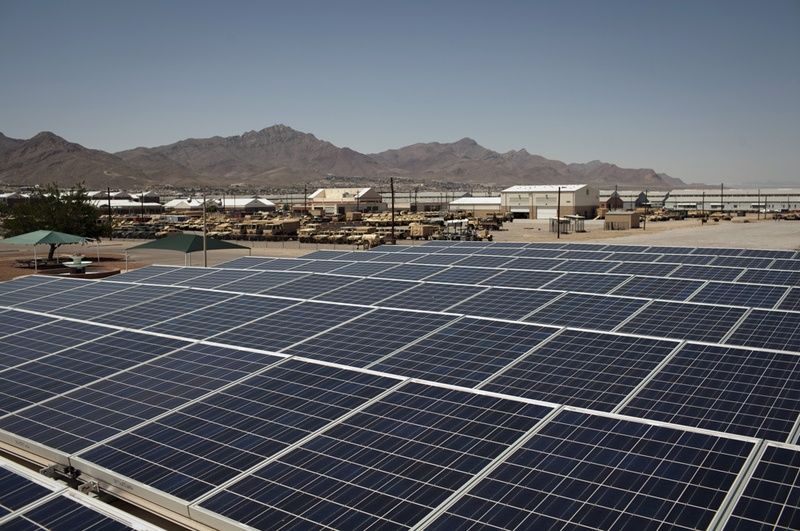
Solar PV Arrays at Fort Bliss
Source: Texastribune
Enhancing energy efficiency in the military focuses on reducing the energy consumption of military vehicles and camps, as well as on minimising the environmental footprint of military activities. A significant step forward in this area is the adoption of NATO’s “Green Defence” framework in February 2014. Global trends show the growing energy needs of rising powers, the depletion of global fossil fuel reserves, the general increase in the price of raw materials and Europe’s growing dependence on gas import. These trends reveal the necessity to decrease energy consumption in most of the NATO member states.
It is easy to understand that the price of fossil fuels can directly affect military forces when every $1 increase in a barrel of oil adds appx. $130 million to the US energy bills. The US Department of Defence spends about $20 billion per year on energy, $15 billion on fuels and $5 billion on facilities. On the one hand, fixed military installations need a huge energy supply every single day of the year, but calculating these costs is relatively unproblematic. On the other hand, areas of operations have special energy needs in order to provide services in remote places and keep the number of casualties on a level as low as possible. During the ISAF mission, fuel convoy attacks happened on a regular basis, and the costs of transporting fossil fuels to generators huge enough to be able to provide electricity for a military base were very significant.
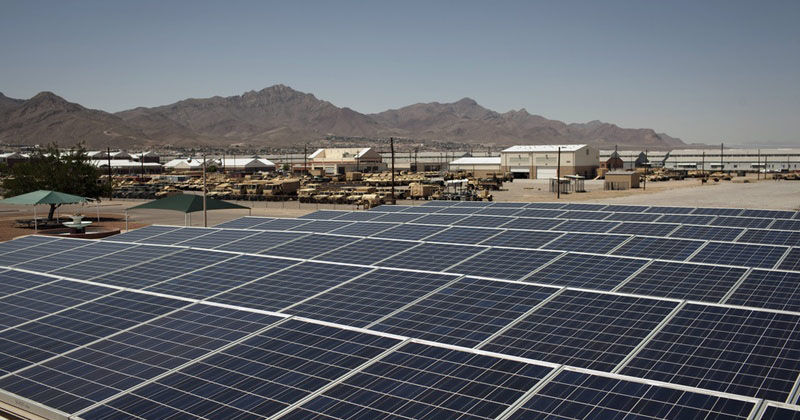
Most of the fixed installations in the military use the commercial power grid to acquire the necessary electricity to be operational 24/7 in 365 days/year. It is not just expensive, but creates vulnerabilities. Power supply cut-offs caused by environmental risks such as storms and earthquakes can threaten critical military infrastructures. In order to prevent these risks, the U.S. military supports the adoption of micro-grid initiatives supplied by renewables, particularly by photovoltaic systems. One of the most successful projects is Fort Bliss, where there is a 1.4 MW set of photovoltaic system installed, and a further 13.4 MW rooftop solar array to cover the needs of post housing. Another success story is the Hickham Air Force Base in Honolulu, where a photovoltaic system of 3.4 MW is in operation. In 2013, a 384 MW of renewable capacity was available at DoD installations, but in 3-5 years, this capacity is planned to increase to 706 MW.
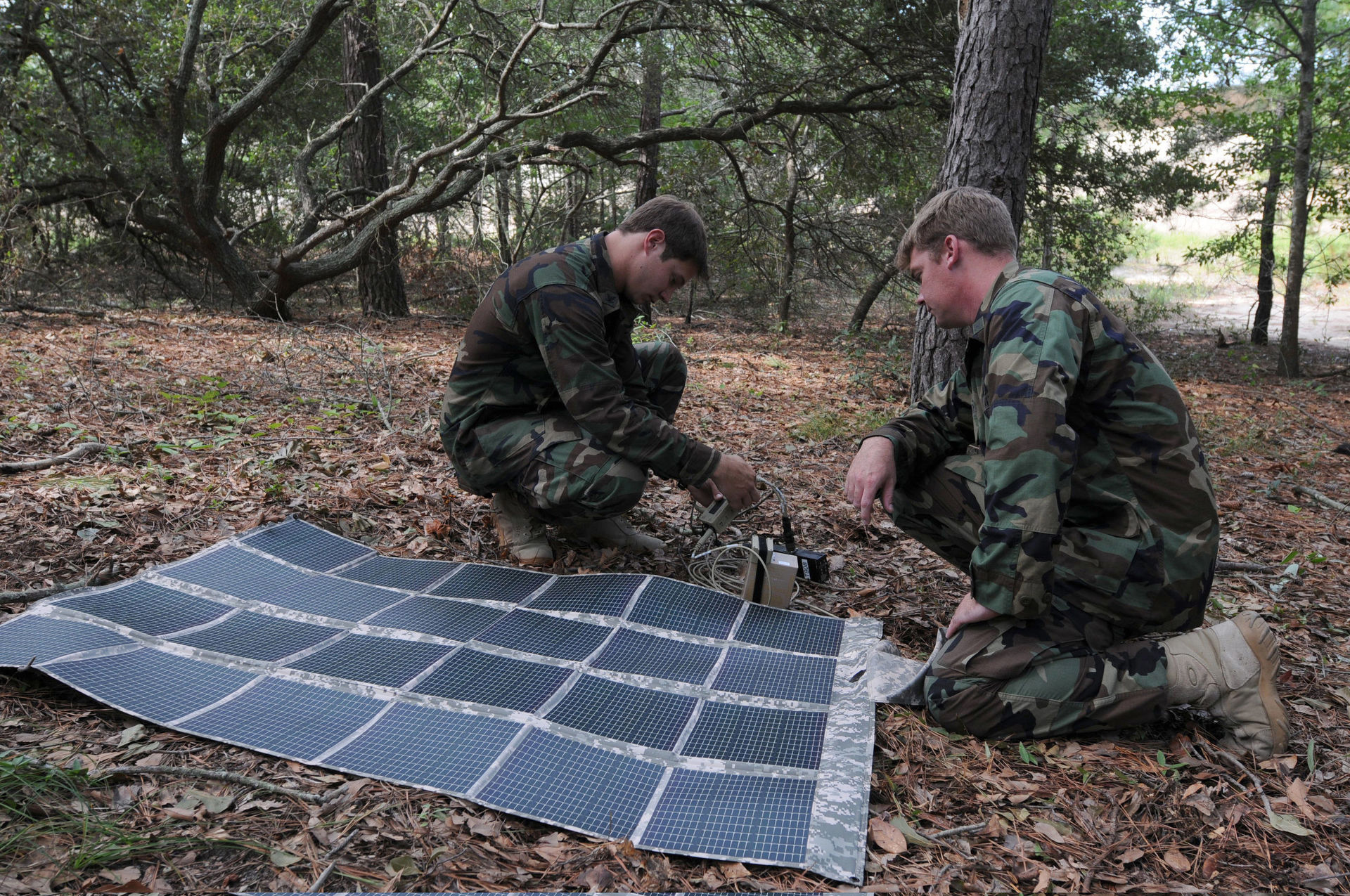
Solar blanket in a Rucksack Portable Power System
Source: Wikimedia
Speaking of solar energy, we can find several arguments to use its potential in the military. A 2010 simulation analysing the potential effects of using renewables in foreign operating military bases led to the following conclusions:
- For each megawatt of solar PV energy acquired, the forward operating bases achieve 6.7% of fuel savings.
- Installing a 2 MW solar PV array would reduce expected supply casualties by 12%.
- Modern equipment like the Rucksack Portable Power System (REPPS) – containing a 4.5 kg portable battery recharging kit that features a 62W solar panel blanket – eliminates the need to return to operational centres to recharge batteries, thus enhances the mobility of Special Forces.
NATO seemed to be active by and large in terms of increasing energy sustainability since the 2012 Chicago Summit. The Energy Security Section within the Emerging Security Challenges Division launched several projects dealing with energy. Allied Command Transformation (ACT) has also been involved in raising awareness at the military strategic command level and holding several training courses together with ENSEC COE. The NATO Support and Procurement Agency (NSPA) is also relevant in terms of promoting renewables in the field of military logistics. A Smart Energy Team (SENT) was established right after the Chicago Summit to create innovative ideas and to provide a platform to present them for stakeholders.
How does NATO contribute to energy security?
Based on the above-mentioned initiatives, NATO decided to contribute to energy security in several ways while maintaining its complementary approach towards energy issues. The first way, which was already present in the three pillars is information and intelligence sharing. NATO offers different types of consultations for its member and partner states, including regular meetings on energy security. During these consultations, NATO can act as a facilitator on energy security and pipeline protection planning, on sharing concerns, expectations and best practices, and developing cooperation.
The Alliance also has the capabilities to support the direct protection of critical energy infrastructures against risks. It identifies four main types of such risks: natural disasters, technical failures, political instabilities or conflicts and man-made attacks. Upon the request of the concerned states, NATO can support the relevant authorities in these cases with technical tools, communication services, technology transfer, or training and education facilities.
Last but not least, NATO could save a vast amount of energy supporting sustainable energy sources like renewables and solar power in particular. Using photovoltaic systems in areas of operations or in fixed installations at home also helps to reduce energy costs. Portable devices decrease the need for recharging batteries, thus increasing the mobility of troops and reducing the risk of casualties. Implementation of such modern energy sources could not just lessen fuel costs but also enhance tactical capabilities and save lives.
Opening pic Texastribune