Global outlook, security, and defence – those were the key topics of the fourth Warsaw Security Forum (WSF) that took place at the beginning of November in Warsaw, Poland. With more than one hundred speakers from across Europe, the United States and Russia, and various sessions which tackled issues such as security and defence policy, energy and cyber security, and topics regarding the future of the EU or the development of anti-aircraft and missile defence systems, the WSF 2017 set the stage for a multilateral dialog and made a clear statement: security is always “in fashion.”
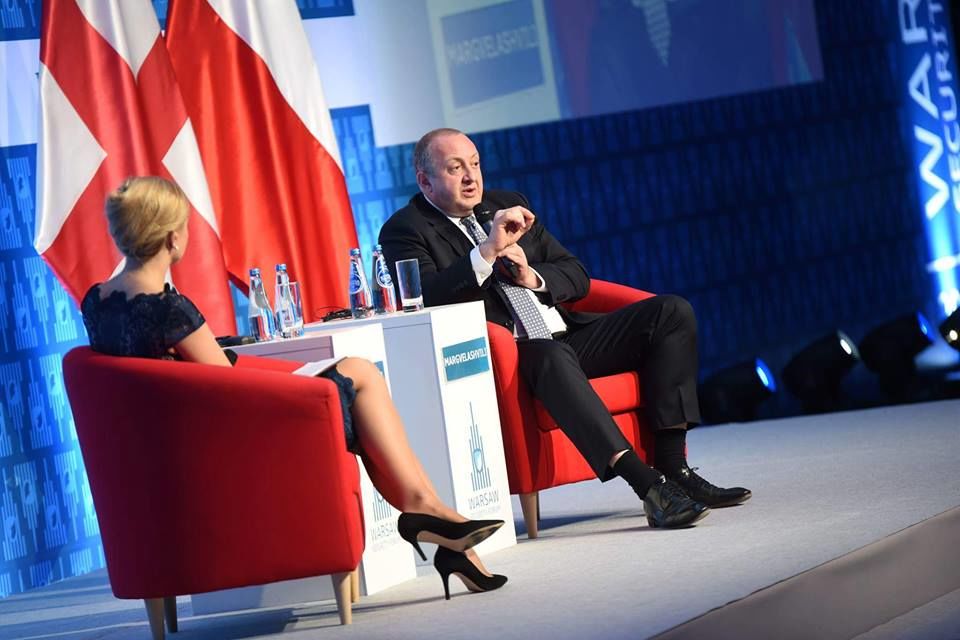
The discussions on the Forum reflected not only the ongoing political situation around the globe, with special regard to Europe’s defence and stability, but focused on the different aspects of security in the cyber world and the flow of information. This high profile event, where the Antall József Knowledge Centre was one of the institutional partners, set the stage for a multilateral dialogue between politicians, stakeholders, representatives of NGOs, various think tanks and the media. Georgia was an official guest country this year with President Giorgi Margvelashvili as a special guest, who took part in a conversation at the second day of the conference, and expressed his country’s strong commitment to joining NATO and the European Union.
Giorgi Margvelashvili, President of Georgia
Source: Warsaw Security Forum Facebook
In the ongoing technical revolution and the development of different threats, both on the ground and in the air, or in the cyber world, cooperation is of key importance. Regarding Brexit and the significance of the ongoing defence cooperation, Angus Lapsley, Director for Defence at the Foreign and Commonwealth Office UK, said, “We are leaving the EU, not Europe […] We have to invest more in key bilateral relationship in Europe [regarding defence]. We will try to maintain a defence cooperation with the EU itself.” Although Europe’s security and NATO’s activities were the focus of the Forum, there were also panels discussing different aspects of terrorist threats that affect various countries around the globe. As EU Counter-Terrorism Coordinator Gilles de Kerchove said during the Security Track breakout session, “It’s not that we are not collecting the right data but it is how to analyse it correctly from the tsunami of data that we have.” The power of media and the spread of false news should also not be underestimated, as one panellist of the “Politics in the Post-Truth Era: Tackling Disinformation and Fake News in Central and Eastern Europe” pointed out. The manipulation of news influences all societies, mainly the ones lacking democracy, but we should not forget about the sometimes ungrateful situation of journalists either, especially regarding (auto)censorship and the pressure to stay independent and lucrative at the same time.
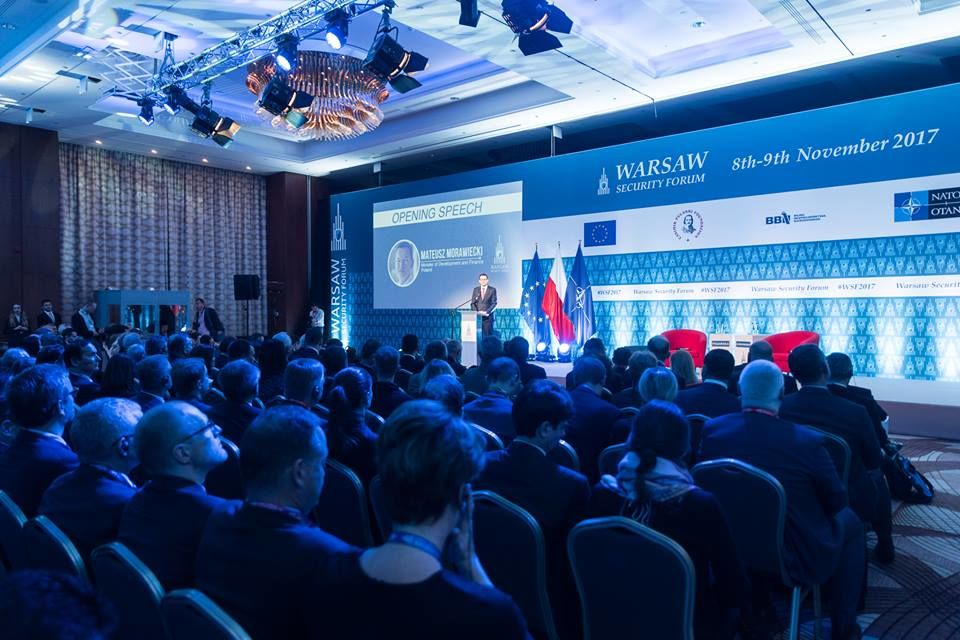
The opening speech of Mateusz Morawiecki, Deputy Prime Minister of Poland
Source: Warsaw Security Forum Facebook
New Security Leaders, New Opinion-Shakers
In order to cover various topics and provide more substantial forms of dialogue, different type of events are held at the Warsaw Security Forum. There are panel discussions, breakout sessions, roundtable discussions and working sessions, many of them held concurrently. New Security Leaders (NSL) is a program that takes place before and during the main events of the Forum. The goal of this transatlantic leadership development program is to discuss the various global security challenges in a small group of approximately twenty participants from more than ten countries. During the intensive workshops and dialogue, the young experts from different fields of security had the opportunity not only to take part in interactive discussions and leadership talks with representatives such as Linas Linkevičius, Minister of Foreign Affairs of Lithuania, and Robert Pszczel, Senior Officer from NATO’s Public Diplomacy Division, but also to participate in a cyber warfare simulation game developed and coordinated by Dr Haim Assa, Head of SIMLAB at Tel-Aviv University.
An important part of both the Forum and the NSL program was tackling the gender issue and emphasising the role of female decision makers in the world politics. One of the NSL focus sessions led by Brooke Stedman, Deputy Director of Women in International Security, discussed the question of security through a gender lens. Today, women and men have the same right to participate in the decision-making processes – unfortunately, it is still a theory rather than a reality. For example, asked Brooke, “How many women participated in signing the Treaty of Rome, the Dayton Agreement and many other important documents of our time”? As Frances G. Burwell from the Women in International Security Atlantic Council pointed out, “50% of the population is something that can be included, and certainly not something that can be ignored.”
The overall impression from the Warsaw Security Forum is that security is a complex, multi-layered question, involving many players – in fact, involving all of us – in an ongoing process of establishing peace and stability. There is no ultimate answer and we may not always be of the same mind and agree on every question, but we can definitely agree on this one: security is a “hot” topic that needs to be discussed any time, everywhere, and with everybody. As Mateusz Morawiecki, Deputy Prime Minister of Poland, pointed out in his opening speech, “Security is priceless. We know that from history.”
Photo credit for the preview image: Warsaw Security Forum