The most blatant difference between the Eastern and Western part of Europe does not lie with the standard of living but with the inequalities regarding minority rights. If one looks a little further into the question, this new European cleavage is even more clearly visible if we consider people’s openness to the topic. However, it seems that this dissonance matters only to those who live within these minority communities, Europe and the rest of the world only pays attention when there is an open outbreak of ethnic conflicts. Nowadays, it seems, every other minority group gains more space in the public debate than the gradually crumbling autochthonous groups and languages.
Ethnic tensions following the fall of communism in Eastern Europe and the Yugoslav wars forced Europe to take action. While in Western Europe the minority-majority relations seemed to have been (more or less decently) settled since decades, Europe had to realize that this was far from being true in the Eastern part of the continent and the European peace maintained after the Second World War is endangered by ethnic tensions.
In the nineties, the still most important legal instruments for the protection of minorities were born: the Framework Convention for the Protection of National Minorities and the European Charter for Regional or Minority Languages. However, after twenty years, one can state that the European Council’s instruments for the protection of minority rights have never reached their original goals, and that there are still European citizens and members of minority communities who neither as individuals nor as a group can exercise their rights described by the Framework Convention and the Charter. For this reason, my organization, named the Federal Union of European Nationalities (FUEN) takes every opportunity to articulate constructive criticism and proposals to contribute to the improvement of these two very important documents. Without doubt, there is a great deal of work ahead for a more systematic monitoring and to create a more efficient sanction system. Furthermore, we should create an index concerning the rights of the minorities of European member states by using scientific methods.
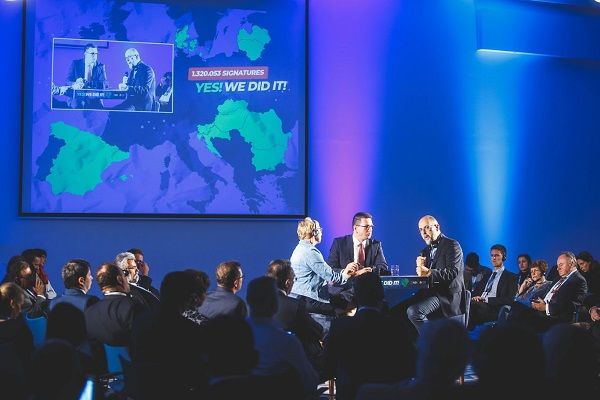
Loránt Vincze discusses minority issues with Hunor Kelemen, leader of RMDSZ at the 2018 FUEN Congress
Source: FUEN
There are still states that have not ratified these two instruments for the protection of minority rights – and amongst the many who did, there are still several that do not meet the standards. For example Romania – one of the firsts to ratify the documents – did not only postpone the submission of the country report regarding the results of the implementation of the European Charter for years, but recently also disapproved the Advisory Board, saying that the criticisms against the country were not justified. It represents a lack of dialogue, a lack of cooperation. and an absence of goodwill, when a state claims that the situation of the minorities living within its borders is well-settled, while the representatives of the given minority say the opposite. Additionally, such a situation challenges the effectiveness of the two legal instruments as well.
The European Union considered the interests of its old member states as a priority when it came to dealing with minority rights. While the EU did not wish to incorporate new sources of conflict with the accession of new member states, it rejected the idea of an internal regulation and the creation of a legal framework as well, as those would have negatively affected France and Greece – two countries that do not recognize national minorities. This way, while minority rights are included in the Copenhagen criteria for the accession countries, there are no legal obligations following the accession. Thus, minority rights have stayed within the national competences of the member states of the European Union, the motto of which, ‘Unity in Diversity’ is therefore not more than a meaningless slogan.
Hungarians living in Transylvania and in Southern Slovakia felt betrayed following the enlargement: the incredible happened and instead of an improvement of the situation of minorities following their accession to the European Union, a period of backlash, of chipping away rights and a time of seemingly useful but never implemented laws started. As a Transylvanian Hungarian, I have personally experienced the negative side of leaving minority issues in the hands of member states. Today, minority schemes vary widely and may be very different in two neighbouring countries. In the Carpathian Basin, for example, Serbia, Slovenia, Hungary and Croatia have created cultural autonomy schemes for the minorities living in their territories – with which they are satisfied. At the same time, a large number of Transylvanian, South Slovakian and Transcarpathian Hungarians fight hopelessly against the authorities, as the majority and the political elites are not willing to consider either autonomy or independent minority-language school systems.
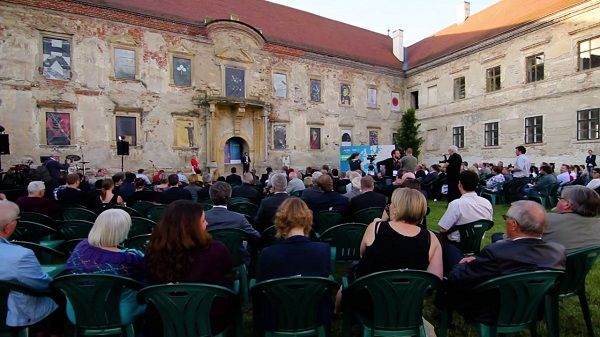
The opening event of the signature collection campaign for the Minority SafePack in Bonchida, Transylvania
Source: FUEN
FUEN intends to change this. The European umbrella organization for minorities, established in 1949, today comprises of more than a hundred organizations. In 2013, for the initiative of RMDSZ (Democratic Alliance of Hungarians in Romania), FUEN submitted the Minority SafePack European civil initiative, the main purpose of which is to seek European protection and assistance for autochthonous national minorities and language groups. Perhaps it is not necessary to evoke the long and difficult journey of the initiative as it received an extensive coverage in the Hungarian press. The essence is that the initiatives named National Minority Protection Initiative in Hungary and European Protection for our Rights! in Transylvania and South Slovakia managed to gain the one million signatures necessary for the civil initiative, while the program developed into a European-level minority-rights movement headed by Hungarian organizations – while numerous communities from Denmark, Italy, Poland, Bulgaria, Spain and the Baltic states also joined to it. In the meantime, Hungary was the only EU member state where the majority stood by the case undoubtedly and united, and not only through political declarations and gestures. The Hungarian society has proven its solidarity towards the Hungarian community across the borders and its appreciation of other nationalities living within the Hungarian borders.
Nevertheless, the successful collection of signatures is only a partial victory, and the difficult part is yet to come. The main task is to convince the European Commission not to sweep the initiative under the carpet, but actually genuinely deal with the question, and to start a legislative process for the creation of a framework which will serve the protection of minority rights. For this reason, FUEN advocates for a European-level pact between the majority and minority groups since the minority will always need the support of the majority in order to succeed in its quest.
In its appeal, FUEN asks those belonging to national majorities to become partners in preserving autochthonous European traditions and languages and in overcoming the processes of assimilation. The goal is to enable communities to preserve and freely experience their identities, to make them feel like home in their homeland, to allow their meaningful participation in decisions affecting their lives, and to let them freely exercise their rights to culture, education and language.
In the coming months, the protection of minorities has to be developed into an unavoidable topic of the next European Parliamentary elections, a topic that will be supported by more and more members of the new European Parliament and the European Commission.
The author of this post is a politician, serving as the President of the Federal Union of European Nationalities (FUEN), Secretary of External Relations of the Democratic Alliance of Hungarians in Romania (RMDSZ), and the AJKC’s Advisor on minority policy.