The drone industry is still in its infancy, but it seems that talking about these miniature pilotless aircrafts is extremely timely. We barely talk about their potential humanitarian use, even though these mini flying robots are able to contribute to the building and maintenance of security - not only within the military. As a matter of fact, the number and intensity of natural disasters in Africa are continuously growing, increasing the vulnerability of people. For this reason, it is perhaps not a coincidence that some African countries have the biggest functioning humanitarian drone fleet in the world.
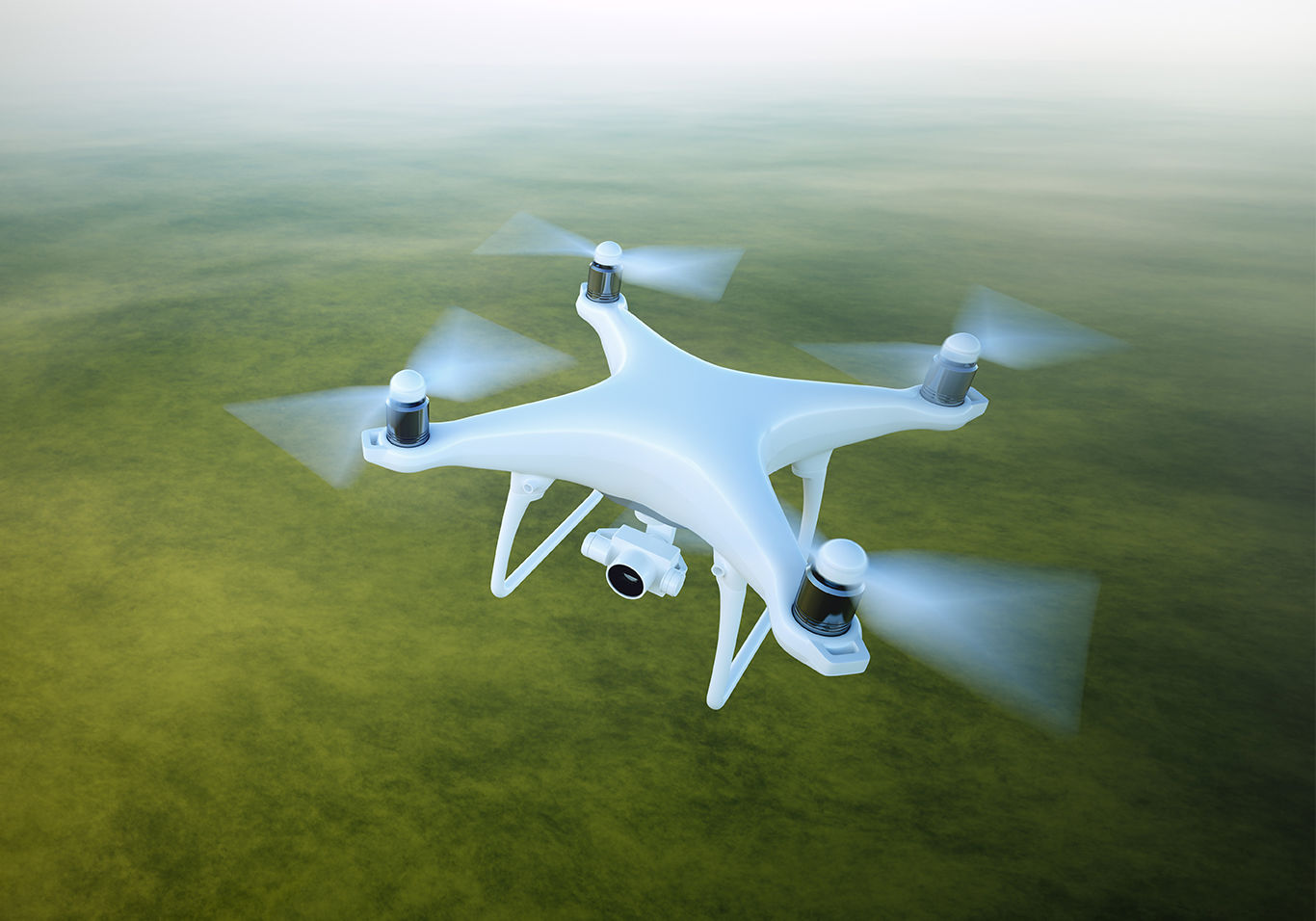
Flying drone
Source: Shutterstock
The drone industry is still in its infancy, but it seems that talking about these miniature pilotless aircrafts is extremely timely, because they seem to be joining a mega-trend thanks to their diverse business potential. Since they have not appeared on the commercial markets yet, we are not used to the presence of the mini flying plane-like objects. We might even feel uncomfortable when we notice them circling in the air. Sometimes we watch them suspiciously and wonder about their actual intentions. We have the feeling that we are being watched. Primarily, drones are used by the military. Hence, our initial uncomfortable feeling might not be completely wrong.
Unmanned Aerial Vehicles (UAVs) have great characteristic features for further future innovation, because they are able to adopt to the needs of different industries. We barely talk about their potential humanitarian use, even though these mini flying robots are able to contribute to the building and maintenance of security - not only within the military. One of the greatest advantages of these little unmanned aircrafts that they are able to reach remote places even in rough weather conditions within a reasonable time. Thus increasing the efficiency of humanitarian workers without threatening their lives.
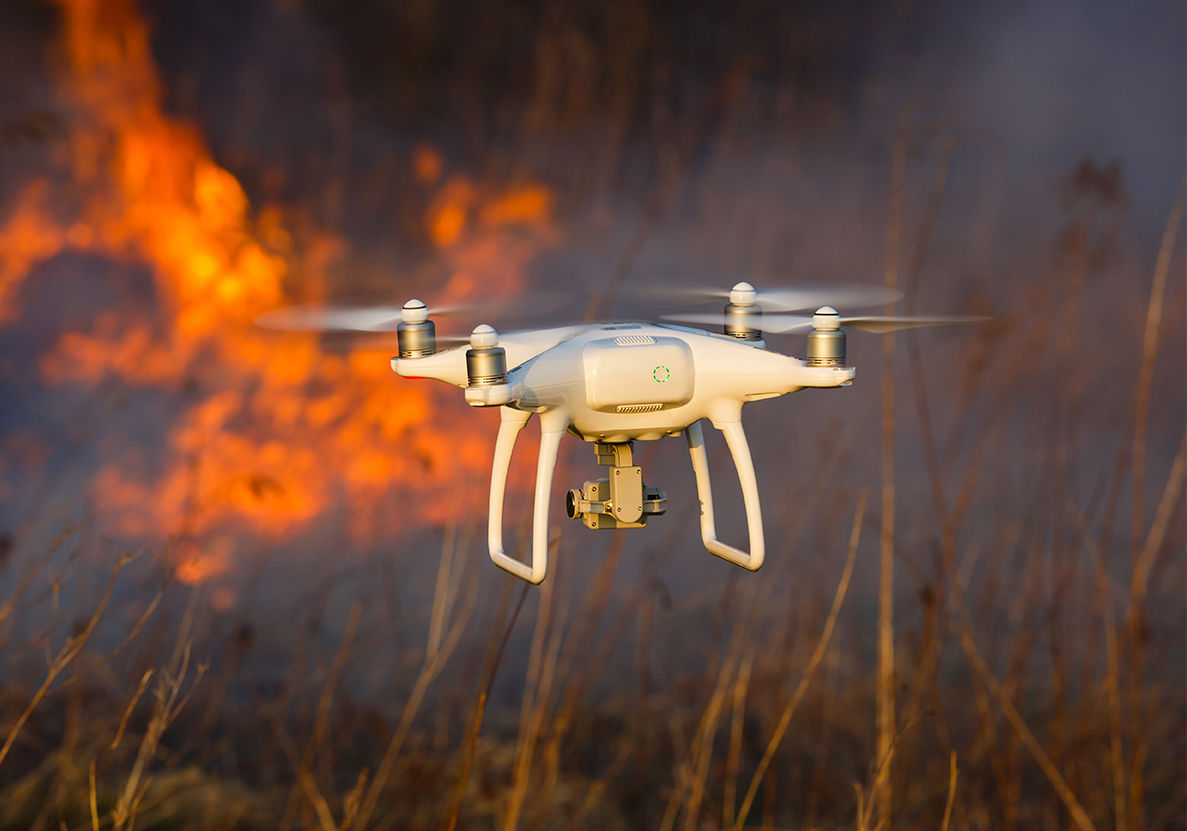
Thanks to their diverse characteristic features, drones can be deployed in case of natural disasters. They can be used to deliver small weight packages, such as medicines and blood. They can take part in search and rescue processes, reconnaissance missions, and situation monitoring. They are able to extend Wi-Fi and mobile phone signals. Thermal sensor drones can provide information for search and rescue operations. They are able to track storms, and forecast tornadoes which could help government and humanitarian organizations to prepare the affected regions and communities accordingly.
Drone collecting information about forest fire
Source: Shutterstock
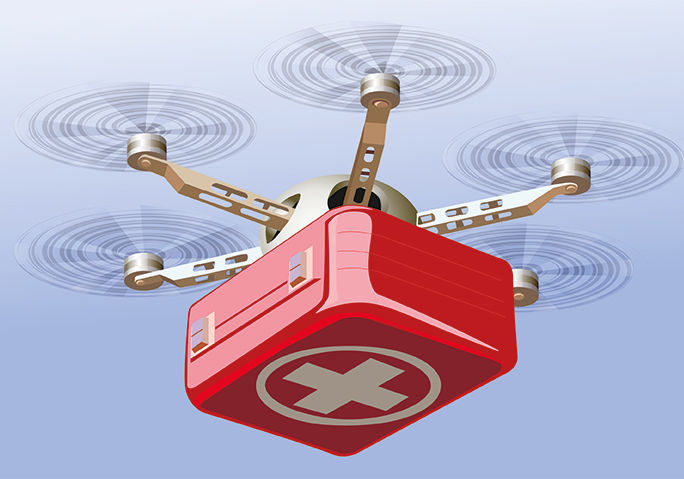
Since UAVs are commanded by a remote control or by other technology (like a smartphone application), they require limited manpower so the time and energy can be used for resource mobilisation in case of a disaster. When drones reach the hospital they will go down to a low altitude and drop their package with the help of a paper parachute without landing. Since their batteries require recharge they need to go back to the home base where their maintenance will be processed. After they will be sent to a new mission.
Natural disasters are special in the sense that an instant information need arises. Without the correct information the safety and security of the affected community is seriously threatened. Timely supply of the needed resources can save life. UAVs can provide accurate information about the affected regions and population by the cameras installed on them. Geographic mapping could be facilitated by the use of these pilotless flying aircrafts installed with cameras. This facilitates geographic mapping and the work efficiency of the humanitarian professionals can be multiplied by the delivery of the generated maps to the relevant organizations. As a matter of fact, the number and intensity of natural disasters in Africa are continuously growing, increasing the vulnerability of people and making the lifesaving procedures more difficult. For this reason, it is perhaps not a coincidence that some African countries have the biggest functioning humanitarian drone fleet in the world.
On the African continent Malawi provides one of the best examples for innovative humanitarian drone usage. Malawi is a pioneer in Africa and one of the first countries in the world – in partnership with UNICEF and a Silicon Valley start-up - who established an air corridor for UAVs with potential humanitarian and development purpose. The need for these types of drones was born because Malawi had recently faced several serious natural disasters. They were not able to fight against these disasters with the traditional methods, so they invested in innovation. In Malawi the drones are specialised on emergency medical supply delivery which can be anything from vaccines and samples for laboratory diagnosis, including for HIV testing. However, sometimes they are sent for reconnaissance missions during drought, floods, and earthquakes. Some parts of the country are hard to access by trucks or motorcycles – in addition it would risk the life of the humanitarian worker trying to reach the disaster affected area. Drones are also a link to connect remote rural communities to more developed resourceful regions.
Another African country, Rwanda is also a leader in non-military drone usage. It was the first country in the world that lunched drone delivery network. This may be surprising considering the economic and financial situation of Rwanda, since they are not among the most powerful nations of the world. However, more than two decades after the genocide, today it boasts one of the fastest growing economies in Central Africa. The government led by president Paul Kagame embraced development and with the cooperation of an American start-up company the commercial investment in the drone delivery network came into existence. The president is investing in new industries, as well as in human human capital and aims to build a knowledge-based, service oriented economy. The strict aerial rules and conflicting regulations did not keep the country from the establishment of the air corridor. Drones have already started the operation with medical supplies and they keep widening their scope for economic development. The establishment of this system was not a time-consuming process according to the relevant bodies. It is particularly interesting if we take into account the situation in the United States where big companies such as Google and Amazon are still just promising the introduction of drone package delivery.
Drone delivering First Aid Box
Source: Shutterstock
Tanzania is also worth mentioning among the most innovative African countries because it has also joined the new wave of the development. Tanzanians started their drone operation to deliver blood and vaccines to remote areas. In 2018, they plan to establish the world’s largest medical delivery system with 4 bases and 120 drones serving 1000 clinics across the country.
Other African countries also wanted to take part in the explosively growing drone trend. Kenya for example planned to establish an air corridor for delivery services similar to the one in Malawi. However, it was not successful because the authority considered it to be a threat to security. Why? Because there is undoubtedly a blurred line between military and humanitarian drones and it is easy to confuse them. Biggest difference between the two is that humanitarian UAVs are not armed, but even the smallest flying mini robots can be weaponized. So how can the civilian population distinguish armed from unarmed drones from a great distance? It does not help either that sometimes military drones are being repurposed for humanitarian missions so we cannot even say that their appearance is always different. This can cause a considerable problem in their interpretation.
There are some recommendations from the United Nations to use UAVs only in case of natural disasters but the governmental and international negotiations about drones are slow and long lasting and conclusions differ from country to country. Perhaps it is still hard to imagine that during/after a natural disaster “reconnaissance” drones are flying around trying to collect information while professionals are sitting in the office, analysing the received data, and preparing the “supply” drones to deliver the required resources. Maybe it is just the matter of time and necessary regulation until the commercial and humanitarian drones can appear in the sky and we will not have that suspicious look on them.
Opening pic source: Shutterstock