Kategória: Research Blog
Forrás: https://digitalistudastar.ajtk.hu/en/research-blog/italy-in-the-time-of-coronavirus
Italy in the Time of Coronavirus
Andrá tutto bene?
Szerző: Alessandro D'Onofrio,
Megjelenés: 04/2020
Reading time: 10 minutes
As of 2 April, the number of infected people in Italy reached 115,242 cases, while the dead toll rose to 13,915, the highest in the world. Given the totally new nature of this virus and the fact that its spread is still ongoing, scientists have not yet been able to agree on an explanation for the incredible mortality rate in the country. Some of them argue that Italy’s relatively old population might have had a role in the high number of fatalities. However, the extreme containment measures have even thus far had a catastrophic effect on Italy’s already weak economy, and the prospect of a deep recession is looming. Still, the Italian political leadership seems to end up reinforced by the emergency, as, thanks to its wise management of the crisis, it is enjoying an unusually high support among the population.
Since the first case was detected in Italy at the end of January, the coronavirus has been spreading at an incredible speed in the country. As of 2 April, the number of infected people in the Mediterranean country reached 115,242 cases with the highest concentration of them in the region of Lombardy, where the recorded cases approached nearly 46,100. What makes the strongest impression is the exceptionally high number of victims: the total numbers exceed 13,915 dead—7,960 only in Lombardy, which is 57.2% of the total number—surpassing even China where the death toll seems to have stopped at about 3,300. Given the totally new nature of this virus and the fact that its spread is still ongoing, scientists have not yet been able to agree on an explanation for the incredible mortality rate in Italy, and for the prevalence of the virus —originated from China—throughout the country, partly because they still have not identified the so-called “patient zero.” As for the current theories about why the disease is proving far deadlier for Italians, the most obvious seems to be that older people in Italy account for a greater share of the population. As a matter of fact, Italy has the world’s second-oldest population, and almost one Italian out of four is older than 65. According to the World Health Organisation (WHO), the new COVID-19 diffusion among the elderly is much higher than among younger generations—in Italy 72.6% of the reported cases are over 50 and the average age of those dying is 78—it is easy to assume that age distribution is playing a crucial role in sustaining the high fatality rate.
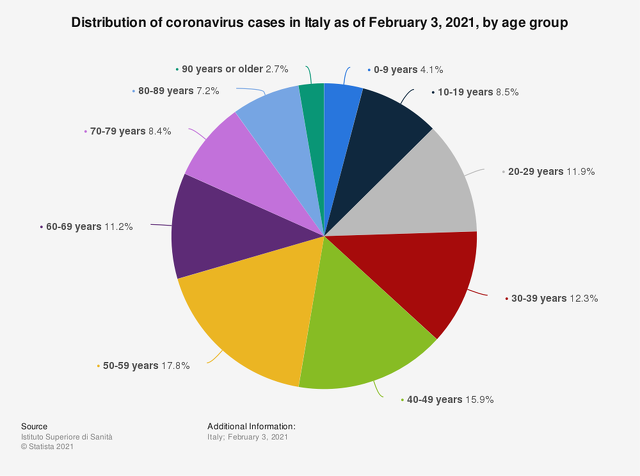
CORONAVIRUS CASES DISTRIBUTION IN ITALY BY AGE GROUP
Source: STATISTA 2020
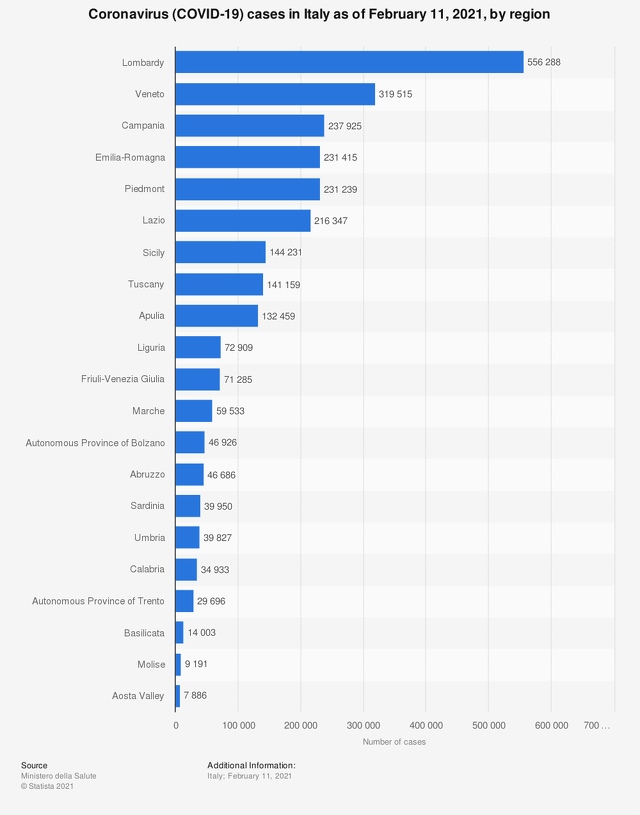
AND WHAT ABOUT ITALY’S FRAGILE ECONOMY?
Since the beginning of March, the world's eighth biggest economy and its 60.5 million citizens are under lockdown. The extreme containment measures have already had a catastrophic effect on Italy's economy overall, with a large part of its industries expecting a huge loss in profits for this quarter. The Italian government anticipates the pandemic to have extremely negative effects on the whole economy, which is likely to push the economy into a recession in the next quarters. Already at the beginning of March, the Organization for Economic Cooperation and Development (OECD) revised Italy's growth forecast for 2020 down to zero, and few days later the European team of Goldman Sachs estimated that the short-term impact of COVID-19 on the Italian GDP will be tougher than on any other Eurozone country with its GDP dropping 3.4 this year. The reason behind this economic slowdown is also connected to the fact that the pandemic is affecting mostly those regions which are the driving force behind the weak Italian economy. In fact, the three most virus-hit regions − Lombardy, Emilia Romagna and Veneto—are responsible for more than 40% of the national GDP. Nonetheless, the impact of the coronavirus on the Italian economy might vary according to sectors. For instance, the gross domestic product of food, health, and media industries is expected to increase. Conversely, the sectors of textile, transport, entertainment, sporting events and especially tourism are estimated to record the highest drop. If the estimates are true, Italy may need to seek a bailout from the European Union and even the IMF, with the lessons learned in the case of Greece.
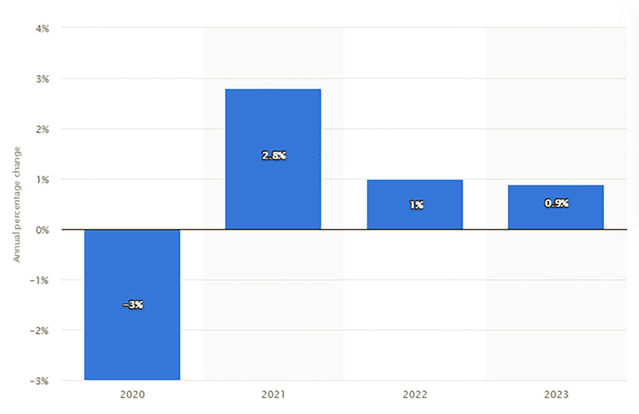
Estimated annual percentage change in GDP in Italy 2020-2023
Source: Statista 2020
In the last couple of weeks, Prime Minister Giuseppe Conte and Minister of Economy Roberto Gualtieri reiterated the need for the EU to utilize, without hesitation, the €500 billion from the European Stability Mechanism (ESM), to confront Europe's economic crisis. Italy, supported by many other European countries mostly in the Mediterranean area, still hopes to convince the EU economy ministers—meeting again next week—to agree on new credit lines from the Eurozone’s bailout fund or to create special EU “corona bonds” to face the coronavirus crisis. However, an agreement seems to be a very unlikely outcome given the shameful reluctance of the Nordic countries, led by Germany, in sharing the debts in this emergency situation. Maurizio Massari, Italy's ambassador to the EU, said that “Only China responded bilaterally. Certainly, this is not a good sign of European solidarity.” At the moment, Italy really needs all the support it can get from its allies as the failure of its economy, which has never really recovered from the 2015 European debt crisis, so it might even trigger a negative spiral for the stability of the whole of Eurozone.
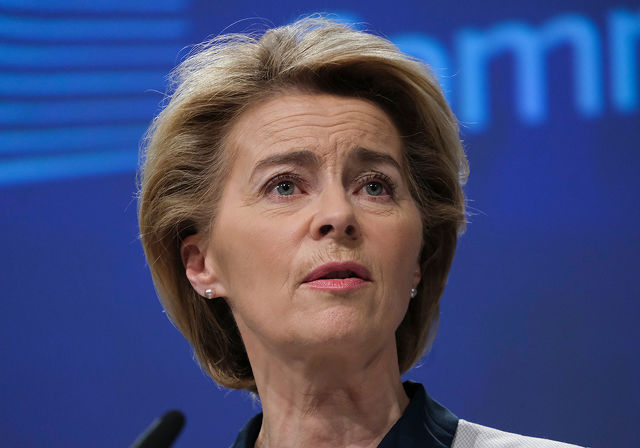
European Commission President Ursula von der Leyen
Source: Alexandros Michailidis/Shutterstock 2020
Whatever the result of the next Council will be, it is exactly in situations like this that the unsustainability of the Italian public debt becomes evident. Currently Italy’s debt stands at 133 % of the GDP and in case of a global financial crisis the country might be forced to declare default. Despite all the pledges coming from the EU institutions, the Italian government asked for as much flexibility it can get. At the same time, PM Conte promised to allocate €25 billion to ease the burden of the pandemic, that includes helping companies and households with mortgage payments, and people facing unemployment. However, the size of this measure is really disheartening if compared to the almost unlimited credit that Germany and other less indebted countries pledged for businesses and citizens, without upsetting the international markets. The first attempt to reach out to Italy has been made by the European Commission which promised to release €7.5 billion of available EU structural funds, which could soon reach €25 billion. On Saturday, European Commission President Ursula von der Leyen announced in an awkward attempt to appease the distress of the Italian government, that she will put the EU’s 2021-2027 budget “at the heart of our efforts” to fight the coronavirus crisis, declaring also that several measures will be discussed in the following days. Support also came from the European Parliament, which approved amendments to existing regulations that would allow the implementation of the European Commission's proposed €37 billion Coronavirus Response Investment Initiative. At the same time, in a bid to make a quick fix of the pandemic-induced Eurozone’s financial difficulties, the European Central Bank launched a €750 billion bond-buying programme. Nevertheless, the flexibility that the EU announced to be ready to grant to Italy will bring the deficit-to-GDP ratio to 2.5% for this year, not far from the limit imposed by EU rules. This will have large repercussion on the GDP-to-national debt ratio that will grow even more in the next months. And if the Italian financial system fails, the debt defaults from Italy will fall through the global financial system, causing damages that will be hard to contain.
HOW IS THE CORONAVIRUS OUTBREAK AFFECTING THE SHAKY ITALIAN COALITION GOVERNMENT?
As the virus is spreading in Italy, people seem to have found a sense of national unity which often being amiss in the Mediterranean country. The emergency situation broke down the traditional barriers dividing North and South, and has gathered Italians together in the fight against the virus. In fact, even if Italians are traditionally less compliant in following the rules, they are now revealing that in a crisis situation, togetherness and solidarity can triumph over panic. At the same time, the government’s approach to the crisis, despite being modelled on the Chinese one, and despite being adopted after an initial misstep, has been praised—and implemented—by many other governments around the world mostly because Italy has been able to show how successful a non-authoritarian country could be when action needs to be taken. Also, conscious of the criticisms of China’s lack of transparency, the Italian government is showing a high degree of openness about its decision-making. The executives have been providing daily extensive information about the spread of the virus at regional and provincial levels in order to educate and inform people of the critical nature of the emergency. The crisis’ most unexpected star has been Prime Minister Giuseppe Conte, a law professor whose political survival before the pandemic was very unlikely, given the shaky foundations of the coalition government. The Italian prime minister’s calm crisis management and courageous conduct found the favour of Italians so far, backing their leader by a large majority. Conte instilled a mood of national solidarity with reassuring television addresses, promising that the state will take care of the least fortunate people and urging them to accept temporary sacrifices of their freedom of movement. Conte also insisted that the Italian government will prioritise its citizens’ health over the budget, spending whatever it has to, in order to limit the emerging pandemic.
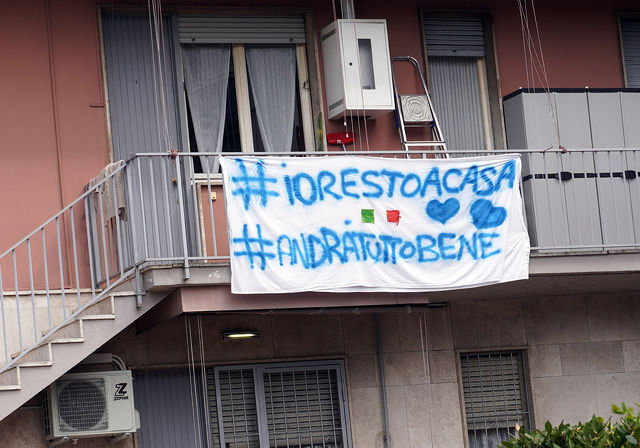
Io Resto a Casa. Andrá tutto bene! – I stay at home. Everything will be fine!
Source: Delbo Andrea/Shutterstock 2020
President Sergio Mattarella, who represents the unity of the country and who normally steers clear of controversy, has intervened the government, as well as the European Central Bank and European Commission for their response to the crisis. However, Mattarella warned that this is the moment of political unity, referring to the attitude of the opposition parties which are still carrying out insensate political attacks on the authorities. In fact, in the last weeks, the Northern League’s leader Matteo Salvini, who was on the brink of bringing down the government before the crisis, is going through a hard time. His bombastic anti-immigrant rhetoric lost all of its effectiveness given that now the country is going through . Salvini jumped at the opportunity to politicize the emergency and at first, he made an attempt to blame immigrants from both China and Africa for the outbreak, suggesting that the ruling coalition’s immigration policy has played a role in the spread of the virus, just to change the target a few days later, accusing the government of mismanagement while bringing conspiracy theories as proofs to show the origin of the virus. However, the latest polls show that the League is suffering a decline in support due to the COVID-19 emergency and lost almost all its advantage vis-à-vis the leftist Democratic Party. As last resort Salvini, after blaming Conte and the government for its crisis management and threatening to vote against the economic measures in parliament, is now trying to promote the idea of forming a government of “national unity,” suggesting former European Central Bank president Mario Draghi as a potential prime minister—a rather acrobatic twist for a politician who has built up his figure blaming Eurocrats and bankers for every problem of Italy.