Kategória: Research Blog
Forrás: https://digitalistudastar.ajtk.hu/en/research-blog/is-it-worth-paying-a-high-price-for-the-blues-sky
Is it worth paying a high price for the blues sky?
China's new Action Plan for tackling air pollution
Szerző: Orsolya Talárovich,
Megjelenés: 03/2019
Reading time: 8 minutes
27 June 2018. The State Council or the Government of the People’s Republic of China published the new, 2020 Action Plan for tackling air pollution, and in January this year, there were many articles in the Chinese press about the sky getting bluer in the huge Asian country. But did the Chinese really succeed in reducing emissions of carbon dioxide, sulfur dioxide, and fine particulate matter in such a spectacular way within half a year, making a step forward in creating an “ecological civilization,” as announced by President Xi Jinping? The plan is promising, but it is already obvious that the anticipated three years will not be enough to achieve lasting results.
The concentration of PM₂.₅ fine particles (i.e. fine particulate matter less than 2.5 microns) in China’s air is very high, causing various respiratory illnesses, such as asthma and lung cancer.
The People’s Republic of China (PRC) has become an indispensable factor in the world economy and the world trade over the past decade. After obtaining regional dominance, its global power position has also become indisputable by today. Although the government introduced restrictions in the past few years to reduce its large credit—which also led to a drop in GDP growth rates—the growth of China’s annual GDP is still remarkable. Many European countries, for example, can only reach a fraction of this growth. However, there is a dark side to this significant economic development, as China has also become the main cause of global environmental problems. So, besides Chinese citizens who suffer from health problems, actors in the international arena have also voiced their demand for change. China tries to take advantage of the situation: according to recent events, it seems to take over the role of the US in this regard, as previously the US played a prominent role in creating multilateral conventions to mitigate environmental problems. There is a good reason for hope because the central government takes on responsibility, and President Xi Jinping’s goal is no less than to create the world’s first “ecological civilization” (shengtai wenming, 生态文明) in the country.
The first political manifestation of this concept made its debut at the 17th Congress of the Chinese Communist Party in 2007; however, a unified definition of its exact meaning has not yet been created. In fact, this is a comprehensive reform programme that focuses on the effective development of environmental protection. The primary—or officially propagated—goal of the fifth generation of Chinese leaders is to create a healthier and more liveable environment for Chinese citizens, which is, of course, an important legitimizing factor for the Chinese Communist Party as well.
The idea is great, but during the first years of the implementation of the reforms, there were a number of problems, since China—as a developing country—still struggles with technological innovation and structural adjustment in some areas, more precisely, with how to maintain economic prosperity while pushing the country towards higher value-added production and making industrial sectors more diversified. This is one of the essential points to understand the greatest concern for Chinese leaders about this issue. The reduction of environmental problems is to be achieved in a way that does not negatively affect economic growth, and if the goals set by their agenda are to be sustained over a long term, it will be unavoidable to transform their industry, which, in a short term, will significantly reduce economic growth and may reduce foreign direct investment flows as well. Conversely, if it is not transformed, it can hinder development in both primary and secondary ways. Primarily, it is due to the country’s raw-material-intensive economy that runs out of raw materials and needs to draw on imports. This is already a sensitive point, as the lack of raw materials is one of the biggest economic weaknesses of the country, and reducing dependence is also a national security issue. Secondarily, it can also impede development because if industrial transformation does not take place, services related to urban development, tourism, or hospitality cannot be further developed.
Among environmental problems, air pollution has been at the top of the agenda since the beginning of the reforms. On the one hand, because it is possible to achieve spectacular results quickly in this field, on the other hand, because Chinese citizens blame air pollution for the most serious health damages they suffer from. Air quality has really reached a critical level recently, largely due to the extensive use of fossil fuels, urbanization, intensive industrial production, and the lifestyle of a middle class seeing a sudden widening over the past decade. Only temporary solutions have been used so far, either because the method (for example, the transformed traffic control) was bad, or because the solutions reduced the rate of the economic development (for example, due to the operational regulations in some factories), contradicting the government’s interests.
National environmental planning within the Five-Year Plans’ (FYP) framework (wu nian jihua, 五年计划) started from scratch and dominates environmental governance in China even today. In addition, specified environmental action plans for a particular time interval also play an important role in the environmental policy of the PRC. Similarly to the FYPs, they are built on quantitative bases, and some targets also coincide. By implementing the previous action plan (Action Plan for Air Pollution Prevention and Control), the capital’s PM₂.₅ levels could be reduced from 89.5 to 60 µg/m³ (micrograms per cubic metre). It was achieved by closing coal-fired power stations and banning people in the surrounding areas to burn coal for heating in winter. These measures were costly and drastic, but even so, no Chinese city managed to reach the annual average of 10µg/m³ for PM₂.₅ recommended by the World Health Organization.

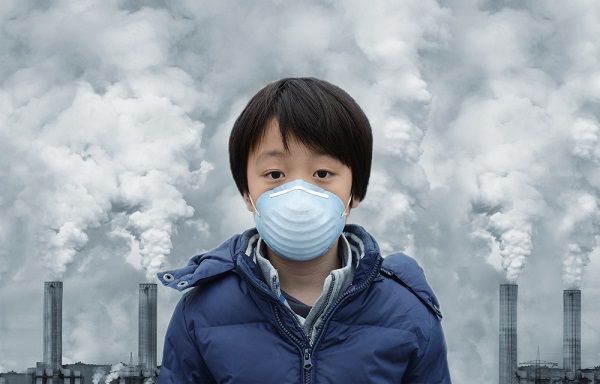
As a result of the severe air pollution, face masks have become part of the everyday outfit of the Chinese citizens.
Source: Shutterstock
The new three-year action plan is seen by many as the second phase of the original air pollution action plan issued in 2013. This also sets specific targets for reducing sulphur dioxide and nitrogen oxide emissions by 2020. Accordingly, the quantity of both compounds should be reduced by at least 15% compared to the 2015 reference year. The annual numbers of days with fairly good air quality is to be increased to at least 80%, and highly polluted days are targeted to be decreased by at least 25% compared with 2015. In comparison to the previous action plan, one of the major changes is that the Pearl River Delta is no longer considered a key area, and instead, the Fen-Wei plain is the new priority, while the other is that this plan puts more emphasis on controlling ozone. The latter is a key point, as the rapid reduction of PM₂.₅ altered the chemical composition of the atmosphere dramatically, leaving more radicals available to produce ozone. Ozone is one of the main components of photochemical smog, which generated in the near-surface air layer when volatile organic compounds react with nitrogen oxides under intense sunlight. Chinese leaders want to reduce volatile organic compounds by 10% by 2020, compared to the reference year.
Small wonder that Beijing’s leadership continues to be confident about the success of the new draft; however, the practice has shown during recent years that there are many challenges to implementing the reforms. Chinese also try to overcome these by using innovative solutions across the country and adapting them to specific locations. An example is the approximately 100-metre-high air-cleaning tower in Xian, which is unique in its size. There is a high level of industrial production in the city, so the air quality often reached critical levels, especially in winter. Although the exact cost of the project has not been disclosed, the basic goal was to find an effective but affordable method to artificially remove pollutants from the atmosphere. Simplified, its principle of operation is the following: There is a large greenhouse at the bottom of the building that extracts the polluted air from outside. The air, saturated with harmful substances, is then heated by solar collectors, and then, warm air has to pass through a number of filters. Once filtered, clean air is discharged from the system.
The tower is still on a trial period, but according to one of the leading scientists in the project, the air quality has improved significantly since its installation. The results are analysed by researchers of the Institute of Earth Environment at the Chinese Academy of Sciences. Although the effectiveness of the tower has been analysed for only a few years, the results are encouraging, according to researchers. Since its operation started, Chinese sources have reported a significant improvement in the city’s approximately 10 km² area, but many Western experts have doubts about the true performance of the tower. Anyway, using either outdoor or indoor air purification equipment is not a new thing in China, and their sales have increased significantly over recent years. One of the main reasons for this is that the middle class has a higher standard of living, and more and more people can afford these luxury products today. Interestingly, the number of air purifiers sold in the country was only 3.52 million in 2015 but increased to 9.82 million by 2017.
However, beyond the positive examples, it is also important to mention that there are a number of groups that do not share the interest in effectively developing environmental protection. They put a lot of pressure on the leaders of the Chinese Communist Party, who already have many difficulties to present unified leadership because of the competing and opposing interests between the “fractions” and cliques within the party. Many people cannot even imagine how many people might lose out with the green transformation. As it was mentioned before, the rapidly growing middle class causes many problems, the most obvious of which is the high carbon dioxide emission from the growing number of vehicles with combustion engines, as this emission accounts for a significant part of air pollution. Thus, new trends in reducing pollution are emerging in this field. The government strictly regulates the type and the number of vehicles that will be launched onto the market. As a corollary, China, traditionally a huge market for car producers, will generate less and less profit for today’s manufacturers having diesel and gasoline models. However, not just the quality of the product, but production processes are also subject to much stricter rules now. China has been operating emission trading systems since 2013, but for the time being, they are only on a trial at a national level and may have a negative impact on productivity. Accordingly, the government predetermines annual quotas specifically allocated to the volume of emissions. In the event that annual actual output exceeds the established quantity, factories must buy the discrepancy, and, if it remains below, they can sell it to others at market price.
In summary, the attitude of the fifth generation leaders towards environmental protection is forward-looking, as they have recognized and acknowledged that China, as one of the world’s leading economic powers, has the task and duty to set an example with its measures to protect the ecosystem. China established the new Ministry of Ecology and Environment in 2018, which is a milestone in the green transformation.
Although in some areas partial results have been achieved, air quality is still very poor, and it is only one of the major environmental challenges. Besides air, water, and soil pollution, the country must increasingly fight against the damaging effects of desertification and mining. Indeed, with some regulations and compliance with the required quotas, it is possible to have a “blue sky” periodically, but as long as profit-maximizing individuals and economic organizations are not willing to use more environmentally friendly techniques and technologies, long-term and durable results cannot be expected in the near future.