Kategória: Research Blog
Forrás: https://digitalistudastar.ajtk.hu/en/research-blog/german-house-of-cards
German House of Cards
What is the price of the chancellery?
Szerző: Enikő Jancsek ,
Megjelenés: 02/2018
Reading time: 11 minutes
The German coalition negotiations temporarily have come to an end to the great relief of the voters, and the parties have reached an interesting agreement. Angela Merkel will stay on as chancellor, but the Christian Democratic Union lost key ministries. Despite its historic loss, the Social Democratic Party managed to come out victoriously from the coalition talks. Although it still needs to be accepted by the majority of the SPD party members, let’s see what the agreement between the three parties could mean on a personal level in German politics.
The world of politics is interesting—especially in today’s Germany. After the elections in Germany and the collapse of the potential Jamaica coalition among the Christian Democrats, Social Democrats, and the Greens, it seemed that the future holds nothing good for Angela Merkel, her Christian Democratic Union (Christlich Demokratische Union Deutschlands, CDU), and its Bavarian sister party, the Christian Social Union (Christlich-Soziale Union in Bayern e.V., CSU). But events took a peculiar turn, after Martin Schulz’s, former chancellor candidate and leader of the Social Democratic Party (Sozialdemokratische Partei Deutschlands, SPD), statement about the impossibility of a grand coalition lost its force. Namely, on 8 February, negotiations between the SPD and the CDU/CSU came to an end, which came as a great relief to the citizens. It seems that the uncertain period that defined Europe’s most powerful country—Germany—during the past few months is finally coming to an end. However, the coalition contract still needs to be accepted by the majority of SPD’s party members in order to come into force. Nevertheless, the agreement between the parties and particularly its part referring to the new division of cabinet positions seem to be more interesting than the contract itself, as it appears to tell more about how power relations have changed during the negotiation process.
A few important modifications that occurred are also important from a European point of view. For instance, former financial minister, Wolfgang Schäuble (2009–2017), who has been Bundestag speaker since October 2017, would not receive a position in the new cabinet. Instead, SPD mayor of Hamburg, Olaf Scholz, would inherit his post in charge of the Ministry of Finance. Horst Seehofer, the leader of the CSU, would receive the position of the Federal Minister of the Interior with enlarged competencies (the position is based on the so-called Bavarian “Home Minister”). Although, generally, politicians maintain the positions they are originally announced in, the distribution of posts is currently still very pliable; the best example is the fact that instead of Sigmar Gabriel, Martin Schulz would have become the Federal Minister for Foreign Affairs, but after facing huge pressure from his party, he withdrew from his candidacy. In addition, the Federal Ministry for Labour and Social Affairs would wind up with the SPD as well. Hence, the CDU lost some of the most important ministerial positions in the forming coalition. It is also interesting to see that after the negotiations, the Federal Ministry of Finance and the Federal Foreign Office will most probably be headed by members of the same party, which is quite unprecedented if we look at former coalition talks.
We can deduce two important facts from the information above: on the one hand, despite the SPD’s and the CSU’s historic loss on the elections, they managed to receive a great deal during the negotiations, whereas the CDU, which had won the elections, ended up receiving the bad part of the deal.
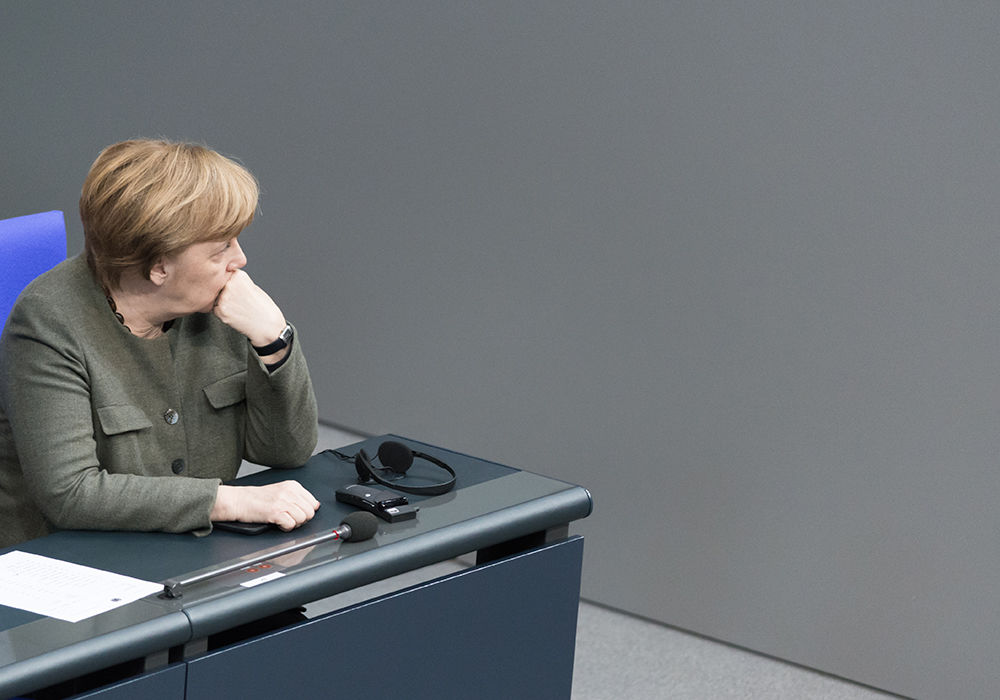
Angela Merkel in the Bundestag
Source: Shutterstock
In regard to CDU, it is important to state that, as long as the SPD accepts the results of the negotiation, Angela Merkel reached her most important goal and remained chancellor. However, it remains a question if it will be possible at all to form a stable government with such an agreement, where power relations are turned upside down. In the party, many criticized the agreement, and it seems that the loss of the position of the finance minister is the hardest hit for CDU members. Many had already accepted the idea of the Jamaica coalition, even with its possible tensions, but when the time came to negotiate the details of a grand coalition, they became annoyed, and that could result in an estrangement process in the direction of the chancellor on the long run. It is also a question how lasting Merkel’s fourth term as chancellor will be. The CDU is not ready for succession—it lacks either a program or a HR policy for that—which could be timely at any moment.
Concerning the SPD, the most interesting decision could be the fact that Sigmar Gabriel was sidelined: he was the most liked minister after making the difficult decision last year of giving up the leadership of his party. Additionally, many found it repugnant that Schulz would make it into the cabinet despite the fact that he often stated he would never be a minister in a Merkel cabinet. Tension has since de-escalated, for he finally chose to withdraw. Concerning the future, it is also an important question how a visionless SPD can stop the decline of its voter base. Based on the latest information, parliamentary group leader Andrea Nahles will have the chance to lead the party—hopefully, in a good direction. She would be the first female party leader in the 153-year history of the party, yet, it remains a question if she could bring a change big enough so that last year’s election failure would not repeat itself in the future.
If we solely look back at the results of the last four years, it might seem logical that the three parties continue to govern in a coalition. However, it is important to keep in mind that the voters think that the cooperation has gone weary—it is enough to look back at the election results to see that. The fact that the Alternative for Germany (Alternative für Deutschland, AfD) is the biggest force of the opposition perfectly shows the extent of the problem. It could also be a worrying development that the uncertainty between the two main parties and around the coalition negotiations might push more voters in the direction of the far right. Now, the most important domestic challenge for the coalition partners is the hindering of this process.