Kategória: Research Blog
Forrás: https://digitalistudastar.ajtk.hu/en/research-blog/french-legislative-elections-emmanuel-macron-s-historic-win

French legislative elections

Emmanuel Macron's historic win?


Szerző: Enikő Jancsek ,
Megjelenés: 06/2017
 Reading time: 10 minutes

After Emmanuel Macron’s election and inauguration as the President of France on the 14th of May, many did not foresee what has just occurred: his party, the Republic Onwards, has a landslide legislative victory in the two-round National Assembly elections. But what implications this event might hold for the French political scene, and what might be the new president’s first steps after such a jaw-dropping ascendancy?

After Emmanuel Macron’s election and inauguration as the President of France on the 14th of May, many did not foresee what has just occurred: his party, the Republic Onwards (La République En Marche ! – LREM), won a majority in the two-round National Assembly elections. It is true that since 2002, which was the first time when National Assembly elections were held after the presidential elections, newly elected presidents have always gained majority. But notwithstanding the past examples, there were some polls before the legislative elections which predicted that only 39 percent of the population wanted Macron to win a majority. The LREM, formed only last year, won 351 seats out of the 577, together with François Bayrou’s party, the Democratic Movement (Mouvement démocrate – MoDem). Many of the elected representatives are political novices – three quarters of the representatives were elected for the first time into the National Assembly. As for the LREM, where one could not become a representative if he/she had already held such a position for three times, half of the representatives are completely unknown.

Consequently, a colourful LREM parliamentary group took shape, although strict rules were applied throughout the selection process. Half of the candidates were female, and 52 percent came from the civil sphere. Among the representatives who made it into the parliament, there is a Fields Medal laureate mathematician, a refuge from Rwanda and an ex-elite police commander. Macron’s victory, among others, is the result of his video directed at American researchers, engineers, entrepreneurs in English language – which is a significant deed from a French president – and his stance on the international stage, for example at the G7 summit, in particular during meetings with the American president and the British prime minister. Macron seems to fill in the international role that François Hollande failed to exploit during his presidency.
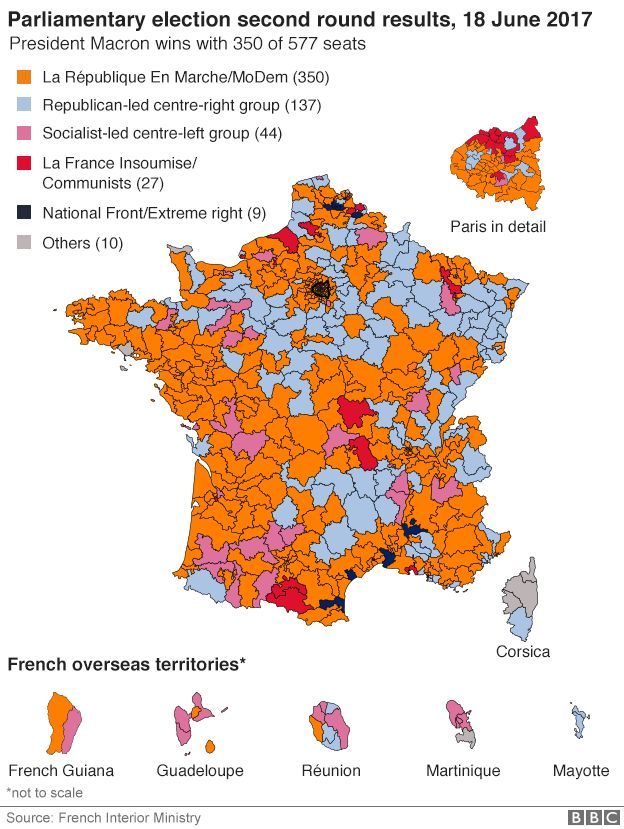
 

Legislative election second round results
Source: BBC

Let’s not forget the abominable performance of the other parties. Marine Le Pen succeeded in winning a seat in the parliament for the first time, but her party did not perform well. Only 8 representatives gained a seat in the colours of the National Front. This is number is not even close enough to the 15 seats required to form a parliamentary fraction – which was the major goal of the party. It is a huge setback compared to the 10.6 million votes Le Pen received in the second round of the presidential elections, although it must be said that infighting within the party did not help its case. Jean-Luc Mélenchon’s party, the France Unbowed (France Insoumise), won 19 seats with Mélenchon winning personally in Marseille. Although now, it is the Republicans that form the second largest force in the National Assembly, they lost 81 seats compared to the elections from five years before. The future of the left-wing remains uncertain, as they ended up as the biggest losers of the election. The Socialist Party’s defeat cannot be expressed in words; they lost 251 seats altogether. 

Thus, the political spectrum was completely rearranged thanks to the first month of Emmanuel Macron’s presidency and, furthermore, due to the renunciation and the ennui of the French society in the second round. Many think that Macron’s win at the legislative elections, in a system of simple majority, does not clearly reflect French political sentiments, as many did not find the young president convincing enough to vote for him. Nevertheless, Macron stated that he wishes to represent the whole nation and thinks that he is aware of the problems and knows what the French society needs. Hence, the question remains whether the electoral system, the very one that has successfully kept the extreme parties at bay all this time, needs to be reformed. One thing is sure, though: the traditional left-wing politics, values, ideas, and framework all need to be reassessed. This was also the message of Jean-Claude Cambadélis, leader of the Socialist Party, who announced his imminent retirement from politics on the night of the elections.

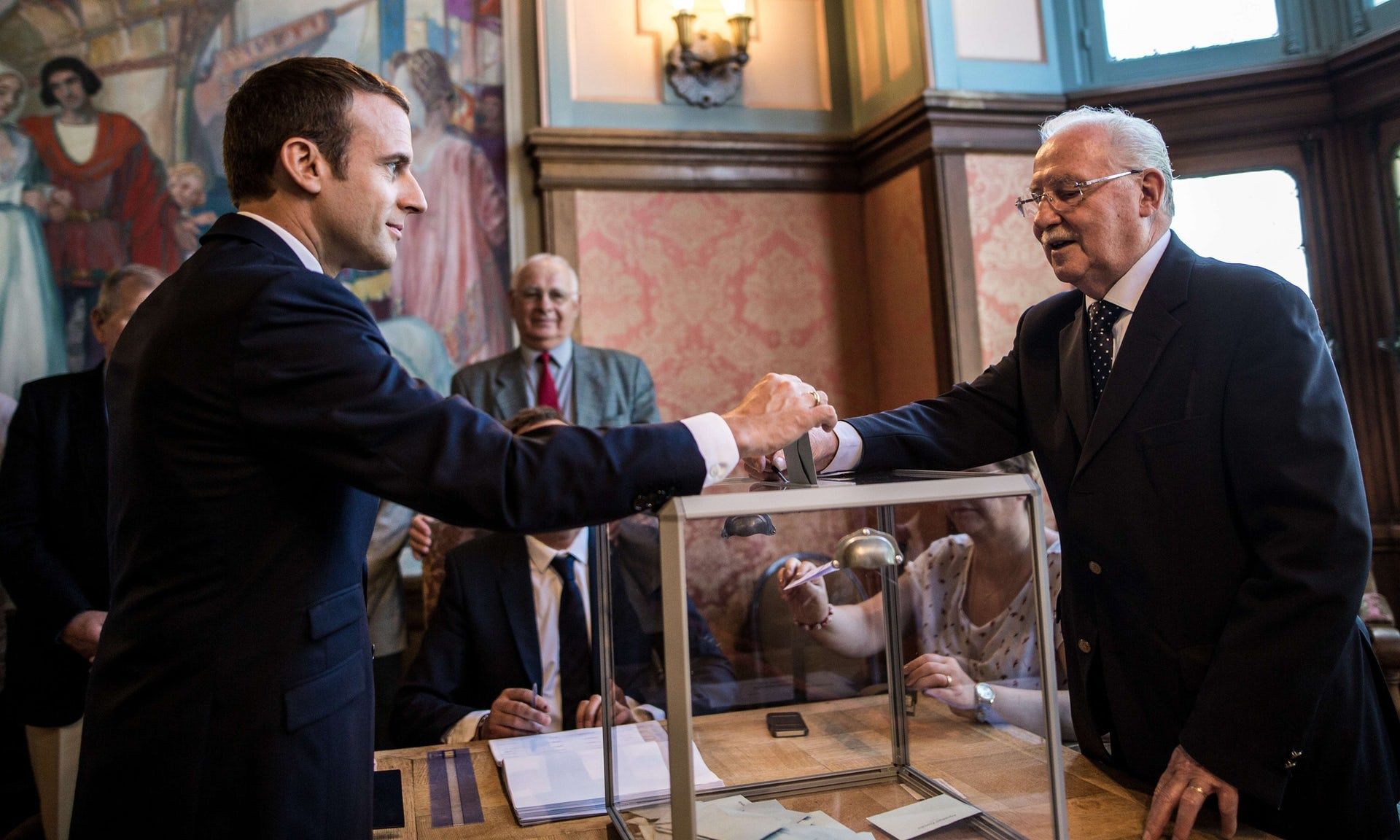
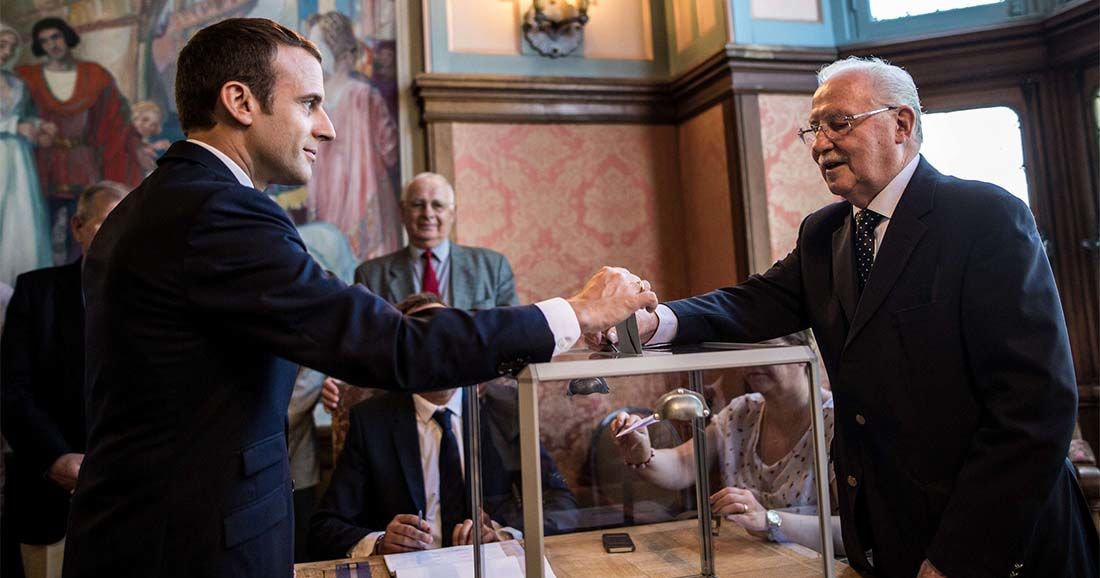
Emmanuel Macron casts his ballot in Le Touquet, northern France
Source: The Guardian

However, the most important question remains: what can we expect in the short-term future? One must not forget that the elections were historic in many aspects. The turn-out reached a record low in the second round, with only 42.6 percent of the electorate participating. Besides, no president since Charles de Gaulle has had such a powerful majority with representatives who depend on him personally for their new careers. Which has not changed, however, is that since Jacques Chirac, every president won with the promise of change which has not been different this time either. 

Emmanuel Macron wants to continue the reforms started by Hollande, and he wishes to capitalize on his legacy. He will most likely take on the enormous task of declaring a war on unemployment, reducing the administrative burden of entrepreneurs, while he also wishes to carry on the fight against terrorism – after a new National Assembly has been kicked off, his first act will probably be the extension of the ongoing state of emergency. Macron thinks that what France needs now is not more new ideas but the implementation of the already existing ones: he wants a programme that brings France into the 21st century. First things first, he have to thoughtfully and quickly reform the labour code, as huge anti-reform protests in Paris are unlikely at a time when many are on vacation. In the meantime, broad negotiations and talks with different trade unions are underway; they are so unparalleled that it gives a glimmer of hope in itself. France needs reforms and almost everyone knows that: the labour market is too strict and the bureaucracy is very complicated. The new president wants a flexible and business friendly economy. He wants to create a Scandinavian type of state, with economic dynamism and public spending close to the half of the total GDP. 

Macron has his work cut out, he had the most rapid political coming-of-age in France’s modern history, a revolutionary political momentum, but now, he has to prove that he will be really able to reform the country and put it on a progressive track. Can he be the Gerhard Schröder of France? For the sake of France, I very much hope so.