Kategória: Research Blog
Forrás: https://digitalistudastar.ajtk.hu/en/research-blog/european-parliamentary-elections-a-prequel-to-polish-national-elections-in-autumn
European Parliamentary Elections
A Prequel to Polish National Elections in Autumn
Szerző: Ziarek Dominika,
Megjelenés: 06/2019
Reading time: 8 minutes
Geographically, Poland was divided into two blocks by Law and Justice that gained the highest voter support in seven districts out of thirteen and at the European Coalition that won in six. As per Ipsos Research, it was primarily residents of villages and small towns, people with primary and secondary education, pensioners, farmers, and the unemployed that most supported the governing party. On the other hand, residents of medium and large cities, people with bachelor’s and higher education, people holding directorial positions, and students were the strongest supporter base of the European Coalition.
Despite the wave of protests and strikes against the government before 26 May and the debate about paedophilia in the church, Law and Justice managed to mobilise a huge number of its voters. Probably the absolute winner of this year’s elections is former Prime Minister Beata Szydło. Although a few years ago, when she was asked about the year of Poland’s accession to the EU, she could not give the correct answer, she won 524,811 votes in the EP elections.
Where does all this support for Law and Justice come from? Post-election research cites “inequality of opportunities” as one of the reasons why the party could dominate the elections. Being the ruling party, they have better access to the national media and have the ability to control its content. For many voters, appealing to tradition and the Catholic religion was important because the right-wing electorate cannot imagine the introduction of partner relationships or a permission for abortions. According to some experts, the result shows the appreciation of PiS’s credibility, as several of the party’s promises were fulfilled. Social programs, such as an extra pension payment for every Polish pensioner or money support for the first kids in the family (500+ program), prompted many people to vote for Law and Justice—especially after the head of party Jarosław Kaczynski had warned that the opposition would terminate the popular social benefits granted by PiS. Law and Justice was able to determine precisely whom to target, and what promises to make and keep due to the extensive sociological research it has been conducting. Through the involvement of experts, the party could get to know its electorate and its opponent’s movements better. This insight allowed it to develop a strategy for 2019, the first result of which was the victory in the EP elections.
The European Coalition failed to prove it could win against the government unlike it had promised before the elections. Polls before 26 May predicted a tight match between Law and Justice and the European Coalition. The reality was entirely different: the gap between the two parties reached almost seven percentage points in favour of the ruling one. Even the well-judged speech of the head of the European Council Donald Tusk did not help. Perhaps due to the large number of parties merging into a single European Coalition with different views and programs, the voters were not sure whom they were actually voting for. According to the Polish People’s Party (Polskie Stronnictwo Ludowe, PSL, one of the member parties of the EC), a coalition with leftist parties had a negative impact on the results of its candidates in the EP elections, as the slogans of the left are not accepted by its conservative voters. That is why some of the conservative PSL supporters turned to Law and Justice instead. At the end of June, the Polish People’s Party will decide if they will participate together with European Coalition in national elections in autumn, or they go separate.
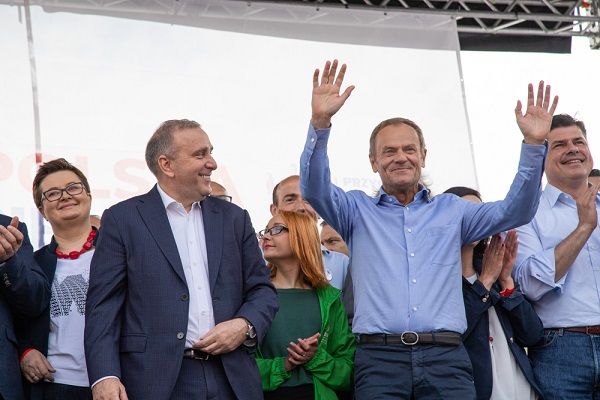
Donald Tusk during the march “Poland in Europe” together with the leaders of the European Coalition. The head of the European Council called for a vote on the European Coalition and a united Europe.
Source: Shutterstock
Spring, the party finishing third in the race, received 6.6% of the votes. Although they expected more, as some surveys predicted a two-digit score for them, the party leader Robert Biedroń emphasised that the voting was a great success for Spring. Even though before the elections Biedroń announced that if he were to get a seat in the European Parliament, he would give it up to one of his fellow party members, now, all of a sudden, it is not so sure whether he will really do so. Currently, the party leader of Spring wants to create a third political force in Poland and write a new chapter in Polish politics. Despite the initial declarations that Spring will not form a coalition, now, Robert Biedroń invited the Democratic Left Alliance (Sojusz Lewicy Demokratycznej, SLD), the Greens (Zieloni), and the Together Party (Razem) to join forces and cooperate. Whether the Democratic Left Alliance will remain in the European Coalition or will compete in national elections in a different format is to be decided by all party activists in an internal referendum at the end of June.
The elections to the European Parliament have shown that Polish politics concentrates voters around two powerful competitive blocks. In the national elections, a higher turnout—and, consequently, an even more heated campaign to attract those voters that stayed at home this time—is expected.
The success of Law and Justice made it feel more confident about the upcoming national elections, and the party expects a majority that would allow it to change the constitutional law. Jaroslaw Kaczyński thanks in an open letter published on PiS’s website all the voters for the support and asks for even more votes in the autumn elections. In July, new political programs will be introduced. Social benefits have proven to be one of the most convincing election promises. 500+ for the first child can be delivered to parents at the latest in autumn, during the pre-election period. Another promise concerns discounts for entrepreneurs and financial support for the disabled, which unfortunately will not be paid out this year.
Political parties, such as Civic Platform (Platforma Obywatelska, PO), Modern (Nowoczesna), or Spring, are still contemplating whether they should run in the national elections separately or in a coalition. There is a risk that individual parties will lose a part of their voter base in the election. On the other hand, running together, each of the coalition partners can make it sure that they will enter the parliament and get more seats than competing separately. The opposition’s main goal to smash Law and Justice is not enough; voters expect much more concrete plans for the future. The PO and Modern united forces and decided that they would take part in the elections together. The fundamental task is to prevent that PiS could get a constitutional majority whereby the party could rule the country on its own—or to win a majority at least in the Senate.
Holiday plans have surely been deleted from the calendars of politicians of all political parties. This summer will be all about election promises and constant attempts to mobilise and convince people to vote. The EU elections were only a prequel to a more heated sequel coming in autumn.