Kategória: Research Blog
Forrás: https://digitalistudastar.ajtk.hu/en/research-blog/changing-climate-and-the-syrian-civil-war
Climate Change: A Reason of Armed Conflicts?
Changing Climate and the Syrian Civil War
Szerző: Andrea Ildikó Lovas,
Megjelenés: 02/2019
Reading time: 4 minutes
The third part of our research article series about conflicts in the wake of climate change examines the Syrian Civil War. The most oppressive drought in the history of Syria hit the country between 2006 and 2010, further deepening its water shortage, bringing its agriculture into crisis, and, as a consequence, putting a serious migratory pressure on its cities. Could all these be a root cause of the Syrian “Arab Spring”? Could climate change unleash a deadly civil war?
The Syrian chapter of the “Arab Spring,” which begun in 2011, has become known as a part of the changes triggered by the wave of democratization in the Middle East. That time, actually, a mood which wished to oust reigning authoritarian regimes and end plenipotentiary dictators swept over the Middle East. However, in Syria, demonstrations of people who hoped to topple the Asad regime led to a civil war that is still ongoing and resulted in hundreds of thousands deaths. But what could be the factor which, all of a sudden, led to a mortal civil war in the country and to a deadly conflict in the whole region? What could give the last push that escalated the demonstration?
Paleoclimatological data, which were presented in the first part of the research article series, confirm the fact that a devastating drought raged between 2006 and 2010 and culminated in 2007–2008 in the Middle East. These data also show that this was the worst drought in the Mediterranean region in the last 900 years. Vegetation in Syria dwindled significantly in that period as a consequence of water scarcity which followed the drought caused by decreased rainfall. The annual precipitation was reduced by 30% from the average 256 mm in 2008, owing to the multiyear, historic drought.
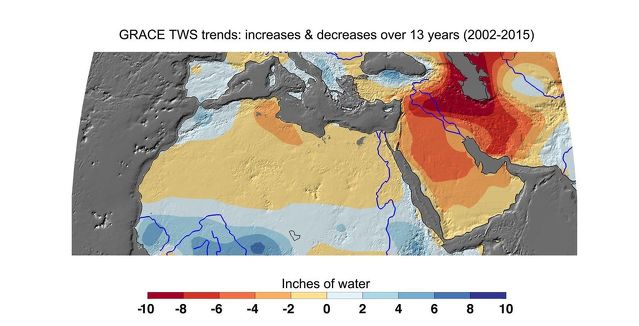
The drastic freshwater losses around the Middle East and North Africa
Source: NASA
To explain the bloody demonstrations and the subsequent civil war that defines Syria’s history, it is necessary to examine the concatenation of events leading to them. The first important factor is the significant population explosion which happened during the second half of the 20th century across the whole Middle Eastern region. This sudden and considerable demographic growth was the most conspicuous in Syria, where the number of people increased by 400% in only fifty years. This rapid growth proved to be an important factor when it comes to other phenomena that continued to worsen because of the drought. The critical situation was further aggravated by the economic, social, and political situation in the country. Syria is a poor, agriculture-dependent nation, where approximately half of the society lived in the countryside in the examined period.
Syria has two main sources of water: the surface water and the groundwater. However, both provide an unreliable water supply for the country. The former mainly comes from water shared with the neighbouring countries; actually, more than 70% of Syria’s water comes from abroad. The latter mean a fast-reducing reserve, and the efficiency of its use is also questionable. Furthermore, Syria’s water security became more vulnerable because of the declining precipitation that accompanied the critical drought. This and the below two factors had a palpable effect on everyday people, too. Meanwhile, political leadership tried to mitigate the astonishingly deteriorating condition caused by water shortage, but they introduced disputable measures that only took short-term aspects in consideration. They chose to expand agricultural lands, but this just speeded up the overconsumption of the rest of the water resources, which meant that it had become more difficult for Syria to break the vicious circle.
Thus, the next factor to which we need to pay attention is the agriculture. As we have already mentioned, this sector has an emphasized role in Syria’s economic life: it is important for both internal food supply and exports. Data from 2007—which was the peak of the drought—suggest that the outdated and non-mechanized agriculture contributed to 18% of the GDP and employed approximately 20% of the whole population. The country’s dependence from the sector is well demonstrated by the fact that, according to data from that period, almost 50% of the society were rural, and, consequently, they ensured their food and subsistence mainly from agricultural production and livestock farming. This clearly shows how much Syrian economy and society depend on the changing climate. The quantity of the produced cereals was 6 million tons in 2006, however, it shrank to 2 million tons in 2008 because of the drought. During the peak of the drought, between 2006 and 2009, more than one million people were affected by the grievous agricultural convulsion in the Eastern Syrian region, and, as a consequence, approximately 800,000 people lost their existence and fundamental food supply. Wheat production decreased by 82% in non-irrigated areas compared to the previous years, and thus, affected families had drastically reduced chances to satisfy their everyday needs. In 2009, around 30,000 families were forced to leave their home because of the drought-caused agricultural crisis, and in 2010, this number increased to 50,000. Because of the drought and the crop failure, in certain regions, 70% of the inhabitants moved to cities to make a living by finding alternative jobs. Dramatic difficulties in production were further worsened by the global economic crisis in 2008. As a consequence, wheat prices rose considerably, and this caused a serious dilemma in imports, increasing the already high tensions.
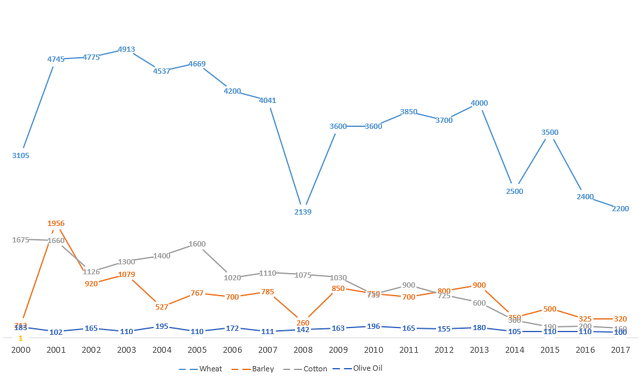
The diagram shows the significant decline in commodity production in Syria in the critical period of 2008.
Source: Wikipedia, author: NucRockstar, licence: CC BY-SA 4.0
During the years of drought, a wave of urbanisation emerged and became critical. The desperate farmers who had lost almost all their products and a significant part of their livestock flooded the cities with no jobs or capital but hope to find better circumstances. This process added to the tensions for more than one reason. One of the critical risk factors was the increased unemployment rate. According to statistical data, this shows a significant rise in two periods: between 2006 and 2008 and between 2009 and 2011—during the latter, it almost doubled. As this evidently coincides with the period of the historic drought, we may conclude that, in the background of the growing unemployment, there stands the agricultural crisis and the dramatic crop failure which are due to the water shortage. Moreover, the Syrian society’s heterogeneity is also an important factor to consider. The ethnic and religious diversity of the population results in a very unstable balance and an extremely tense situation in the country. The inner migratory pressure did only sharpen this unstable situation by increasing tensions coming from the heterogeneity.
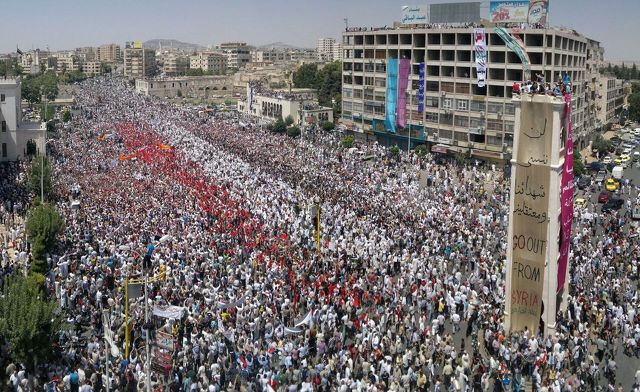
Demonstrating masses walking on the streets in Syria
Source: Flickr, author: syriana2011, licence: CC BY 2.0
All this could provide a firm basis for the formation of changing identities and the lack of perspectives, which could directly lead to the rise of the “Arab Spring.” The above concatenation of events could explain why pent-up tensions became unmanageable in 2010–2011, leading to a civil war in Syria. It is clearly visible how climate change could also manifest itself as a “threat multiplier” in the case of Syria—similarly to the Egyptian uprising about which I wrote in the previous part of the research article series. Consequently, changing climate became the agent that, through critical water scarcity, multiplied social and economic tensions as an indirect root factor. The pent-up discontent was channelled into the political sphere, triggering demonstrations which determined the country’s history.