Kategória: Research Blog
Forrás: https://digitalistudastar.ajtk.hu/en/research-blog/changing-climate-and-the-case-of-yemen-and-tunisia
Climate Change: A Reason of Armed Conflicts?
Changing Climate and the Case of Yemen and Tunisia
Szerző: Andrea Ildikó Lovas,
Megjelenés: 02/2019
Reading time: 3 minutes
The fourth part of our research article series about conflicts triggered by climate change examines the “Arab Spring” in Yemen and Tunisia from the perspective of the historic drought which we have already presented in our previous articles. This drastic drought, which afflicted the Middle East in the 2000s, played a significant role in escalating an economic and social discontent that evolved into revolutions in 2010–2011. But how can water scarcity be found in the background of an Arab uprising regarded by many as a democratic awakening?
Source: Shutterstock
My article series aimed to offer an unconventional perspective for our readers, examining case studies of the “Arab Spring,” adopting a new approach and shedding light on some of its possible hidden root causes which seem indispensable to understand the whole process. In the previous parts, I have already discussed the Egyptian and Syrian cases, so after these examples, I would also like to examine Yemen and Tunisia in the same way now.
We generally associate the outbreak of the “Arab Spring” with Mohamed Bouazizi’s suicide: the street vendor burned himself to death in December 2010 in a suburban district of Tunis, protesting against the oppressive and unjust regime. The vendor’s deed could be the spark which exploded the pent-up tensions, so it is worth examining first how hopelessness had become so deep.
The drought which had historic dimensions, as confirmed by the paleoclimatological dataset in the Old World Drought Atlas, involved serious consequences in Tunisia too. It raged between 2000 and 2008 and proved to be the worst of its kind in the region for the last several hundred years. In the period between 2000 and 2002, the quantity of freshwater per capita decreased so drastically that many cities were forced to order water rationing. The dramatic population explosion in the 20th century also made the critical situation tauter by radically increasing the number of people living in Tunisia. The 4 million-strong population in 1960 rose to more than 10 million in 2010, and this rapid growth went hand in hand with the progressively diminishing water supply. The hydrological effects of the initial meteorological drought led to an agricultural drought, so the severe water scarcity, which was due to a drastic drop in precipitation, had serious consequences in the agricultural sector too.
The demonstrations which marked the beginning of the “Arab Spring” are usually illustrated with malcontent people protesting with bread in their hands. This scene is a symbol of the dramatically increased food prices, which can be traced back to the critical deterioration of production. In Tunisia, cereal production decreased by 50% between 1999 and 2002 as an effect of the drought, and a similar contraction followed in 2008, too. The resulting need for import and the extremely high food prices in the wake of the economic crisis led to a trade imbalance in agriculture. To confirm this statement, it is enough to look at the GDP rates: the agricultural sector contributed to more than 10% of the GDP in 1999; however, it decreased to 7,8% in 2008.
Besides the macroeconomic effects, the consequences of the agricultural drought also affected the social sphere because, in the examined period, this sector employed 33% of the rural population, i.e. 16% of all the people in the country. The quick and sizable crop failure which was due to the multiyear drought led to a gradual loss of employment. Consequently, migration to cities started to increase. Protests that started on the countryside have soon spread into cities where tensions were already high because of the high food prices, unemployment, and the deepening inequality and increasing social heterogeneity, both due to migration.
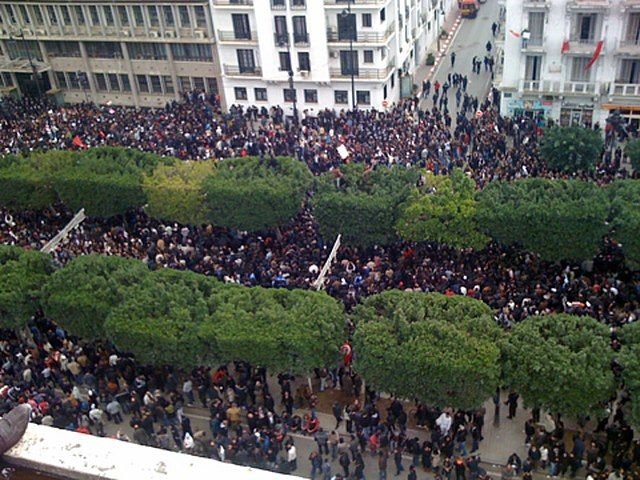
People protesting on the streets of Tunis
Source: Wikimedia Commons, author: VOA Photo/L. Bryant, licence: public domain
In Yemen, probably the situation is even more critical, as this is the poorest country, struggling with the most severe water scarcity, in the Arabian Peninsula, and this multiplies its vulnerability. The drastic population explosion—notwithstanding the dramatic poverty, the number of people living in the country quintupled between the middle of the 20th century and 2011—also exasperated the situation there. However, in line with its population increase, which was considerable even within the region, water supply decreased incessantly. The freshwater per capita per year ratio got under the critical minimum level. The main water resource of the country is the groundwater, but this also started to dry up at some places. The critical situation which already imperilled local people’s existence was further deteriorated by the historic drought in the Middle East that appeared at the beginning of the 2000s, as it also reached Yemen between 2007 and 2009.
In 2012, renewable internal freshwater resources per capita were slightly over 84 cubic meters, and the groundwater table also decreased drastically year by year. The critical drought further escalated this situation because, without a rainfall, resources were scarce to draw on. As a consequence, the agricultural sector was also a subject to the ruthless effects of the drought. Critical conditions forced farmers, who make up 70% of the whole population, to sell their livestock and lands. In the beginning, herders gave up only a few of their animals to feed the remainder. However, as the severe drought dragged on, the price of forage triplicated while the selling price of animals dropped by almost 50%. As circumstances continued to deteriorate, more and more animals died, and shortage made the price of the crops rise drastically. Whereas agricultural employment was 50% in 2000, it decreased to 24% in 2010. Similarly to Egypt, Syria, or Tunisia, people were forced to leave their homes to earn a living, so many of them tried to get along in cities.
On the macro-level, the country needed more and more food import. As Yemen also fell victim to the world economic crisis in 2008 and its extremely high prices, discontent intensified among people. Hopelessness made the country a ticking bomb, and the Egyptian and Tunisian revolution might have helped it go off. The people, suffering from unemployment and serious food and water shortage, found a scapegoat in the political leadership which handled problems questionably, and protests started on the streets, as it also happened in other regional states.
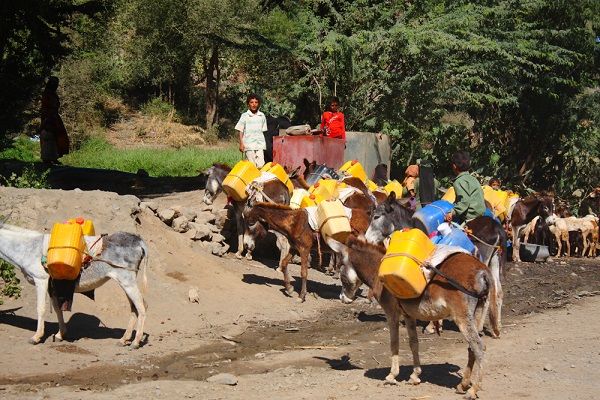
The everyday struggle for freshwater in Yemen
Source: Shutterstock
With this research article series, I wanted to reveal that behind the indirect root causes of the demonstrations and revolutions during the Arab Spring, one can also find a number of other hidden factors. One example of this is the climate change which came to be a “threat multiplier” because of the historic drought. It is evident that the multiyear drought, which appeared in 2000 and raged during the period of the “Arab Spring,” made conditions critical in each examined countries. Demonstrations have tumbled the Middle East and generated a diversified process whose effects and consequences people can still feel and endure.
The purpose of my work was to point out that people can conquer new heights with the help of advances in technology and push the envelope of civilization evolution, but human needs will always be the same: water, food, security, and survival. If these fundamental needs are ensured, there will be a mutual reliance between the state and people. However, if any of them is missing or get threatened, people may become mistrustful and hold the government responsible because it is supposed to ensure their basic subsistence. However, if this mutual interdependence wavers, people might easily rebel against the regime in an attempt to remove the leadership they find “guilty.”