Kategória: Research Blog
Forrás: https://digitalistudastar.ajtk.hu/en/research-blog/challenges-and-opportunities-of-the-hungarian-v4-presidency
Challenges and Opportunities of the Hungarian V4 Presidency
Szerző: Ispán Gergő,
Megjelenés: 10/2017
Reading time: 10 minutes
In the past few years the headlines about the Visegrad Group mostly dealt with their common views on migration policy, which, in many instances, contrasted with the opinion of the Franco-German axis mainstream. This year, for the 5th time, the Hungarian government is taking over the Visegrad countries Presidency for the 2017/18 period. It is expected to be a difficult and complicated year, if Hungary wants to strengthen the V4’s cooperation within the European Union’s decision-making system. The present article is a short analysis about the V4’s activity up to the present days, the Hungarian Presidency’s programme, as well as the potential problems and challenges.
Since its inception 26 ago, the V4 countries have achieved numerous great successes, chief among them the EU and NATO accession which guaranteed these states’ commitment to the western world. However, after the first decade of the 2000s, new problems emerged on the horizon of the Visegrad countries. The recent migration crisis has shaken the entire European Union at its very foundation, the Ukrainian civil war in the eastern neighbourhood of the cooperation raises further trouble in the V4 countries’ security policy.
The threat from the southern and eastern borders makes these countries’ military and defence cooperation essential. In 2015 the work of the V4 countries’ authorities on the Hungarian southern border reinforced this fact. Since then, the decision-makers of the Visegrad countries have become even more receptive to the idea of creating a joint EU army, and aware of the necessity of a common defence system on the Union’s external borders.
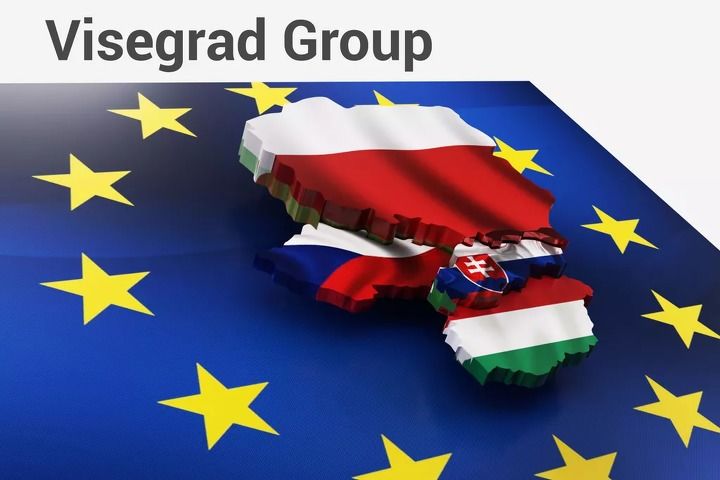
The Visegrad Four in Europe
Source: Shutterstock
In which direction this regional cooperation should develop, has become a broadly-shared concern in recent years. Is it desirable, or even necessary, to establish institutions within this cooperation? Many people thinks it is an inevitable step, as it would elevate the cooperation to a higher level – and ensure that the shape of the V4 cooperation would be guaranteed not only by the promises of ministers and heads of states. Today, the only institutions which have a direct connection to the V4 are the International Visegrad Found, the Visegrad Patent Institute, and the rotating Presidency system. At the same time however, this regional cooperation is many times more effective due to this lack of formal institutions, as there are no bureaucratic hurdles and thus, the various processes are easier to carry out.
After the foundation of the joint, regional EU Battlegroup, it was combat ready from January of 2016 until June of 2016. This success places the Visegrad Four cooperation on a higher level. To the existing force of three thousand, Poland contributed an additional 1800, the Czech Republic 728, Hungary 640, and Slovakia 560 soldiers.
Since Hungary will take the 2017/18 years’ presidency of this Central-European organization, it is safe to say, that we are facing an interesting period. At the ceremony held on the 19th of June, Viktor Orban praised the unprecedentedly strong cooperation between the V4 countries. He stated that, there is an enormous need for cooperation like the V4 within the EU, and he highlighted recent efforts in joint defence on the Hungarian border, where the Visegrad Group proved their willingness, and their ability to defend Europe.
The Hungarian prime minister also reviewed his government’s programme and aims for the Presidency. Accordingly, the four main themes in the coming year will be European Visegrad, Regional Visegrad, Digital Visegrad and the Global Visegrad.
The first chapter – European Visegrad – highlights the importance of the cooperation with the European Union in line with the principle of subsidiarity, competitiveness, predictability, and the responsible handling of the migrant crisis.
The Regional Visegrad chapter incorporates methods for strengthening defence cooperation within the V4 and emphasises coordination in the fields of security and foreign policy. The latter one is particularly important in light of the above events. In addition, this chapter includes the necessary development of the joint infrastructural and transportation policy, as well as climate and energy policy cooperation.
Meanwhile, the ideas of Digital Visegrad will allow for the harmonisation of economic and social policies, while ensuring that digitalization continues to spread to new areas.
The last chapter of the government’s programme, Global Visegrad, describes the policies towards international organizations, and non-V4 countries, which will be in the framework of the V4+ programme.
Recently, however, some events have foreshadowed the strength of the Visegrad Group’s convergence, which shows that the Czech Republic and Slovakia are by far not as committed towards to the V4 as Hungary and Poland. This impression was reinforced by Slovakian Prime Minister, Robert Fico’s statement in April, where he stressed that his country’s allegiance lies primarily with the European Union, to which the V4 is only secondary. Accordingly, the Visegrad Group is not a primary factor in his country’s foreign policy—or, as he put it: “I am very much interested in regional cooperation within the Visegrad Four but Slovakia’s vital interest is the EU.” This statement was given by Mr. Fico at the German-Czechoslovak Neighbours Contract’s 25th anniversary event—a symbolic gesture, as German Chancellor Angela Merkel wants to ensure that the V4 will not become an opposition power within the European Union against the French-German mainstream.
The foundation of the Slavkov Triangle, which was established by Austria, the Czech Republic, and Slovakia in January 2015, is another sign that the Slovakian and Czech partners are not entirely committed towards the V4 cooperation. The so-called S3 at the time of its foundation already aroused the suspicion that it will function as a V4 replacement for the participating countries, but the signatory states denied this rumour. However the two successor states of Czechoslovakia do not seem like they want to replace their relationship with Hungary and Poland with their ties to Austria (since these regional organizations can coexist), but it is still best to keep these kind of statements in mind. The Hungarian-Polish influence sometimes gets too dominant in the group, and it is along these lines that France and Germany are trying to drive a wedge between the Visegrad Group members.
Experts have also expressed concerns regarding the tendency of inequality within the V4, which might be troublesome for the cooperation in the long run. Edward Lucas, the editor of The Economist’s Foreign Relations, is one of them. He thinks Poland is predominant in the group over the other three countries. His claims are grounded in truth, even if we only examine military expenditure: The biggest V4 country spends twice as much of its GDP on defence (in percentage) than his partners.
Thus, it is quite apparent, that the Hungarian government is looking at a difficult Presidency, as ensuring cooperation between the Visegrad countries will be far from an easy task. Still, the V4 remains a relevant actor on the political map of Central Europe.
Opening pic: Shutterstock