Kategória: Research Blog
Forrás: https://digitalistudastar.ajtk.hu/en/research-blog/break-or-breakthrough-sino-vatican-relations-at-a-turning-point
Break or breakthrough?
Sino-Vatican relations at a turning point
Szerző: Noémi Eszterhainé Szőke,
Megjelenés: 04/2018
Reading time: 10 minutes
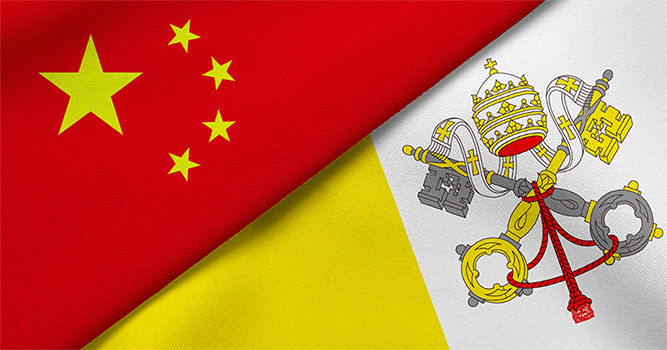
This January the international press began running a story that the Holy See and China had gotten close to an agreement on episcopal appointment. In the last 67 years the Vatican and the Peoples’ Republic have lacked diplomatic relations. Chinese Catholics have had to choose between practicing their faith within the national church independent from Rome or within the outlawed ’underground’ church that has remained loyal to the Pope. In light of this, a possible agreement which could resolve the situation would be a welcome development; however, besides the optimistic voices, many worrying and critical opinion have also appeared in the press.
Right after the foundation of the Peoples’ Republic of China (PRC) in 1949, the Chinese Communist Party (CCP) started to institutionalise control over religious life. The main tool for this purpose became the Religious Affairs Bureau, established in 1950, which oversaw the patriotic religious organizations set up in subsequent years. There have been five officially recognized religions in China (Buddhist, Daoist, Islam, Catholic, Protestant), all of them controlled by their own patriotic organization. The leaders of these religious organizations have to be loyal to the CCP, and they cannot maintain a relationship with foreign organizations or powers. This latter criterion effected Catholicism severely, as one of its core concepts is the unity of the Church, guaranteed by the Pope, and the disciples’ loyalty toward him. The Chinese Patriotic Catholic Association was established in 1957, independently from the Vatican, in order to prevent ’foreign influence’ in China. All foreign monks and priests had to leave the country, and relations between the Holy See and Chinese Catholics was limited to illegal and secret channels. With the establishment of the Patriotic Association, Catholicism in China became divided: those who practiced their faith within the Association could not officially recognise the supremacy of the Pope, but they could more or less openly practice their religion. (Although they also became victims of persecution during the Cultural Revolution). From the very beginning, those who stayed loyal to Rome had to practice their faith illegally, within the so called ’underground’ church. Both organizations’ Catholics have built up their own clergy and episcopal system. Until today, the Holy See has been unable to take part in the appointment of the former’s bishops, with the process controlled by the CCP through the Patriotic Association instead. The Holy See has maintained a relationship with the ’underground’ church via secret channels in Hong Kong and Taiwan.
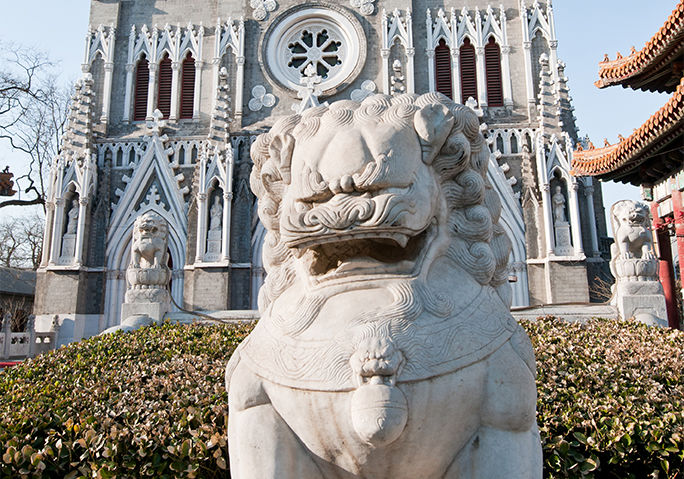
Beitang Temple, Beijing
Source: Shutterstock
However, there have not been any changes in the relations officially, and the connection between the two churches and the Holy See has become very complex. On one hand, there are still people both within the ’official’ and the ’underground’ church, who strictly distance themselves from the other side. On the other hand, there is a high degree of overlap between the bishops’ appointment and the operation of the two churches. It has happened many times over the last decades that a bishop from Patriotic Association secretly asked for communion with the Pope. Many times the Holy See affirmed the communion and recognized these bishops as legitimate. At the same time, it also happened that the ’underground’ church still did not recognize one of these bishops, leaving one diocese with two bishops at the same time. (It is worth mentioning that, although the Patriotic Association doesn’t recognize any foreign authorities, including the Vatican, according to the regulations of the organization, but individual members do not have to deny the Pope, and can pray for the Holy Father during official masses.) There are places where the two churches’ clergy and the disciples closely work together and help each other (e.g. by providing priests or venue), but this greatly depends on the attitude of the given region’s political and religious authority.
There are approximately 12-15 million Catholics altogether in China today, and the long-unsettled relations between the Vatican and the PRC, the constant uncertainty, has had a considerable negative effect both on the unity of Catholics in China and their spiritual (and often physical) safety. The Holy See is well aware of this, and thus a very slow and cautious exploratory dialog has been started—in secret—between the Vatican and the CCP. One of the first signs was a letter written by Pope Benedict XVI. in 2007, addressed to all Catholics in China. One of the aims of the letter was to give spiritual support to Chinese disciples, but it also wanted to provide practical guidance for members of the legal and ’underground’ churches for their daily lives. Amid this division, the Pope urged both sides to find all possible points of cooperation. The letter contained an important message to the CCP too, as the Pope—citing Jesus’ speech about the tribute penny—emphasized to the disciples the importance of trying to live in peace within the extant society. In the following that followed further steps were taken: in 2008 the Chinese Philharmonic Orchestra performed in the Vatican. When in 2014 Pope Francis paid a visit to South Korea his airplane was allowed to flight through Chinese air space. As he flew over the country, the Pope issued a radio address and gave a blessing to all Chinese people.
In 2016 Pope Francis received a present from the Chinese, a silk print of a stele. The stele has a Nestorian Christian script on it from the 8th century AD, the earliest known Christian records in China. Although Nestorianism is a heretical Christian teaching, it is worth to look at this gesture from the perspective that Christian missionaries’ activity in China—especially due to the experiences of the 19th century—was long connected to the image of foreign powers’ violent intrusion. Meanwhile, the Nestorian Stele has remained a memento of another type of Christianity, one that appeared very early in China, and so it is not completely alien to Chinese culture. More importantly, this is a memory of peaceful Christian evangelization. Officially the silk print was not a present from president Xi Jinping but from the leader of the delegation, Hu Deping, who has very close relationship with him. (Hu is a leader of an NGO, the China Biodiversity Conservation and Green Development Foundation. His father, Hu Yaobang, a former General Secretary of the CCP, was a good friend of Xi’s father.) All these gestures are subtle signs that there has been an active dialogue in the last decade between the two in the background.
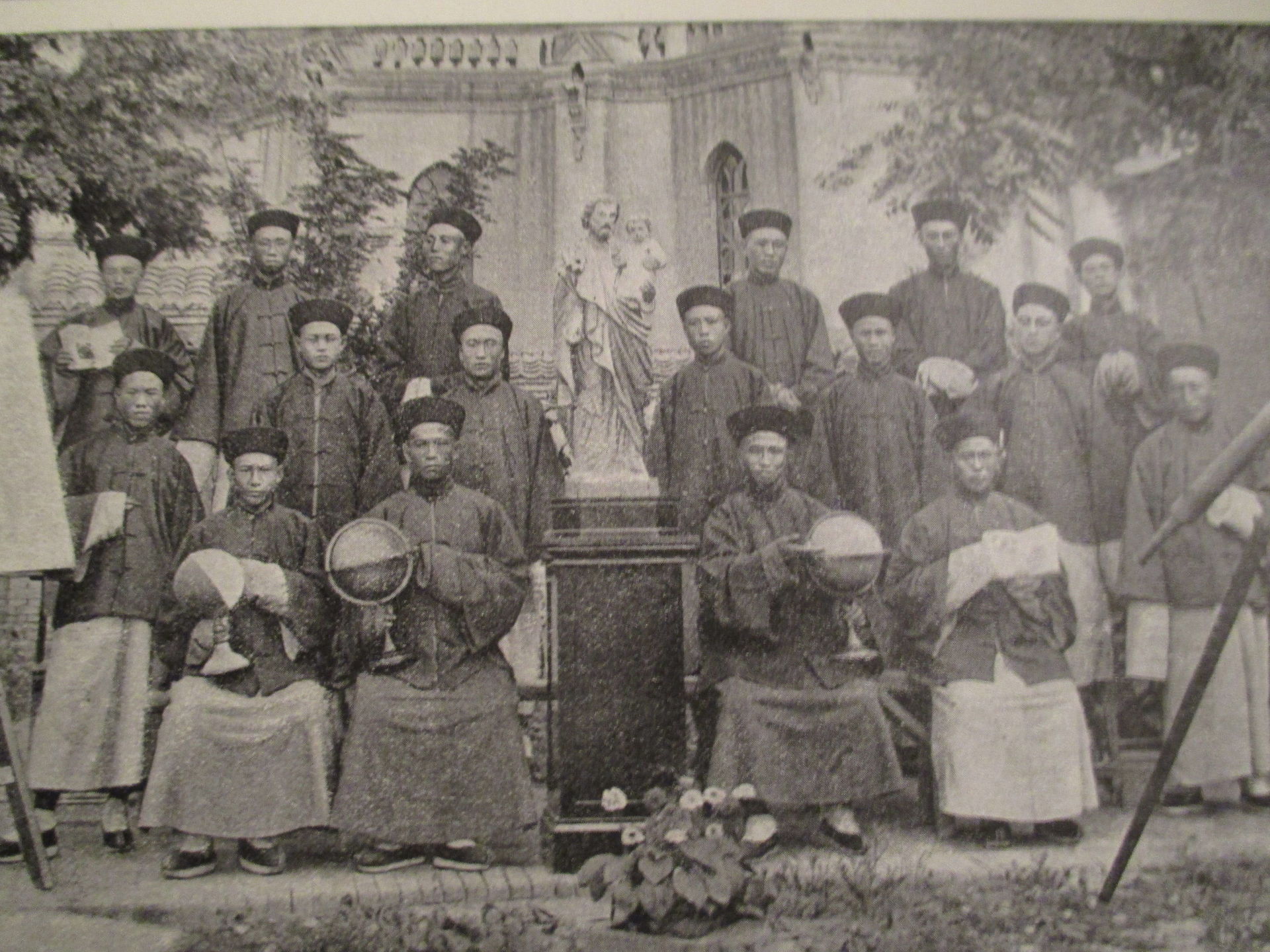
Chinese seminarists in a Jesuit mission in 1900
Source: Wikipedia
This January, according to leaked sources, the two sides have gotten closer than ever before to a deal that would enable the Holy See to take part—albeit in a limited manner—in the episcopal appointment process. The Western media’s reaction was mixed. Besides the positive, optimistic voices, a lot of concerned and critical viewpoints appeared as well, with some of them accusing Vatican diplomacy of naivety and lack of knowledge about the circumstances in China. Others claimed that the Chinese government was leading the Vatican by the nose and using it for its political manoeuvres. This opinion was apparently confirmed by the words of Bishop Marcelo Sanchez Sorondo, Chancellor of the Pontifical Academy of Social Sciences, who strongly praised China and the work of the Chinese leadership. Doubts have been reinforced by leaked news, which stated that, as part of the deal, the Holy See asked two ’underground’ bishops to resign and make place for the Patriotic Association’s bishops (one of them had been previously excommunicated). The former bishop of Hong Kong, Cardinal Joseph Zen, offered harsh criticism of Vatican diplomacy, accusing it of selling out the Church. The former Bishop, who regularly stands up for Hong Kong’s democratic political rights against the CCP, had previously expressed repeated scepticism about the trustworthiness of the CCP. Concerning bishops’ appointments, his greatest fear is that, according to the present deal, the candidates’ appointment would remain under the control of the Patriotic Association's Bishops Conference (considered illegitimate by the Vatican), and the Holy Father would only have veto right.
Cardinal Zen’s concerns are not unfounded: the planned deal would be but a small step indeed, and there is no guarantee that the CCP would respect the veto right. At the same time, it must be seen that the two sides’ bargaining positions are far from balanced and the Vatican’s scope for action is rather narrow. A political change in China in the near or distant future is very unlikely. The increasingly advanced cyber technology is continuously giving new tools for the Chinese government to expand its control over the ’underground’ church. At present the Vatican stays in contact with the ’underground’ church mainly via Hong Kong, which diocese is an immediate subject of the Holy See. This status of Hong Kong is secured by the Sino-British Joint Declaration, which has guaranteed a special status to the island for 50 years after 1997. However, it remains to be seen what will happen in 30 years, when the declaration expires.
Considering all of the above, Vatican–PRC relations appear very fragile, and the issue has so many elements that there will not be a black-and-white answer. A full restoration of diplomatic relations is not expected in the near future, because one of the conditions would be the restoration of the Holy See’s control over the entire episcopal appointment process—which the CCP will apparently not allow. On the other hand, from China’s side a condition would be that the Vatican—according to the ‘one China’ policy—should break off diplomatic relations with Taiwan. Although it would not be a difficult step from the Vatican politically, the rightful aversion of the disciples could not be ignored. Clearly, negotiations between spiritual great power Vatican and economic great power China can only be successful if the two sides are able to build up a certain level of trust.
Opening pic source: Shutterstock