Kategória: Research Blog
Forrás: https://digitalistudastar.ajtk.hu/en/research-blog/beyond-prespa
Beyond Prespa
Macedonian-Albanian relations in North Macedonia
Szerző: Dianna Horvát,
Megjelenés: 02/2019
Reading time: 6 minutes
The year 2018 was crucial for North Macedonia with the Prespa Agreement being signed by Zoran Zaev Macedonian and Alexis Tsipras Greek Prime Ministers and thus ending almost three-decade name dispute between the two countries. The two politicians made a significant achievement, which was also recognised at the 55th edition of the Munich Security Conference, where they received the Ewald von Kleist Award. In the previous period, there were significant changes in Macedonian–Greek relations, but in North Macedonia, there are some other internal affairs unfolding.
The Prespa Agreement was followed by an unsuccessful referendum and a successful vote in favour of the agreement in the Macedonian parliament, and it was later ratified by the Greek Parliament as well. So the country, now officially called North Macedonia, could start its NATO accession path. However, there are some other affairs unfolding regarding its domestic policy. Over the past years, the official use of the Albanian language has been an ongoing issue and also one of the main reason for a few-months-long insurgency in 2001. The previous language law was defined by the Ohrid Agreement—which served as a compromise to resolve the above-mentioned conflict—according to which, the Albanian language could be officially used in areas where Albanians made up more than 20% of the population. In accordance with the new law in force since the beginning of 2019, the Albanian language and alphabet can now be officially used on the entire territory of North Macedonia. The legislation was signed by Talat Xhaferri, Speaker of the Assembly, and not by the President of the country, Gjorge Ivanov, who stated that it violated the Constitution. Ivanov refused to sign the above-mentioned law that passed the Parliament two times, in January and March 2018, when it was voted by the Social Democratic Union of Macedonia (SDSM), the Democratic Union for Integration (DUI), and the Albanian opposition, while members of the Internal Macedonian Revolutionary Organization – Democratic Party for Macedonian National Unity (VMRO–DPMNE) were absent.
The map of North Macedonia: the yellow, orange, and green represent the regions where, according to the 2002 census, Macedonians, Albanians, and the Turkish have a majority, while regions with mixed ethnicity are marked with blue. Regions marked with M are those where Macedonians have a relative majority.
Source: Wikimedia commons, author: PANONIAN, license: public domain
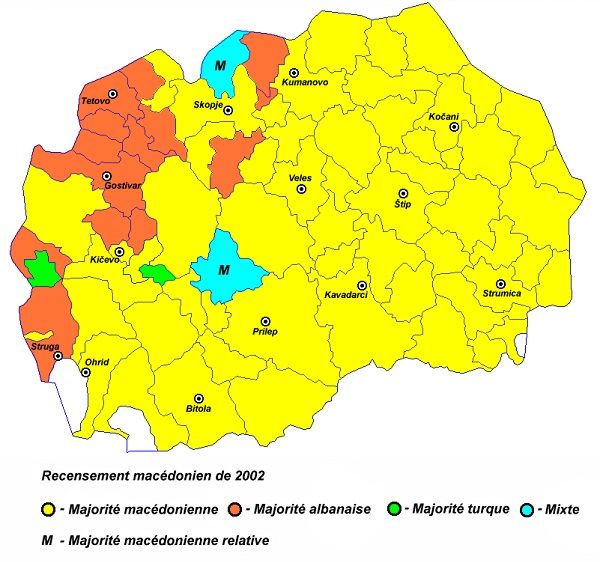
According to the last census in 2002, 64.17% of the population is of Macedonian and 25.17% is of Albanian ethnicity, which makes the Albanian the largest minority in the country. Municipalities with the largest Albanian population such as Tetovo, Gostivar, Debar, Struga, Kičevo, as well as Skopje and Kumanovo, are close to the borders with Albania and Kosovo. As stated by historical sources, Albanians settled in the region during the 18th and 19th centuries, followed by another migration wave from Kosovo between the two World Wars. According to Macedonian census data—between 1953 and 2002 there were seven censuses in the country—the number of the Albanian community has been continuously increasing. After Macedonia’s peaceful secession from Yugoslavia and the declaration of its independence in 1991, the new Constitution defined minority rights—such as the language use and education—for the ethnic communities living within the country. But regarding the Albanian minority, some questions remained unresolved—such as the use of the national flag of Albania or the Albanian language having equal status to the Macedonian. In the coming years, interethnic tensions grew, and in February 2001, they escalated into armed conflicts between the Macedonian security forces and the Albanian rebels, the so-called National Liberation Army (or in Albanian: Ushtria Çlirimtare Kombëtare, UÇK). The insurgency ended in August 2001 with the Ohrid Agreement thanks to a mediation by NATO and the EU. The agreement provided larger political participation and wider cultural and educational rights for the Albanian minority.
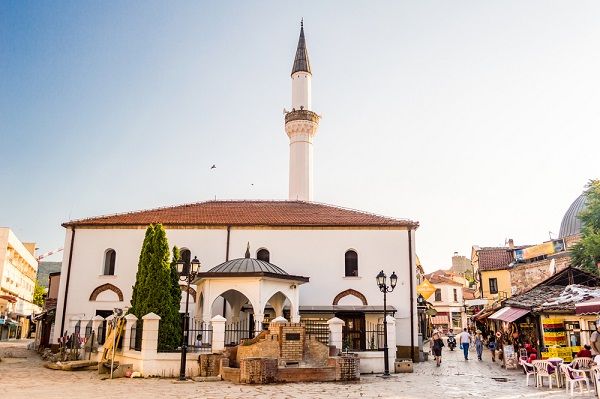

Murat Pasha Mosque in the Old Bazaar of Skopje
Source: Shutterstock
After the fights in 2001, NATO deployed three peacekeeping missions in the country. Their main goal was to disarm ethnic Albanian groups and destroy their weapons, and to protect international monitors residing in the country. In 2002, NATO Headquarters in Skopje were created; in 2012, they were transformed into a NATO Liaisons Office. The office, where both military and civilian personnel work, has a wide range of activities: on the one hand, it promotes NATO’s activities within the country, and on the other hand, it supports NATO missions in the region. Since the 1990s, the support for NATO in North Macedonia is strong, although, in recent years, the public opinion varied, influenced by other external factors—for example, it decreased in 2008, after a Greek veto on the countries NATO accession which was due to the well-known name issue. During the 2018 name referendum, the Albanian minority was the biggest supporter of the accession, as it was previously predicted by public opinion polls—but even that support proved to be insufficient to make the referendum successful. Although more than 90% of the participating electors voted “yes,” the referendum should have had an at least 50% turnout to become valid. The high turnout of Albanian voters did not come as a surprise, taking into consideration that North Macedonia’s NATO integration is also supported by Tirana. Before the name referendum, Albanian Minister for Foreign Affairs Ditmir Bushati met Prime Minister Zoran Zaev in Skopje and urged the Albanians living in North Macedonia to vote with “yes” on the upcoming ballot. Albania has been a NATO member since 2009 and was among the first countries after Greece to ratify the protocol for the accession of the Republic of North Macedonia to the Alliance.
In the newly named country, there will also be some other domestic affairs in 2019, as the presidential elections are approaching. The current President Gjorge Ivanov has already served two terms, hence he cannot run for President again. The first round of the elections will be held on 21 April, and if needed, a second one on 5 May. The voting is secret and direct, and the term of office lasts five years. So far, only the main opposition party, VMRO–DPMNE, announced the name of their candidate; Gordana Siljanovska Davkova is a university teacher and a lawyer. The candidates of the Social Democratic Union of Macedonia and the ethnic Albanian Democratic Union for Integration are still not announced. According to some reports, there is a possibility for a consensual candidate between the two parties, who will be acceptable for both the Macedonian and for the Albanian voters.
In the coming period, the Greek–Macedonian name deal will not only have an impact on the consolidation between the two countries and the Euro-Atlantic integration of North Macedonia. As already mentioned above, the Ewald von Kleist Award is assigned for outstanding achievements in maintaining peace and international security, which is a sign that the global community also believes that the Greek–Macedonian agreement could serve as an example and have a long-term positive effect on resolving other ethnic tensions and ongoing issues in the region.