Kategória: Research Blog
Forrás: https://digitalistudastar.ajtk.hu/en/research-blog/an-unexpected-ally
An Unexpected Ally
Japan's Up-and-Coming New Partnership with the EU
Szerző: Emese Schwarcz ,
Megjelenés: 11/2019
Reading time: 7 minutes
Connectivity, the Belt and Road Initiative, regional cooperation, and infrastructure. Such were the fundamental talking points during the EU–Asia Connectivity Forum at the Charlemagne building of the European Commission, organised by the European Political Strategy Centre. But what of the outcomes? What were the conclusions of the discussions?
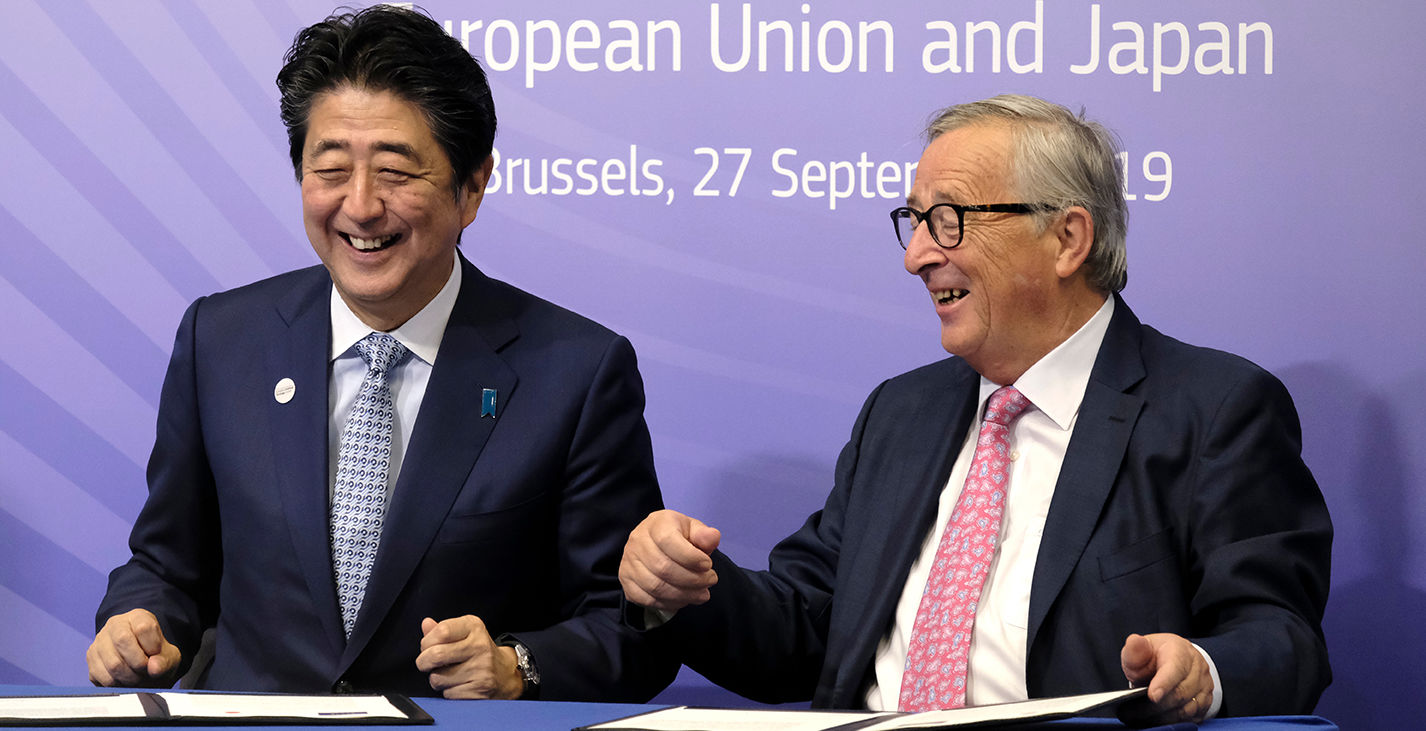
On 27 September 2019, the European Commission convened a large-scale conference about connectivity strategies between Asia and the European continent. I had the pleasure to take part in it as a member of the audience; therefore, I was lucky enough to witness Japanese Prime Minister Abe Shinzō and European Commission President Jean-Claude Juncker signing a partnership agreement between the country of Japan and the European Union. The agreement is quite important in itself, but, before shaking hands on the document, PM Abe delivered an interesting keynote speech as well.
In his speech, the Prime Minister drafted up the already existing agreements between the two actors, namely the Economic Partnership Agreement (EPA, 2017) and the Strategic Partnership Agreement (SPA, 2018), the former entering into force in 2019. Both of these documents are certainly signalling a strong commitment towards partnering up, which should not be disregarded, especially considering the ongoing troubles with South Korean–Japanese economic ties that unfolded this summer. The EU–Japan EPA will help the Japanese out with eliminated customs duties and elevated agri-food product exports (most importantly, cheese and wine)—some of which are to be placed under protection of the EU on the Japanese markets. Tariffs will be abolished in the cases of industrial (such as chemical and textile), fishery, and wood products, amongst others, making this EPA the world’s largest free trade agreement. The car industry will also receive advantages in the coming years. Interestingly, however, the EU went against Japan’s newly reinvigorated industry and did not lift its self-imposed ban on whale meat import. Other than trade benefits, the agreement also touches upon labour rights and environmental and data protection.
You can read more on ambiguities about Japanese whaling and how the international community is related to the question in the next issue of our quarterly, In Focus: Japan—The Legacy of the Heisei Era.
The SPA, however, is much more of a political agreement, as it expresses the commitment to shared values, such as the rule of law, democracy, and human rights. Japan, being a democratic powerhouse of East Asia, takes pride in its representative role. As such, this SPA is unlike any other: it is legally binding. And the contents? The document calls forth resolve to address global challenges, such as nuclear proliferation, climate change, terrorism, poverty, diseases, and threats to maritime territories, outer space, and cyberspace. Overall, partnering up in protecting freedom, security, and justice.
No small feat—and very ambitious too. With these two agreements, the two parties proclaimed their alliance, which might prove to be very beneficial—and not just economically. In the sea of natural disasters and ailing economic ties with traditional allies (e.g., South Korea or the United States), Japan will need a helping hand to avoid another dragging recession like the one that broke the country for almost two decades at the beginning of the Heisei Era (1989–2019). Gaining an ally in security and geopolitics is also necessary for Japan, considering the changing regional power landscape in the East. A joint assistance activity has already been launched, wherein Japan and the EU joined forces in combating piracy near the Horn of Africa.
Source: Alexandros Michailidis/Shutterstock
With a preamble like this, what more can we expect from the brand new partnership agreement? The answer is easy. The new agreement contains everything left out from the previous two that might help accelerate connectivity. As Parag Khanna said in his speech later in the EU–Asia Connectivity Forum, the 21ˢᵗ century’s geopolitics is all about competitive connectivity. Now, Japan has definitely found a way to score a big one: the agreement touches upon energy, transport, and people-to-people exchanges, much like China’s ambitious Belt and Road Initiative. It is interesting, however, that the agreement builds on promises about features that were lacking in the BRI, such as the financial sustainability of the infrastructural projects, transparency, and quality. These infrastructural projects are targeting regions such as the Western Balkans, Eastern Europe, Central Asia, the Indo-Pacific, and the African Continent—the very same regions that the BRI wants to operate in. Not only that, but the Indo-Pacific seems familiar in another way too.
The Indo-Pacific region was especially put into spotlight in 2016, when, after expressing concerns about joining the BRI initiative, PM Abe introduced the Japanese answer to the trend of connectivity and cross-regional infrastructural projects. The “Free and Open Indo-Pacific” (FOIP) strategy is a 50-billion-dollar venture that promises infrastructural investments with the aim of building high-quality infrastructure that is resilient to natural disasters, increases employment, expands educational opportunities, and facilitates foreign direct investment. Another organic element of the strategy is that it stands behind values such as the rule of law, freedom of navigation, and free trade—along with the free and open usage of trade routes. Although Abe explained that the goal of FOIP is not to race with the BRI or challenge it, rather to complement it by providing an alternative to the countries interested, the project is still very much resembling the Chinese initiative.
With the EU on board by promoting joint infrastructural investment in the Indo-Pacific region, Japan has certainly earned a powerful ally. The triple partnership is bound to be fruitful, especially in Japan’s case: PM Abe can surely claim it as another element of his Abenomics policy, which is a great tool for boosting electoral support towards the cabinet. In his words, cheese and wine are very important for Japanese customers.
On a serious note though, partnering up with the European Union is a judicious political move: where geopolitics fail, and the Japan–US relations are not comforting enough, another ally from another region might be necessary in order to secure new trade routes. And this is also beneficial for the EU, because—as Parag Khanna said—the Asian region is an economic powerhouse (conducting 60% of global trade), one that has a potential not yet utilised by the Western powers. It remains to be seen how this relationship between the two evolves even further.
Related content
/en/in-focus/in-focus-japan-the-legacy-of-the-heisei-era
Lessons On the Japanese Gubernatorial Elections
/en/ajrc-analyses/a-race-for-the-capital
/en/ajrc-analyses/a-forming-new-political-identity-for-japan