Kategória: Research Blog
Forrás: https://digitalistudastar.ajtk.hu/en/research-blog/an-indirect-root-cause-of-the-arab-spring
Climate change: A reason of armed conflicts
An indirect root cause of the “Arab Spring”?
Szerző: Andrea Ildikó Lovas,
Megjelenés: 11/2018
Reading time: 12 minutes
Nowadays, climate change is mostly mentioned as a “threat multiplier,” because its direct effects and indirect consequences have several times been identified as the root cause of armed conflicts or civil wars. Fight for water, mass migration from drought, compulsive conquest of new lands…Ever-returning phenomena throughout the history of mankind. In what way the case of the Middle East is different, then? To what extent did the severe drought between 2006 and 2010/2011, the kind which was last experienced about 900 years ago, contribute to the outbreak of the “Arab Spring”? How could climate change become the main shaper of the history of cultures and regions, and what role do humans play in it? The purpose of my research article series is to walk through these questions when individually examining Middle Eastern countries such as Egypt, Syria, Libya, Yemen, and Tunisia.
The “Arab Spring” is an immensely sensitive, and, from many aspects, a thoroughly-examined phenomenon in the Middle East. There is more or less a consensus among academics about the direct root causes. However, the series of uprisings shall not be considered over yet, as we can still experience its effects and consequences to this very day. For example, there are endless civil wars in Syria and Yemen, as well as in Libya, where, presently, the second war has been going on since 2011.
At first glance, climate change could barely be identified as a cause of the outbreak of a civil war. However the context, which I would like to reveal, suggests otherwise. For example, how the consequences of the changing climate could become a “threat multiplier.”
If we read between the lines, we can see that ethnic-religious tensions, economic degradation, and social and political discontent should arise from somewhere; that is, aridity and the consequent severe water stress.
Without a doubt, there were droughts and will always be regardless of global warming due to the cyclical climatic changes of our planet. However, if we observe the statistics, we can see that the number of severe droughts is gradually rising, and so do their period and intensity. Behind all of this, one can easily identify the aggravating anthropogenic factor. This differentiates the examined drought from the previous ones in our history. As it were, the human hand was not a relevant factor yet.
Thus, the question arises: Why did the tension become unsustainable only in 2010/11, and why did it happen in all the five countries quasi at the same time?
The first important aspect of my research is the population explosion in the region. In the past 50 years, the population has increased with 194% in Egypt, with 400% in Syria, has quintupled in Yemen, and has become six and a half times higher in Bahrein. In Tunisia, the number of inhabitants has risen from 4 million to 10,5 million, and, in Libya, due to the linear growth experienced in the mentioned time interval, it has increased from 1 million to six. Such a volume of growth in such a short period of time brings about severe and a broad spectrum of aftermaths, which in turn also has serious effects on the distribution of the scarce water supply.
In this context, the mentioned countries’ economic, social and political status, and their agricultural dependence, is not a negligible perspective either. A poor country combating water stress is more likely to suffer a conflict caused by climatic cataclysm than a developed one.
For instance, Yemen is the poorest country in the Arabian Peninsula, where 60,8% of the urban population lives in slums 60,8%, while in Syria it is 19,3% and in Egypt 10,6%. According to reports by the World Resources Institute, Bahrein, Syria and Yemen are among the world’s 36 most water-stressed countries.
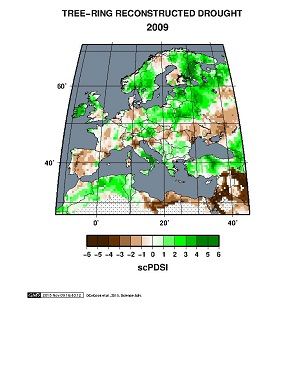
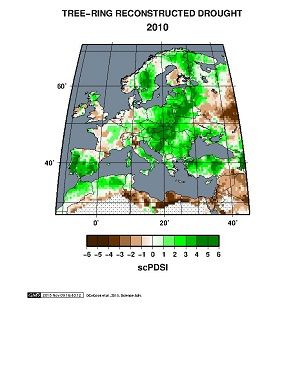
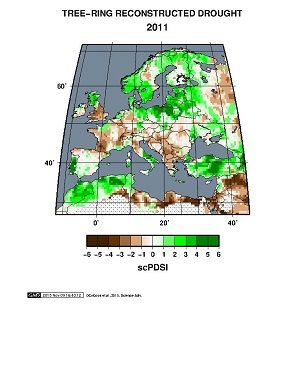
The point when water scarcity reached its most critical levels is the already mentioned aridity in the Middle-Eastern region in the beginning of the 2000s, a defining moment in history. One of the NASA’s latest studies declares that the drought having started in 1998 could be the worst of the past 900 years. A paleoclimatology method illustrates it very well, where the given region’s climate culture is defined through the measurement of the thickness of tree rings. Thin rings indicate dry years, while the thick ones signal wet years, which provides assistance in more efficiently ascertaining the parameters of aridity and its severity. The pictures below depict the expansion of the growing aridity in the period from 2009 to 2012.
 |
 |
 |
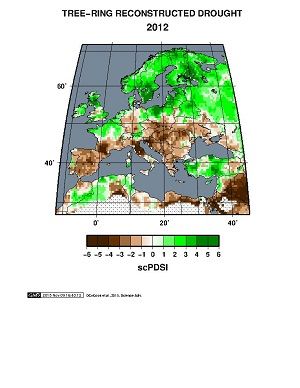 |
PICTURES—The figures illustrate the aforementioned method. The green areas mark the wet regions, while the different shades of brown mark the dry regions. The spread of the significant drought could be followed well from year to year.
Source: NOAA—National Centers for Environmental Information (NCEI): Old World Drought Atlas
Taking into consideration the anthropogenic factor too, the situation is made worse by inadequate political answers. For example in Syria, so as to alleviate the agricultural degradation, the number of irrigated areas has been gradually increased, which action rapidly consumes the groundwater supply, thereby aggravating the already unstable situation.
The serious deterioration of the performance of agriculture is a direct consequence of this, which in turn also necessitates an increase in food import. In addition, we should also bear in mind that the country we are talking about is poor and in several respects underdeveloped as compared to the West, which is a very significant aspect in this context from the point of view of industrial deficiencies.
Besides, the proportion of people employed in agriculture in the investigated countries during the drought period, is also very high, and the sector provides a considerable part of the GDP too. Thus, helplessness caused by aridity does not affect only the economy, but also brings about changes in society and its rural-urban-distribution.
It may consequently be derived that critical water scarcity in the given countries eventuates a grave degradation of non-mechanized agriculture, thereby the livelihood of several people is jeopardised. Thus, the affected rural populace is forced to leave their home in the hope of a better life, which entails a massive urbanization. According to the World Bank’s data, there is a considerable transition between 1960 and 2006 in terms of urbanisation in most of the countries affected. In Tunisia, the proportion of the urban population rose from 37,51% to 65,27%, in Libya from 27,32% to 77,03%, and in Yemen the growth was also absolutely remarkable: from 9,1% to 29,49%.
As a result of this extent of inner-migration, ethnic, religious, and cultural heterogeneity noticeably intensifies. Unemployment rate also largely increases. All of this, as well as the social tensions arising from that, could easily become the trigger in case of an already armed bomb, which, in the present context, could have led to the “Arab Spring.”
In summary, we could ascertain that the indirect role of the drought is unquestionable in the escalation of regional pressure. It has not only heightened the issue of the scarce supply of resources, which has been just getting worse after the population explosion, but human intervention has also worsen the situation, i.e. the political answers to handle the above-mentioned resource-issue, which contributed to the aggravation of climate change-effects and water scarcity.
In the upcoming parts of my article series, I would like to analyse this phenomenon in each country in line with the aforementioned aspects. In doing so, I would like to apply the statistical data and indicators that were only mentioned and not expanded upon in this article.
Opening pic source: Shutterstock