Kategória: Research Blog
Forrás: https://digitalistudastar.ajtk.hu/en/research-blog/after-the-ep-elections
After the EP Elections
A retrospective of the EU-Western Balkan relations in the Juncker era
Szerző: András Braun, Dianna Horvát,
Megjelenés: 05/2019
Reading time: 11 minutes
As the term of the European Commission will expire soon, and a new European Parliament has been elected, we are approaching the end of an era. In our retrospective article, we aim to take a short overview of the development of the EU–Western Balkan relations. Where are these countries now on their accession path? What has been done in the past five years? What have the main achievements and challenges been, and how has the EU tried to save the credibility of the enlargement process? To make the progress made in the past five years and the answers to these questions more intelligible, we structured our article around four main points.

Source: Shutterstock
The EU’s presence in the region
In his opening statement in July 2014, Commission President Jean-Claude Juncker clearly stated that during the term of his Commission, “no new members will be joining us in the European Union.” However, he also added that negotiations would continue to preserve the credibility of the European perspective that had been offered to the Western Balkans (WB) in 2003.
As a sign of this promise, in June 2014, Albania was granted with official candidate status, and enlargement negotiations continued, as Serbia could open its first and Montenegro a few new chapters in December 2015. Some progress has also been made with the potential candidates. The Stabilisation and Association Agreement entered into force both in Kosovo (April 2016) and in Bosnia and Herzegovina (June 2015). Moreover, the latter submitted its application to EU membership in February 2016. However, as we wrote in our previous post, Bosnia faces additional domestic obstacles that challenge its EU aspirations. When it comes to Kosovo, five EU member states (Spain, Romania, Cyprus, Greece, and Slovakia) and two WB countries (Serbia and Bosnia and Herzegovina) still do not recognise Pristina’s declaration of independence. Besides, visa-free travel is still not granted for the citizens of Kosovo—a freedom that the other five countries in the region already enjoy. Concerning the “front runners,” Montenegro has so far opened 32 out of 33 chapters (but closed only three), while Serbia opened 16 and closed two. In 2019, Albania and North Macedonia is going to have a real chance to start accession negotiations, which would of course be a great news for Tirana and Skopje but would also strengthen the multi-speed characteristic of the enlargement process.
The above advances show that the technical process of the enlargement has continued, while EU decision makers realised their ultimate responsibility in core political issues such as regional stability and good neighbourly relations.
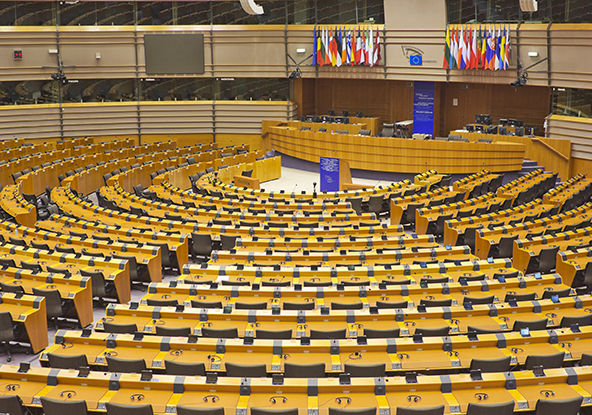
The debating chamber of the European Parliament
Source: Shutterstock
Juncker’s Balkan tour and the Sofia Summit
After having announced the Western Balkans Strategy on 6 February 2018—where 2025 was mentioned as the next possible accession year—European Commission chief Jean-Claude Juncker went on a Western Balkan tour, visiting all six countries of the region and finally arriving in Bulgaria for a joint meeting with their leaders. The visits were partly an overture to the EU–Western Balkan Summit held last May in the Bulgarian capital, which in January 2018, took over the rotating Presidency of the Council of the EU for the first time since its EU accession one decade earlier. One of the four priorities of Bulgaria’s six-month presidency was the Western Balkans, especially the connectivity between its countries and the EU through transport, air, energy, education, and digital solutions. The Sofia Summit was the first event of its kind since the Thessaloniki meeting of June 2003. Despite some expectations, at the Summit, the main emphasis was not on enlargement but closer cooperation between the Western Balkan countries and the EU. Enlargement was also not mentioned in the 17-point declaration adopted at the event. This left many of the Balkan partners feeling somewhat disappointed.
At the Summit, there was also a not so good news for average Balkan citizens: roaming charges between the region and the European Union were not abolished—although in some of the countries, they got lower. Consequently, communication with relatives living abroad remains somewhat difficult; an issue which is quite important in a region with many family members living abroad.
The role of member states: more activity, but enlargement fatigue is still there
In 2014, some member states that are in favour of the Balkan integration initiated the Berlin Process under German leadership. The initiative involves ten member states (Austria, Bulgaria, Croatia, France, Greece, Germany, Italy, Poland, Slovenia, and the United Kingdom). The annual Western Balkans Summits starting in 2014 (which took place in Berlin, Vienna, Paris, Trieste, London, and this year in Poznań) aimed to foster regional cooperation and help Western Balkan countries on their EU accession path in political, economic, and social terms. As a result of this initiative, the Regional Youth Cooperation Office was opened. Another important initiative made by the V4 was the creation of the Western Balkans Fund, which follows the successful model of the International Visegrad Fund.
Enlargement, as well as 2025 as the possible accession date for some of the WB6 countries, is seen in different ways within the EU. Commissioner for Enlargement Johannes Hahn explained that 2025 is an indicative date for Serbia and Montenegro, which is realistic but also very ambitious. On the other hand, at the above-mentioned Sofia Summit, French President Emmanuel Macron stressed that he was not in favour of moving toward enlargement before having all the necessary certainty and having made a real reform that allows the European Union’s better functioning. Paris’ point of view on this question was also made clear in June 2018, when France, along with the Netherlands, postponed the beginning of the membership talks with Macedonia and Albania—the new date of accession negotiations is this June, but their outcome is still unclear. Nevertheless, the Balkan region remained a focal point for the EU through the whole of 2018. Two success stories are the Prespa Agreement solving the Skopje–Athens name issue and the ratification of the border demarcation agreement between Kosovo and Montenegro (which was one of the visa liberalisation requirements for Kosovo). They are certainly positive results pointing towards reconciliation in this region of a turbulent history. But some other questions still linger around unresolved—the most well-known among them is the Belgrade–Pristina dialogue.

Despite no enlargements, the Western Balkans have been a focal point during the Juncker Commission.
Source: Shutterstock
EU as a regional mediator
Although the EU (helped by the United States and other Western partners) has managed to prevent possible stability crises in the Balkan region, the situation of democratic governance and the rule of law is still far away from the EU standards. As the EU’s strict criteria demand the solution of the political conflicts before the accession, the European Union recognised its crucial role in solving political conflicts. This is why the EU was a successful mediator in Montenegro, North Macedonia, and Kosovo. Besides the efforts of the European Commission, the European External Action Service has shown great interest in facilitating the dialogue between Belgrade and Pristina. Federica Mogherini, the EU’s High Representative, has been consistent with her predecessor’s work and continued it: the goal is to reach a final agreement between Serbia and Kosovo. The next Belgrade–Pristina meeting will be held at the beginning of July, just before the Western Balkans Summit in Poznań.
Following the 2019 Berlin Summit, which aimed to reboot the Belgrade–Pristina talks, French President Macron announced France’s Western Balkans strategy. This move is a sign that although Paris opposed starting accession talks with North Macedonia and Albania last year, Macron would like to contribute to the EU’s Balkan policy, which will probably develop further after parliamentary groups in the European Parliament have formed.