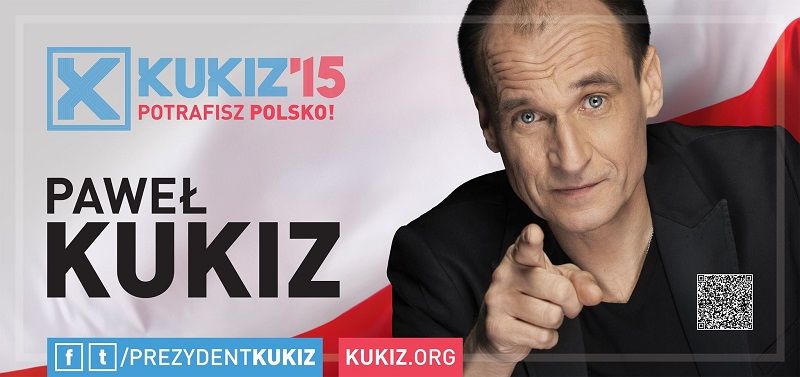
Based on the election results, the movement could delegate 42 representatives into the lower house of the Polish parliament (they failed to gain seats in the upper house). However, it proved to be a difficult task from the first moment on to keep the politically and ideologically mixed group of representatives together, as the delegates – among others from the far-right National Movement (RN) and the liberal-conservative Real Politics Union (UPR) –often had drastically different views. Friction within the movement became clearly visible early on, as one of the movements newly elected representatives, Janusz Sanocki, decided not to join the parliamentary group (klub poselski) of Kukiz’15 before the formation of the new Polish parliament, while another representative, Paweł Kobyliński, left the movement and joined the liberal Nowoczesna (Modern) party just a few months later.
Kukiz, who in his public appearances accused the former governments of selling out the country to foreign multinational companies, promised to pursue a critical and constructive opposition politics. On 18 November 2015, in accordance with other oppositional political parties, the Kukiz’15 parliamentary faction also voted against the formation of Beata Szydło’s government, nonetheless the big winner of the 2015 parliamentary elections, the Law and Justice party (PiS) still had the majority to form a government on its own. Paweł Kukiz stressed on several occasions that the movement’s representatives will not be restricted by party discipline, so common among other political groups, therefore it came as no surprise that delegates of the movement frequently voted dividedly. Nevertheless, in contradiction to the members of other oppositional parties, the politicians of Kukiz’15 quite often, in nearly one third of the cases, voted in favour of government proposals – triggering wide-spread criticism not only from other opposition parties, but from part of the Polish media as well.
The creation of separate, ideologically distinct sub-factions within the group of representatives was another spectacular testimony to the growing differences between the political views of individual groups within the movement and the faction. In parallel to this process, several politicians left the movement between April and June 2016. In the end of April, the party leadership of the National Movement – citing differences in political aims – decided to leave the parliamentary group, however, to their big surprise (and somewhat comically) only one of the RN’s five delegates agreed to do so. Not long thereafter, in the face of a smaller political scandal, Kornel Morawiecki and Ireneusz Zyska decided to leave Kukiz’15, while Małgorzata Zwiercan was expelled from the movement due to the same scandal. After a short period, the three politicians formed the Free and Solidary (WiS) parliamentary circle (koło poselskie) in the Polish Sejm. In June 2016, delegates Magdalena Błeńska, Anna Siarkowska and Małgorzata Janowska also left the movement. After a half year, as independent representatives they announced the formation of the “Republican” (“Republicanie”) parliamentary circle in February 2017.
Opening pic by Shutterstock