Kategória: Research Blog
Forrás: https://digitalistudastar.ajtk.hu/en/research-blog/a-hungarian-success-story
A Hungarian success story
Interview with the founders of Logiscool, Dr Anita Breuer and Gyula Csitári
Szerző: Veronika Antall-Horváth, Enikő Jancsek ,
Megjelenés: 03/2018
Reading time: 12 minutes
Logiscool is an experience-based programming school for kids and teens. The first Logiscool opened in January 2014 in Budaörs. Since then, it has expanded rapidly and currently has 50 schools in 8 countries, with more than 10 000 former students, who took part in experience-based programming courses. Programming helps the development of algorithmic thinking, digital literacy and creativity, which will become an important set of skills in the future. Below you can read our interview with the founders, dr. Anita Breuer and Gyula Csitári.
Q: As the founders of Logiscool, could you introduce the institution and its activities?
Dr Anita Breuer (BA): There is a common misconception that Logiscool is a foreign, international company which came to Hungary. And we are very proud to explain, that no, that is not the case, this was our own idea. Back in 2013, a thought came into my mind about developing a programming school for children. I wrote an e-mail about this to Gyula, who was abroad at that time, and he wrote me back “Ok, we will talk about it over the weekend”.
Gyula Csitári (CsGy): It turned out to be much more than one weekend.
BA: It really did turn into many-many weekends and weeks. The preparations lasted from spring 2013 to January 2014, when we organized our first course in Budaörs, a town in Pest County. It started out as a pilot project, but as it was very successful – more than one hundred children registered – we continued our work, and since then the number of pupils is continuously increasing.
Q: How old are the children who attend Logiscool?
BA: “Kids and teens” is a very good expression for our target group: we teach children and teenagers between six and eighteen years of age. With younger children the teaching process is somewhat slower, but still we can achieve great results with them, and with teenagers we are able to work the upper level programmes. Between eighteen and twenty-something years of age there is not a big difference in learning methods, but currently Logiscool is a programming school for pupils.
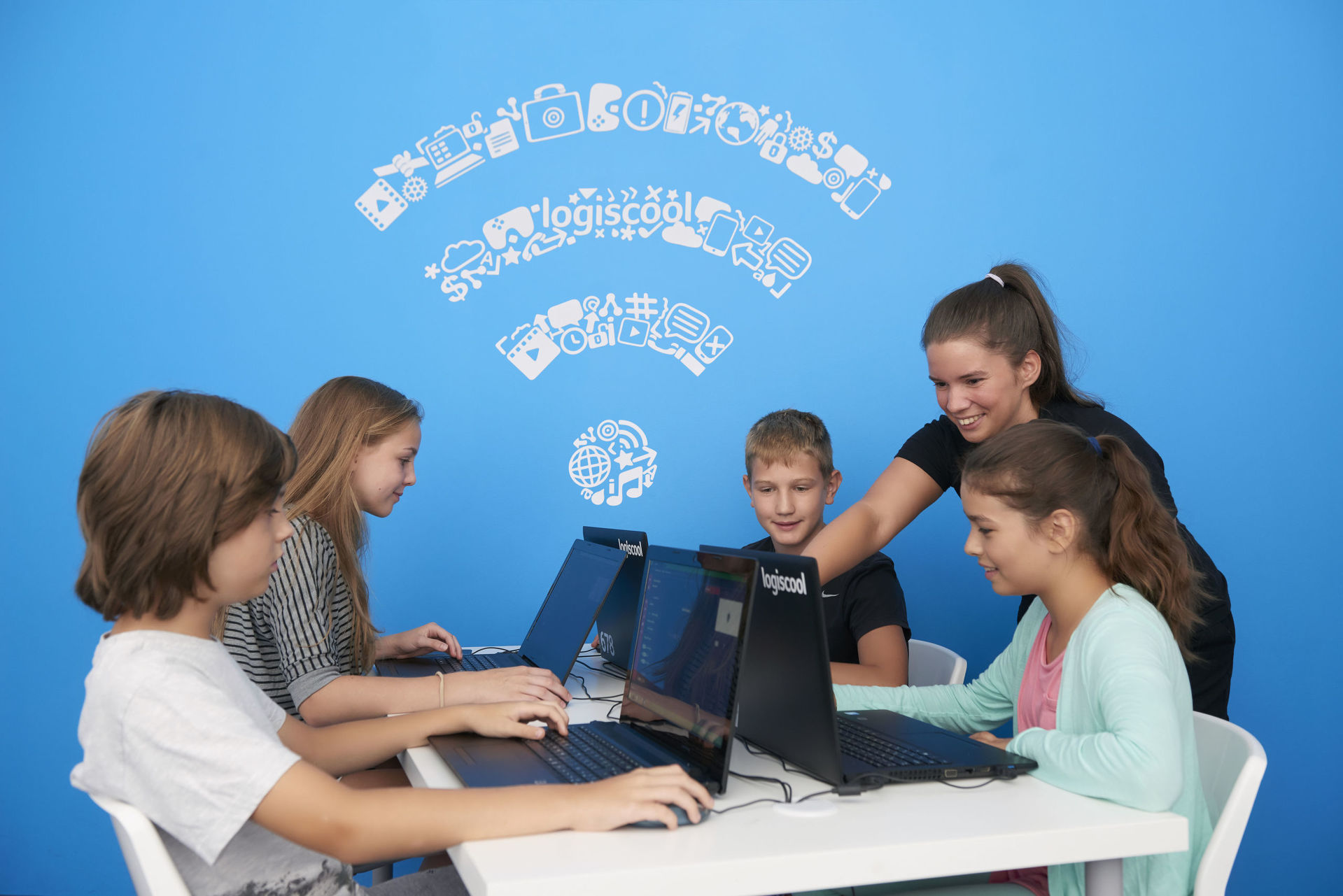
“Kids and teens is a very good expression for our target group.”
Forrás: Logiscool
Q: In which language are the classes conducted?
BA: The classes are conducted in the official language of the given country. There are some countries where we have English classes, though the pupils are Germans or French, but these are exceptions. We also have courses in English language in Hungary, but since our pupils are still children, we think that it is better for them to learn in their mother tongue. Anyway, the language of programming is English, so sooner or later they will have to switch to English.
Q: When and how did the franchising start?
CsGy: Because of the high demand, it started really soon. Just a few months after the opening of the first school, we already had interested parties. The demand is growing ever since. Only one year after our start, we already had six schools, after two years there were sixteen, and currently we have 50 schools in eight countries. And there are many other contracts waiting to be signed. Among our first partners there were parents whose children attended Logiscool, others read about our programme, found it interesting and contacted us. In this way we can grow and develop, we have the opportunity to get in touch with many different people who are interested in our work. This is a great long-term opportunity for idea exchange and network-building with people who share the same passion.
BA: These are all success stories, successful businesses. And, as Gyula already mentioned, they are all very proud to be part of it.
Q: Are there some plans to involve other age groups, for example students, in the Logiscool programming activities?
BA: Regarding the future, we can imagine just about anything. Logiscool has turned four in January, we still don’t have a decade-long experience. The world is changing from one day to another. We, and also some of the national economies are facing various challenges. There is a shortage of labour force all over the continent: Hungary is lacking twenty-two thousand and Europe couple hundred thousand IT experts. This is an ongoing problem in other parts of the world too, so there is a great need for these types of training. Some of the parents – majority of them is not in the IT business – want to learn something about programming also, in order to understand what their children are learning.
CsGy: We already have the technical support for it, whereas the past two years we are using our own learning platform. At the beginning, we used other programs that are available on the market, but later we developed our own learning platform, called Scoolcode. This is an incredibly good system, suitable for teaching different age groups, from visual programming for children, to written program languages for teens. The program is easy to use for everybody. There is no obstacle to reach many children and teens who are eager to learn. In January, we have been at the world’s largest education fair taking place in London. In the same month we have been invited, through the European Parliament’s initiative, to take part at the Digital Skills and Jobs Coalition, which is dealing with digitalisation and how Europe should respond to arising challenges. There my wife, Anita held a presentation about Logiscool. After all the experience we gained in programming and education, we have the relevant knowledge and could give some answers to questions regarding these topics.
Q: Can you tell us something about the summer camps? Who can participate, is there some kind of application form, or do your regular students attend it? What is the agenda in the case of these camps?
CsGy: Anyone can apply, that’s why it is a challenge to always come up with something new and different than our regular classes. Our regular courses are extracurricular activities, the pupils come once a week from September to July, during the school year. During summer we have to have topics that are interesting for newcomers and for those who attended the regular course, but also for those who didn’t go to the course, but were at the summer camp the previous year. That is why we have to be very creative and always have something new and interesting for everyone.
BA: We have different, very popular programs. For example, we have Minecraft camps, which is not taught during the school year. It’s not only a game, children learn serious programming through these activities. Our video editing camps are also very popular, because even 10-year-olds want to be big You Tube stars. They can also learn how to make a webpage, and we also have robot courses in the camps, but also during the school year. There is a huge variety of different activities, they can do just about anything. Every year we have to filter the content, to decide which topics we will work on, because the digital world is enormous and it is full of surprises.
Q: In your opinion, do you have an influence on pupil’s later career choice?
CsGy: We had a pupil, who started our school during high school, sometime later she was already teaching at Logiscool, and currently is attending ELTE Faculty of Informatics. Before that, she wasn’t that much involved into programming.
BA: Not everyone who attends our school will become a programmer, that is not the goal. Algorithms, logical thinking and all other things that we teach are applicable in different life situations. So basically, later by working in any profession you will have the opportunity to use the knowledge gained in Logiscool. But, some kids that are with us since their fourth grade and are now in high school, they are seriously considering some professions related to programming or mathematics. So, yes, there are more and more children who are positively influenced by us. One of the goal is to give them good basic knowledge on which they can later build on. They have a great time here, for example, we teach them to make their own computer games, so they really learn through playing. We obviously do not say to the kids: “you should come and learn programming, because that will be very good for you in the future”. For them, the opportunity to create something gives a great sense of achievement. That is why we have a saying, that Logiscool is a fun-based programming school.
“Logiscool is a fun-based programming school.”
Source: Logiscool
Q: If we look at the Hungarian public education, it is not really digital and it doesn’t seem as it will become one in the forthcoming period. In your opinion when and how will this change? Are they going to implement it in the existing curricula, or will it be an additional part of the educational program?
BA: We know exactly what the situation in the Hungarian education system is, since we live here. But the reality is that many other countries which also have decades or century long educational tradition and experience are struggling with the same problem. It is hard to quickly switch from one to another. Hopefully, this will change in the future. But, while some educational programs – like for example math or language – do not change so quickly, this field changes more frequently. To apply all these changes in the educational system and to always have enough trained teachers, that is a big challenge that every country – including Hungary – will have to deal with. Nevertheless, there will always be a need for schools like ours, because even if they implement it in the curricula, it will never be so detailed and so thoroughly taught like we do it. We are very positive and open-minded about the possible changes in the future. If programming becomes part of the regular school program, it will be available and liked by even more children. This generation grows up with smart devices in their hands, and it is very important to teach them how to use it smartly.
Q: What are Logiscool's plans regarding the future?
BA: We see that Hungary is very Budapest-oriented, but for us the business possibilities in the capital are almost “full”. We have quite a lot of schools in Hungary, in total 36, and with the other seven countries we have 50 schools at the moment. In the forthcoming period, we want to expand internationally. The world is at our feet, and we have a great product to offer. The brand of the company is innovation. We are constantly evolving and developing our methodology, our concept and web platforms. This is an ongoing process. We are heading forward. We have a lot of plans, far more than we can currently accomplish, especially regarding the development. Can you imagine, there is a lack in developers within the Hungarian labour market. That affects us too. We are teaching and have taught in total more than 12 thousand children. Why not teach over a million around the world? We have the knowledge and equipment for that. We would like to become a Hungarian success story. Until now there hasn’t been a Hungarian, internationally successful franchise system, and we want to be become one.
Q: Thank you for this interview. We wish you all the best in your future endeavours.
The interview was conducted by Veronika Antall-Horváth and Enikő Jancsek on 17 November 2017.
Opening pic source: Logiscool